What Bafana Bafana teaches South Africa about itself
For decades, Bafana Bafana embodied the disappointments of the democratic era. As the team recovers, South Africans are once again projecting their political aspirations and fears onto the national side.
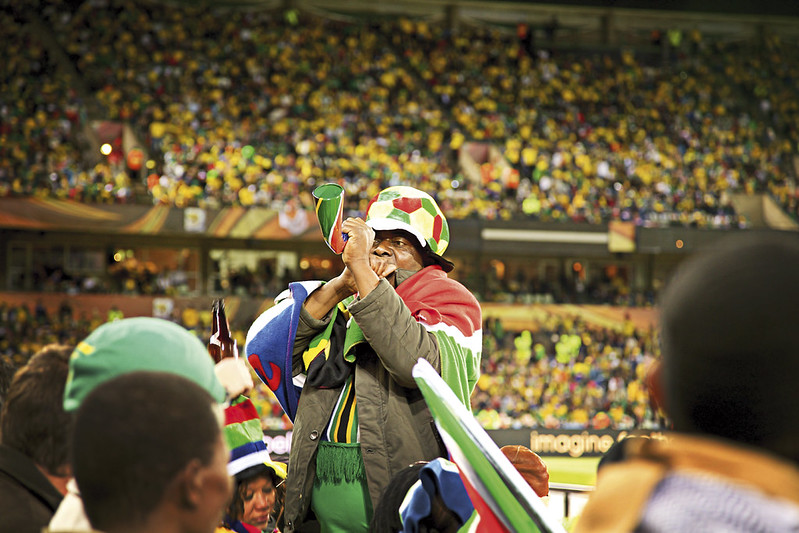
A South African supporter blows a vuvuzela during a match at the 2010 FIFA World Cup. Source: Media Club/Flickr.
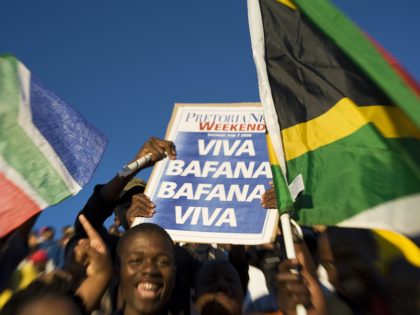
Bafana Bafana winning the 1996 Africa Cup of Nations (AFCON) wasn’t just a new trophy to add to the cabinet; it was a grand reintroduction of South Africa onto the global footballing stage in its democratic glory. The team was imbued with political meaning and became another representation of the Rainbow Nation project.
But like the fantasy of a unified nation, that image of Bafana would come to mirror the realities of South African politics.
For almost 30 years, the team would demonstrate the corrosive nature of government corruption. This period was marked by the decline in attendance and quality of the Premier Soccer League (PSL) and the severe impairment of developmental football. Bafana would also fall victim to the South African Football Association’s (SAFA) consistent administrative failures through pay disputes, financial mismanagement, criminal investigations, multiple qualification blunders, including the infamous 2011 “Dance of Shame” or the point deductions debacle
And typically, in the aftermath of such events, there is an incredible lack of accountability.
This cumulative effect of these elements would be visible in the poor results in the field. Bafana would struggle to qualify for three AFCONS (with back-to-back absences) and had not directly qualified for the World Cup in 24 years – this, of course, excludes the 2010 World Cup, where they automatically qualified as hosts. The sporting crown jewel of South Africa was nothing more than an embarrassment, and fans would become despondent. They would still watch the team but expected nothing from them, and if anything, Bafana became the butt of jokes. So much so that one of Trevor Noah’s most famous bits from his 2011 “This is My Culture” special featured a segment on Bafana where he says, “When Bafana loses, no one really cares. We’ve become so complacent with that team; anything is enough for us. Anything. . . . They lose, they draw, they don’t win.”
This apathy would extend elsewhere as the team was not tasked to take on any political or nation-building messaging, which is a luxury not afforded to other major organized sports teams in South Africa.
What makes Bafana’s failures sting is that their performances are never just about results, they open a deeper wound. The double-edged embarrassment they produce is entangled with a national anxiety that the team and by extension, the country, fell short of the promise of 1994. They reveal an unsettling truth about what the country has become and, in doing so, call into question the story South Africans tell themselves about who they are.
SAFA’s response to failure was often more theatrical than structural. The mission to revive Bafana became, in many ways, a search for a messiah. Since 1996, Bafana has seen twenty coaching changes, with the hopes that a new face on the sideline would solve problems that were institutional. The federation would turn to local footballing legends such as Jomo Sono, Pitso Mosimane, and Stuart Baxter. When that didn’t work, they looked abroad with appointments such as Phillipe Troussier and Ted Dimitru.
But SAFA’s impulsivity was best captured by its willingness to spend exorbitant sums hiring Brazilian managers. The appointments of Carlos Queiroz, 1994 World Cup winner Carlos Alberto Parreira, and Joel Santana felt less like a technical decision and more of an attempt to import the identity of flair, flavour, and greatness associated with Brazilian football. This demonstrated a South African tendency to chase exceptionalism while neglecting the slow and often unglamorous work that comes with it. Unsurprisingly, those expensive experiments failed. The coaches came and went, the results remained largely unchanged, and, in the process, women’s and youth structures were treated as expendable.
That is what made the appointment of Hugo Broos in 2021 seem so left-field. He was not the charismatic or sexy choice, nor did he carry the same sentimentality that a prospect like Benni McCarthy offered. However, he was a much-needed reset. He opted to go younger and would often ruffle feathers with his unpopular coaching decisions—sometimes excluding superstar players on principle rather than performance—or through his blunt honesty in press conferences, where he would offer a sober assessment on the state of South African football, the lack of professionalism by senior players, or the bad performances at the youth level. And he had not only the credentials but the results to back his words.
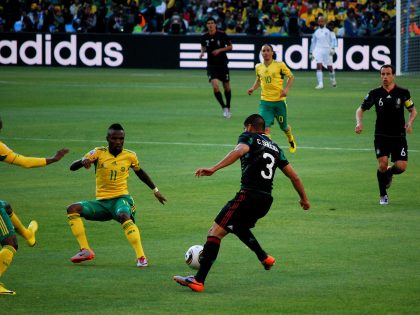
Broos stands as the longest-serving coach in the country’s history. He led Bafana to a third-place finish in the AFCON 2024, their most successful outing in the tournament since 1996, with two players making the team of the tournament. Ahead of AFCON 2025, Bafana had a record-setting 27-match unbeaten run, the longest in their history and the second-longest unbeaten streak in the world at that specific time. It gave South Africans the license to like the team again and to be cautiously optimistic. So even when the team was knocked out in the round of 16 in AFCON 2025, it was disappointing but not devastating.
The ways in which Bafana was conceptualized mean that they have long occupied a state where they were not burdened with being a vessel for political ideology.
However, this iteration of Bafana could represent a shift. Under Broos, Bafana have not won anything noteworthy, but they have become credible enough for South Africans to once again create an image of themselves through the team.
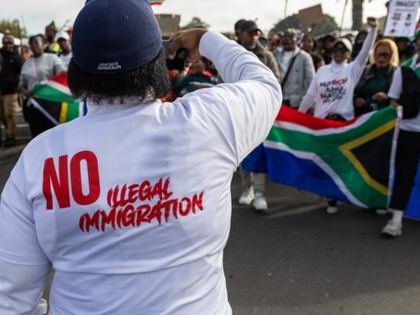
Ahead of the World Cup, there seems to be a nationalist sentiment brewing behind Bafana, particularly online. On a more benign level, it manifests as optimism for the team to make a deep run in the tournament, a boastful display of the local league, and the country’s footballing infrastructure. But on the other extreme end, it unearths South Africa’s xenophobia and the country’s current dark political mood. This has been demonstrated through debates around defender Ime Okon, whose identity is interrogated, despite being born in South Africa and having a South African mother. It also manifests through self-satisfied observations that South Africa is the only African country at the World Cup that will field an entirely naturally born squad. These discussions move Bafana away from the X’s and O’s of the game to a more sinister terrain.
In the 20th century, sport served as a site where major political conflicts were expressed, and it happened episodically. However, in this contemporary moment, the political economy has significantly changed. Today, sport has become a privileged domain where a growing range of social conflicts are litigated. Questions of race, gender, immigration, policing, human rights, and identity are continuously disputed and negotiated. And the athlete functions not just as a competitor but as an influencer, public intellectual, activist, labour organizer, cultural representative, and a diplomat at all times. This is historically unusual. Sports are increasingly asked not just to represent politics, but to help produce and organize political discourse
The cost-benefit structure of political discourse within sport has also been upended. In previous generations, political speech from athletes often came with severe institutional punishment. Muhammad Ali was barred from boxing and stripped of his heavyweight titles after refusing conscription into the US military, Jesse Owens was effectively ostracized upon his return to America after the Berlin Olympics, and Mahmoud Abdul-Rauf and Craig Hodges were blackballed within the NBA following their public political stances.
These days, institutions may not only tolerate political expression but, in certain instances, amplify it further. To be clear, this happens under very specific conditions where the messaging is brand compatible and where imperialist white-supremacist capitalist patriarchy is not challenged meaningfully. For example, the NBA and NFL have adopted social justice initiatives addressing racial inequality; brands such as Nike have produced campaigns with explicit political messaging; and streaming platforms such as Netflix frequently convert political events within sport into documentary content.
This creates a circulatory economy where fans demand representation of their political agendas, then they are packaged, redistributed, and monetized by athletes and institutions, and the media rewards this with visibility.
This circulation often does not drive substantive political action. Rather, it makes politics a consumable product. It also exposes sports to swing in the direction of populist politics, and therefore, if the climate is more right-wing, then sports can contort itself in that mold.
The expanding role of sports in politics could be attributed to people feeling anxious about their political disenfranchisement and the loss of meaningful spaces for participation. Voting is almost obsolete, traditional institutions are crumbling, upward mobility is severely constrained, and moral meaning in formal politics has been foreclosed. And so, the displacement of political desire goes into alternative cultural sites, with sport becoming one of its primary recipients. Athletes are given authority that exceeds their capacity, as if they are not embedded within the same structural ecosystem.
For more than two decades, Bafana was spared from this ideological function. They were perpetual underachievers and too inconsistent to serve as a stable symbol. This should demonstrate that sports, at best, will always reflect rather than transcend the political conditions that surround them.
However, now that they seem competent, they could be, once again, asked to fill an impossible demand.
To be clear, this is not an endorsement for the exclusion of politics from sport. That separation is neither possible nor desirable, particularly in a country like South Africa.
But perhaps Bafana can serve as an example against projecting onto sports the things that can and cannot be resolved through political processes. It is not to make the same mistake that was made in 1996, where symbolic gestures were confused with authentic political reality, or where sports are used to manage societal tensions. Because the more sport is treated as an exceptional political site, the more it reflects a crisis in politics itself.