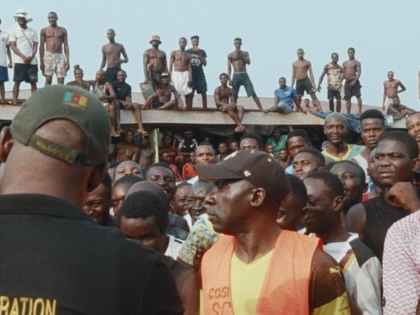
The film Adú justly calls attention to Europe’s closed borders, but neglects to examine why people are migrating from Africa.
Latest
Diagnostic dilemmas
The increasing visibility of Qur’anic healing in Cairo intersects with psychiatry’s growing foothold in public awareness, creating fertile ground for debates about affliction, care, and expertise.
Fractured dreams: The life of a Libyan exile
Muammar Gaddafi occupies a contested space in the histories of postcolonial Africa. What about his Libyan opponents?
What happened to Ethiopia?
The ongoing displacement and killings of minorities and the ongoing war in Tigray—labeled by the federal government as enforcing law and order—are disturbing. It can’t go on.
Kwame Nkrumah’s Encounter with Karl Marx
Nkrumah’s written works and speeches reveal a selective encounter and appropriation of tools—in this case from Marxist thought—that were translated through Nkrumah’s traveling theory.
The way we tell stories
Raoul Peck’s ‘Exterminate All the Brutes’ missed the opportunity to engage with the history of colonialism in a way that empowers viewers to imagine a future in which whiteness is not the locus of power and authority.
AIAC RADIO
This month on Africa Is a Country Radio we wrap up our seasonal theme of port cities, and make a stop in Dakar, Senegal. Listen on Worldwide FM or Mixcloud.
Culture
Three psychologies of Mau Mau
How racialized intellectual outputs placed in just the right circumstances can do the most damage.
The Nigerian and the Lenin Prize
Peter Ayodele Curtis Joseph was a prominent left nationalist in Nigeria’s struggle for independence. Then he was forgotten. How do we commemorate him?
Nigeria’s Twitter ban and the resistance politics of VPNs
Anyone who cares about civil society, free speech, and human rights should find the state’s digital silencing of its citizens deeply troubling.
Trapped by history
Mexican American director John Gutierrez new film, set in Cape Town, South Africa, touches on colonialism, displacement, and man’s complicated relationship with nature.
The legacy of French colonial psychiatry
French psychiatry in West Africa saw Black bodies as “alien” to white ones. It hasn’t changed much.
Capitalism in My City
The Mathare Social Justice Centre has partnered with Africa Is a Country to produce a series of posts and videos to document everyday capitalism in Nairobi. The project is funded via the Shuttleworth Fellowship awarded to Sean Jacobs.
In the second video from our Capitalism In My City project, Dennis Esikuri talks to everyday Nairobians about the current employment opportunities in the context of the COVID-19 epidemic.
In the first video from a series for the Capitalism In My City project, Brian Mathenge decodes what everyday capitalism looks like from the margins of Nairobi.
Politics
A different picture of the struggle
Oral histories conducted with women involved in South Africa’s liberation struggle offer us startlingly candid portraits of youth activism.
Where do just ideas come from?
Episode #41 of AIAC Talk explores Senegal’s early post-colonial history, to make sense of the unhappiness with the government of incumbent president Macky Sall. Watch it Tuesday on Youtube.
Kwame Nkrumah and Israel
Israel projected itself as a plucky postcolonial nation. Many African nations and leaders bought into it. Israel’s occupation of the Sinai in 1967, changed that.
Accra to Bandung, Addis to Beijing
On AIAC Talk this week, we are tackling Africa’s long and evolving relationship with Asia. Watch it live Tuesday on YouTube.
Another neoliberal Spring
Now that we have had time to process it: Uganda’s January 2021 elections were a key step in the country’s long transformation towards a fully fledged neoliberal society.
Technology
Nigeria’s Twitter ban and the resistance politics of VPNs
Anyone who cares about civil society, free speech, and human rights should find the state’s digital silencing of its citizens deeply troubling.
Silicon Valley in Africa
Western tech companies in Africa often claim to be "social entrepreneurs." But do their models reduce or contribute to inequality?
WhatsApp and anti-capitalism: should you stay or should you go?
Facebook and its “family” of services are a one-way street towards greater integration, data exploitation, and erosions of privacy by an increasingly monopolistic company.
More widespread than we think
Today's social movements rely on tech collectives to organize safely. But few know the history of other technologies used by earlier liberation movements.