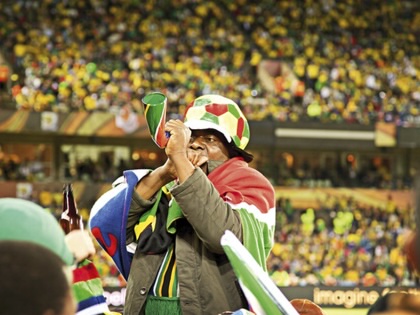
Where are the politics of Bafana Bafana?
While most sports in South Africa are inseparable from the national political imagination, men's football manages to stay relatively removed.
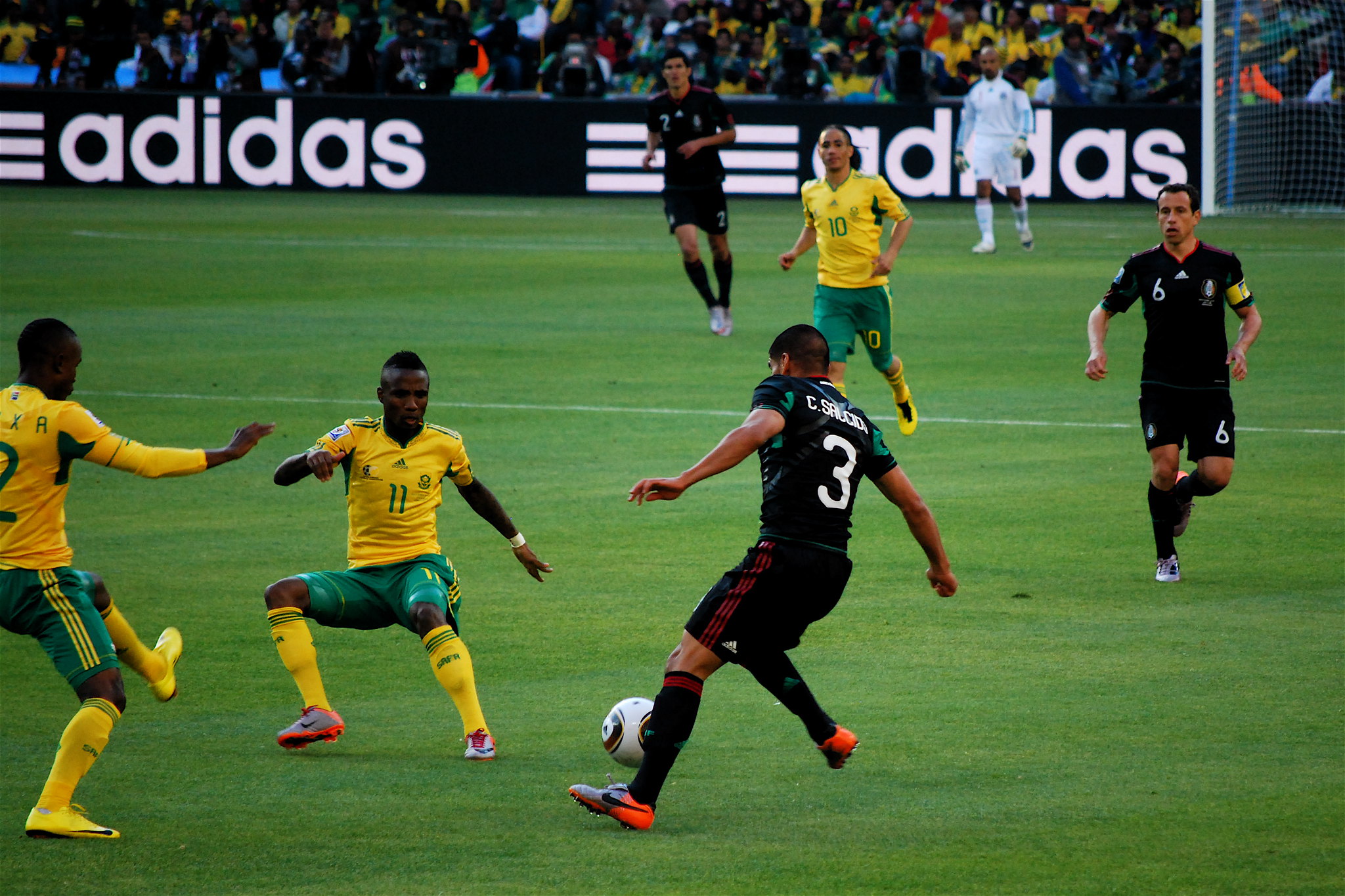
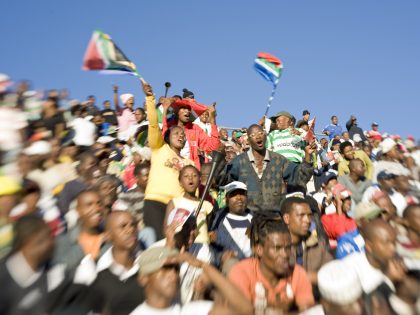
First match of the 2010 FIFA World Cup — Mexico vs. South Africa in Soccer City, Johannesburg. Image
The connection between sport and politics is implicit, particularly in African football. The beautiful game has long functioned as a site of resistance, liberation, identity, and togetherness. These politics surface at every level of the game: from the federation to the team, from players to fans.
But, then there is Bafana Bafana.
The South African men’s national football team exists in a curious parallel universe. Despite football being the country’s most popular sport, the national selection can shrug off political codes in a way others cannot. This is uncharacteristic, especially considering how the country’s affinity for political discourse permeates elsewhere.
No team in South Africa is more demonstrative of the entanglement between sports and politics than the men’s national rugby team. In 1995, Nelson Mandela famously reclaimed and christened the Springboks as the vehicle for the Rainbow Nation project. However, that blessing would to turn out to be a burden, as they would become the ultimate representation of the promise and the failure of that dream.
Since then, rugby has remained a space where the country attempts to exorcise its racial demons. And, despite the team’s world dominance, the leadership of a black captain, and a beloved coach in Rassie Erasmus who has a better track record of integrating non-white players than previous iterations, they are not absolved from having to explicitly engage with the country’s greater politics. In fact, these elements only raise the stakes further.
The fans add a dimension to this dynamic with their own ideological investments that turn every major victory into a discussion of South Africa’s inequality and racial disparity. SA Rugby, as an institution, has also willingly taken up political matters into its own hands. The union found itself in hot water in early 2023 when Jewish organizations accused them of discrimination for disinviting the Tel Aviv Heat from the Mzanzi Challenge competition—well in advance of October 2023.
Individual players have used the sport to confront gender-based violence (GBV) in South Africa. Makazole Mapimpi made a moving dedication to Uyinene Mrwetyana, a university student brutally murdered because of her gender, during the 2019 World Cup. Team captain Siya Kolisi has spoken out on GBV in several interviews and press conferences, and more recently lent his support to Women For Change’s Purple Campaign.
Cricket South Africa (CSA) is also no stranger to politics. In 2020, Lungi Ngidi faced backlash from ex-Proteas players after his repeated demonstrations in support of the Black Lives Matter campaign in the aftermath of George Floyd’s death. A year later, CSA would issue a directive for players to take a knee during the 2021 T20 World Cup. All the players obliged except for Quinton de Kock, and he withdrew from a match in protest. He would later apologize and then join in on the gesture, explaining that he was in support of the movement.
That is not the only site where cricket became political. CSA came under fire from Jewish organizations after they stripped David Teeger of his captaincy of the U19 Cricket team. Teeger had made comments in support of Israeli soldiers during an award ceremony in late October 2023, yet was still initially appointed captain. Following a formal complaint from a pro-Palestine organization to the South African Sports Confederation and Olympic Committee (Sascoc), CSA revoked his captaincy citing security concerns.
In 2022, CSA launched their annual Black Day Campaign with the women’s team to raise awareness about GBV. The promotional material also featured senior men’s players to demonstrate a united front. However, this stands in sharp contrast to how CSA has ignored multiple appeals from various organizations, and from the South African sports minister himself, for the men’s team to boycott Afghanistan in response to the Taliban government severely restricting women’s rights.
Women’s sport, structurally marginalized in general, is forced to be political. Across every code, women must confront massive disparities in wages and resources to simply participate. And, these battles sometimes stretch into the very question of race and gender. For example, Caster Semenya’s exclusion from competing by World Athletics and her subsequent court case demonstrate how Black women are denied the very category of woman, as Hortense Spiller’s seminal 1987 essay, “Mama’s Baby, Papa’s Maybe: An American Grammar Book” powerfully illustrates.
The above examples are far from exhaustive, but they show how various sport codes are continuously engaged in political conversations at multiple levels.
Bafana Bafana does not do the same. The men’s national football team is comparatively aloof. And, it’s not like the opportunities are not there.
Ahead of this year’s Africa Cup of Nations (AFCON), Bafana coach Hugo Broos made a racist and sexist comment about Mbekezeli Mbokazi and his agent. To be clear, contrary to much of the media coverage, the statement was neither tongue-in-cheek nor the fault of English being Broos’s second language. It revealed an ideological belief. Relating Mbokazi’s tardiness to his blackness which must then be corrected through modeling whiteness—demonstrated through the phrase “but he will get out of my room as a white guy”—is white supremacy 101. Blackness is framed as a site of deviance, negligence, and perpetually in deficit while whiteness is constructed as the locus of virtue, order, and discipline. To understand this statement as anything else fails to recognize how anti-blackness works.This is not revolutionary insight; it is a basic argument of critical race theory and Afropessimism.
The comments did raise some eyebrows, but not enough to create a storm, and they are certainly not affecting the squad and their campaign presently. In fact, a glance at responses to the ENCA video or chatter on X shows that many Black fans are not only unperturbed but have affection for Broos.
The difference here, and why it matters, becomes clearer when contrasted with rugby. If Erasmus had made a similar comment about any Black player in the national squad, it would dominate the tournament narrative and the results would become secondary. We’ve seen this before: during and after South Africa’s 2019 Rugby World Cup campaign in Japan, much of the coverage centered on a moment caught on camera when Mapimpi was excluded from a post-match huddle with six white players. Erasmus and Mapimpi found themselves repeatedly explaining that it was part of a ritual or an inside joke, depending on who you ask, but it didn’t quell the noise. It became another flashpoint to discuss race in rugby.
Another opportunity where Bafana Bafana could have engaged politically, but haven’t is with the case of Israel. South Africa’s case in the International Court of Justice (ICJ) against Israel made the country’s position on Palestine clear, effectively giving sporting organizations the green light to do the same.
The only act of solidarity from football at the national level came from South African Football Association (SAFA), which hosted two exhibition matches against the Palestine men’s national team in early 2024. But here’s the catch: the games featured an invitational squad with no involvement from the current Bafana Bafana team. Since then, there have been calls from pro-Palestine organizations, from the Congress of South African Trade Unions (COSATU), and even an open letter penned by former Mamelodi Sundowns player Sipho Ndzuzo, demanding the federation and team to join in the campaign to suspend Israel’s participation in world football. Those calls have fallen on deaf ears. While SAFA’s invitational was an act of goodwill, the place where politics are tested are not in what is embraced, but in the things that are actively refused; where the line is drawn.
So, why is Bafana seemingly so unaffected by politics? Perhaps, that’s the way the SAFA wants it. The federation is a drama factory, and constantly in the news for corruption, strained sponsor relationships, and financial crises. The last thing they need is their prized gem taking a stand in regards to anything.
While every major sport has had to address GBV to some capacity, Bafana Bafana, have not had to. Perhaps that’s because current SAFA president, Danny Jordaan, allegedly hired a PR firm, using federation funds, to clean his image after being accused of rape in 2017. Furthermore, when the football coach condescendingly refers to a player agent as a clueless “little woman” during a press conference, with the federation’s full backing, it becomes evident that contempt for women is tolerated institutionally.
Before they left for AFCON, the sports minister pledged an additional R5 million (over $300,000) to Bafana Bafana. This is consistent with how the men’s team has always been rewarded, regardless of performance. Banyana Banyana (the women’s team) are not afforded these luxuries; neither are the rugby, cricket, or athletics squads. Bafana never have to fight for legitimacy, even when their results are poor. This is less a reflection of the nation’s love of football, than a reflection of a chauvinistic culture embedded in the greater society.
Unlike rugby and cricket, football does not have to answer for an exclusionary past and therefore does not become a site of redress. Since it already belongs to Black South Africans, Bafana is not expected to be pedagogical in the same way. The Springboks must be “Stronger Together” and reflect a progressive, unified South Africa; the Proteas have to be “#MoreThanCricket,” to emphasize that the squad isn’t just playing for glory, they are playing to reconcile the nation. And, the success of a team or a specific athlete in women’s sports has to serve as a mechanism to break down barriers and affirm to young girls that their dreams are valid.
Meanwhile, Bafana is not even held to the standard of winning, a good showing is simply enough. Their position in the national imagination means they are not morally interrogated and are not primed to take on the political responsibilities that define other sports. Not favorites at AFCON, Bafana are rewarded for just existing, and in that, there is politics and the shape of the game itself.