The boys are back in town
Bafana Bafana’s resurgence has been forged where South African football always lives — between brilliance and the bizarre.
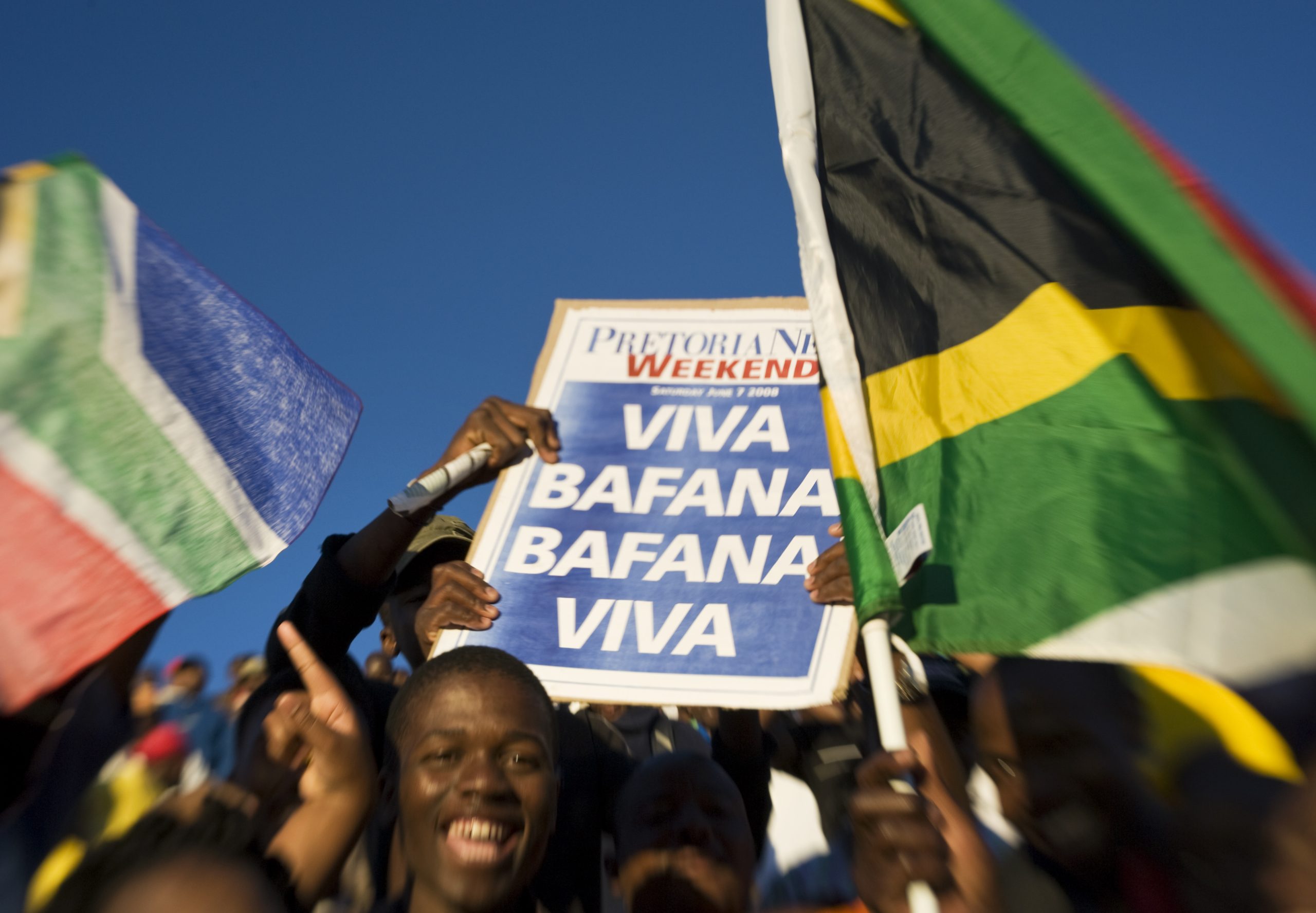
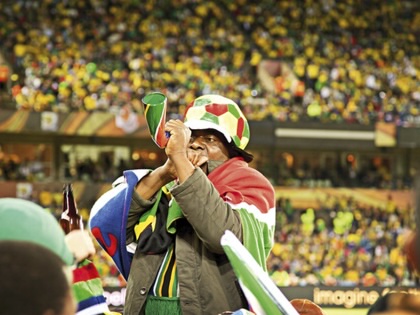
Bafana Bafana supporters at SuperSport Park, Pretoria, June 7, 2008. Photo: Media Club South Africa (CC
Bafana Bafana, as South Africa’s senior men’s national football team is nicknamed, doesn’t do anything in half measures. The team goes from brilliant to bizarre in a spellbinding transformation that would puzzle and amaze even the greatest of shapeshifters.
Bafana shot to the stars in 1992 when they emerged from the football wilderness to win 1–0 against the then two-time African champions and World Cup quarter-finalists, Cameroon, in South Africa’s first international match. But they were brought back to reality when Zimbabwe thumped them 4–1 and Nigeria drubbed them 4–0 in Bafana’s formative years—leading to the team being mockingly called the 4X4s.
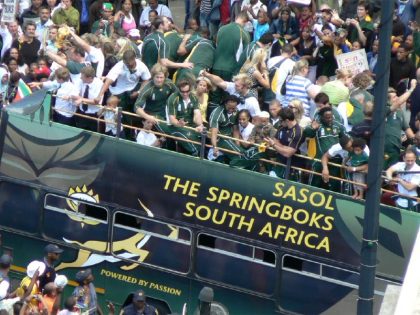
Thanks to home ground advantage, and a sprinkling of Madiba Magic, the 4X4s rose from dust to soar higher than everyone on the continent when they won the 1996 Africa Cup of Nations (AFCON) staged in South Africa. Clive Barker, who brought the AFCON trophy to Mzansi in 1996, also helped the team book their place in France ’98 for their maiden FIFA World Cup appearance. He, however, wasn’t on the plane to France, ejected by the South African Football Association (SAFA) when the two couldn’t find common ground regarding Barker’s remuneration package. That sacking normalized Bafana going back-and-forth between the brilliant and the bizarre. Barker insisted on relying on home-based talent, dismissing the need to bring Europe-based players simply because they play abroad, in a more competitive environment than South Africa, which was still finding its feet in the global arena.
In appointing Frenchman Philippe Troussier, SAFA undid the work of the brilliant Barker. Troussier was a complete disaster, fighting with the media and hanging his players out to dry by labeling them as tourists rather than a side that came to compete in France. For him, Bafana’s weakness was the fact that they didn’t have enough players plying their trade abroad—preferably Europe. He failed to grasp what made the team African champions, by focusing on what they lacked instead of building on what they possessed. His bizarre tenure marked the beginning of the two worlds Bafana would hop between.
Bafana Bafana would either have a warm coach, usually a local, who could get the players to go through brick walls for him and the country, or a cold, often international, coach who didn’t understand the South African psyche and what was needed to get the best out of Mzansi players. The “warm” coaches were normally undone by the association that failed to back them when they stood their ground with players who wanted to pick and choose which matches they would play. These coaches, however, also refused to stray out of their comfort zone—adopting an approach that didn’t push the team to be great, but settled for being good. The cold coaches were normally removed by player power, with the group showing their displeasure through their performances. In their push for excellence, the cold coaches set standards based on European metrics without understanding the human beings they managed.
That mismatch resulted in players not doing self-introspection because the “outsider” was the problem and the entire blame of the team’s poor performance was shifted to the coach. For Bafana to succeed, they needed a coach who could marry the brilliant and the bizarre worlds that the team lives in.
Enter Hugo Broos. His appointment was both brilliant and bizarre. An AFCON winner as coach of Cameroon, and a serial winner in his playing days at Anderlecht and Club Brugge in Belgium, Broos brought the winning mentality that Bafana needed. His triumph in Cameroon—where a number of their star players boycotted the national team, opting instead to cement their places at their European clubs—prepared Broos well for what he would experience at Bafana.
The Belgian took over a side that had created an environment where certain players believed that simply by just breathing, they deserved to start in the national team. Europe-based players and those plying their trade for the so-called big teams in South Africa behaved like playing for a national team was their birthright. Broos was able to deal with that challenge in South Africa because, when he was met with a group of primadonnas who saw themselves as untouchable in Cameroon, he forgot about them and instead worked with a group of unassuming cubs and turned them into Indomitable Lions. His unfancied side brought the 2017 AFCON to Cameroon, returning the country to the summit of African football for the first time since 2002.
But Broos was not a sexy name to South Africans, who are obsessed with brand names in their coaches. He didn’t have the charisma of a Hervé Renard, the profile of national hero that Benni McCarthy had, or the solid CV of a Carlos Queiroz—names that were bandied about as potential Bafana coaches before SAFA appointed a 69-year-old Belgian. Because of that, Broos’s first press conference was cold. One journalist even asked him if this job was part of securing his retirement package. The Belgian adopted a defiant posture.
“I am not coming here for a retirement check and then go back to my country with no success. I am not like that,” Broos said, when he was unveiled as Bafana coach on May 12, 2021.
“If you look at my CV, it’s a CV with plenty of success. I want success, and I want to win. I am very angry, and I am very disappointed when I lose. I don’t want to lose! But it’s not only me [who will bring success]. I have to build a team that is going in the same direction as me. A team that knows that there is one thing that is important, and that’s the team. Not an individual, a team. We have to create a team.”
Bit by bit, Broos removed egocentric and individualistic elements to create a united Bafana. He challenged South African football authority, from the Premier Soccer League (PSL) chairman Irvin Khoza to even his employers at SAFA. The fights that he picked with these bodies were all for the benefit of the players and South African football. He challenged Khoza, demanding the PSL take a pause earlier so as to allow players to rest before they get to AFCON. (Broos lost that battle in 2023, but won it ahead of the 2025 AFCON). He also challenged his bosses to better take care of the junior national teams, rewarding players who did well there—like Shandre Campbell and Tylon Smith who are former Under-20 players who are in the AFCON squad.
That endeared Broos to the players, who appreciated having a figure who fights for them and was uncompromising when it came to discipline. Broos even dropped one of the best right backs in Africa, Khuliso Mudau, because he didn’t train at his club when he was fighting over a new contract, a season after backing the player when he was involved in a spat with his Mamelodi Sundowns’ coach.
Broos’s biggest success at Bafana is restoring the pride of the national team jersey, which has resulted in success that has filtered down to the junior national teams. The Under-20s are the reigning African champions, who reached the knockout stage of the World Cup, while the Under-17s are regional champions and also advanced to the next round of their age group’s World Cup. Broos achieved this by fighting for the respect of competitions like COSAFA Cup (Southern Africa’s regional championships) and African Nations Championship (the AFCON for local-based players that’s also known as CHAN). He rewarded players who took these competitions seriously. Rushwin Dortley graduated to the Bafana first team after doing well at COSAFA while Malibongwe Khoza earned his first call up after doing well at CHAN.
All of this, however, wouldn’t have been possible without the “awakening” at club level. Orlando Pirates’ run in the 2013 CAF Champions League and 2015 CAF Confederation Cup, where they stunned North African opponents, compelled South African clubs to take continental football seriously. Pirates’ success, especially their 3–0 win over Al-Ahly in El-Gouna in the 2013 Champions League, removed the fear factor that South African clubs used over North African sides. That was the heaviest defeat that Al-Ahly had suffered in the Champions League. That record was changed by Sundowns, the 2016 Champions League winners, who thumped Al-Ahly 5–0 in the quarter finals of the 2018–2019 edition of the continent’s premier inter-club competition.
Those victories showed the brilliance of South African football teams. But the bizarre crept in during Pirates and Sundowns’ road to the final in those Champions League campaigns—with the two sides failing to win the overall competition that was won by North African sides. Pirates and Sundowns failed to win the Champions League in those seasons because they insisted on playing an expansive brand of football, even in instances where pragmatism was needed. Those were school fees that South African football needed to pay to get to where they are now, as one of the dark horses in the 2025 AFCON after finishing third in the previous edition in Ivory Coast.
Bafana achieved that with a largely home-grown squad. Broos, like Barker before him, insisted that just because a player is in Europe doesn’t mean that they are better than the ones playing in the local league. The 2–0 win over Morocco in the last 16, with the Atlas Lions boasting a galaxy of stars from the best sides in Europe, justified Broos’s words. The victory came at the hands of a starting XI that featured nine South Africa–based players and Percy Tau, who was at Al-Ahly at the time.
Sphephelo Sithole, who is based in Portugal, was the only player based in Europe. Importantly, ten of the 23 players that did duty for South Africa at the 2023 Afcon refined their talent in the MultiChoice Diski Challenge (MDC, now known as the DStv Diski Challenge). The league is a combination of a reserve league and a developmental institution. To be eligible, players have to be Under-23 to play. But when it was launched, it was changed from an Under-19 league that it was initially supposed to be to a reserve league, because SAFA took umbrage that the professional body (the PSL) was now venturing into amateur football—which is the domain of the association.
But slowly, the PSL has been moving the league to what they had originally intended it to be—a place for upcoming talent to cut their teeth in a structured environment. That was another episode of the bizarre and brilliant of South African football, the governing body flexing their muscle over the league, which was doing something that would benefit football. The two organization’s failure to pull in the same direction has hurt Bafana and South African football.
It’s why the country has fielded weak teams in CHAN, the Olympics qualifiers, and even in some of the age group competitions with teams not obligated to release their players since they don’t fall under the FIFA calendar, and no sense of patriotism to allow that to happen despite the rules. South African teams that participate in continental football, for instance, sometimes don’t have their domestic schedules cleared so that they can best represent the country, as is the case in other parts of the continent.
These issues are slowly being ironed out, which will create room for brilliance to have a permanent home in South African football, instead of being a visitor that’s often chased away by the bizarre.