A giant chance
An African Cup of Nations at home for red hot Morocco is a chance to put past trauma aside and charge on to the world stage.
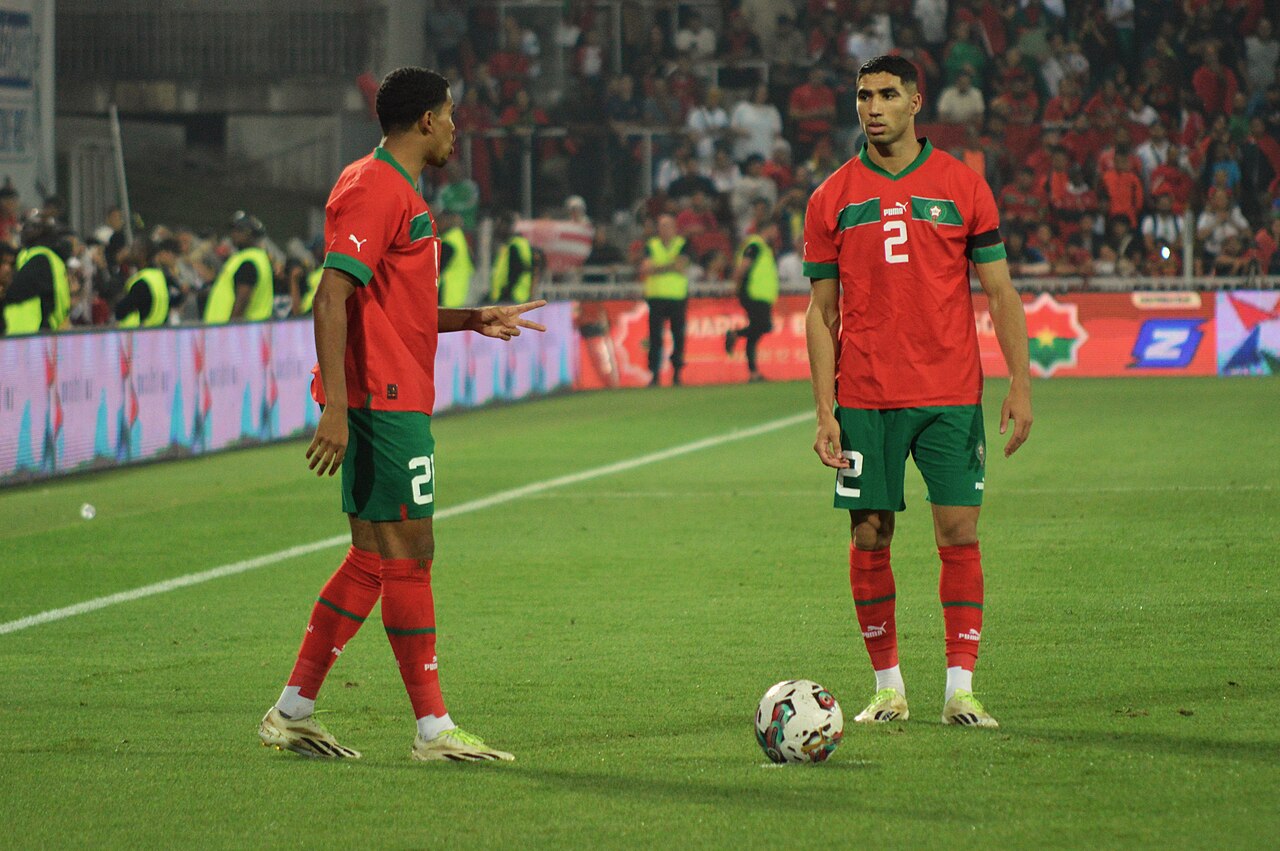
Amine Adli and Achraf Hakimi at a friendly in 2023. Image credit Nawfel Ajari via Wikimedia
Before we can become the kings of the world, we must become the kings of Africa.
What is at stake for Morocco playing an African Cup of Nations at home?
On multiple occasions when asked about his impressive Moroccan national team and their prospects of one day winning the World Cup, head coach Walid Regragui immediately and repeatedly stressed the importance of the Africa Cup of Nations. In Rabat at the beginning of December, I interviewed Moroccans about the upcoming tournament for corporate television. Trying to adhere to the stiff standards of buttoned-up professionalism, I probed for light, upbeat answers that would speak about general excitement and anticipation. Yet, as soon as the cameras were switched off, nervousness surfaced. These days in Morocco, that snapback to reality, that pebble nudged in the Atlas Lions’ paw feels tangible across many sectors of the public.
If we were to apply the cliché of an unstoppable force meeting an immovable object to this situation, the unstoppable force is unquestionably Moroccan football. Amine El Amri, a Moroccan football journalist, pointed out that his country participated in every single FIFA competition this calendar year except the FIFA Beach Soccer World Cup. That alone hints at the astronomical rise of Moroccan football across all age groups and categories.
The immovable object? A 50-year-old mental block around the African Cup of Nations that refuses to crumble. Time and again, despite boasting impressive squads, Morocco have consistently failed to deliver in the knockout stages of AFCON. I began covering the tournament in 2017, so I have witnessed the last four eliminations in person.
In 2017 and 2021, Morocco outplayed Egypt only to be undone by their North African rivals. More painful exits came in other years. The 2019 elimination was particularly difficult to swallow. Morocco were on the verge of reaching the quarterfinals, but standing in their way were the Benin Squirrels (not the “cheetahs”). Coached by Hervé Renard, Morocco played compact football, conceding almost nothing but creating little themselves. In the dying minutes, with the score locked at 1–1, Morocco were awarded a penalty kick. Hakim Ziyech, usually clinical from the spot, stepped up. His low effort struck the right post, instantly draining the momentum the Atlas Lions had built late in the match. With spirits dampened and facing an inspired Saturnin Allagbé in the Benin goal, Morocco were eliminated in crushing fashion.
The 2023 tournament proved just as frustrating. Fresh off a historic 2022 World Cup semifinal run, Morocco arrived in Côte d’Ivoire as favorites. Once again, the Atlas Lions earned a late penalty. Once again, their star—this time Achraf Hakimi—rattled the woodwork. The defeat to South Africa was a cold splash of reality after the World Cup euphoria, and another reminder of the psychological barrier haunting the team.
Since losing the 2004 final to hosts Tunisia, Morocco have never progressed beyond the quarterfinals.
The psychological toll of such a drought should not be underestimated. Take Senegal as an example. Prior to winning the 2021 AFCON, the Teranga Lions had never lifted a major football trophy since gaining independence in August, 1960. In the immediate aftermath of that triumph, Senegal went on to win the U17 AFCON, U20 AFCON, and the 2023 African Nations Championship. In the span of a single month, a nation once defined by its mental failures on the pitch transformed its reputation into that of serial winners.
Morocco does not need its men’s senior national team to kick the door down for the rest of its football landscape. Despite the senior men’s team leading African football on the World Cup stage, Morocco have enjoyed greater continental success with their youth and women’s teams. The Atlas Lionesses have reached consecutive WAFCON finals. The U23 side won AFCON and claimed bronze at the 2024 Olympics. Morocco’s futsal team has lifted three consecutive African titles. Rather, a Moroccan AFCON victory would be useful in that it would lay the foundations for an opportunity to outdo their 2022 semi-final berth in North America next summer.
However, expectations are dangerous because they can be double-sided. “Expectations are so high that anything short of reaching the final could cost Regragui his job,” El Amri explained on the African Five-a-Side podcast. It is a harsh assessment, but Morocco has a deep bench of coaches ready to step in. Tarek Sektioui, for example, has won an Olympic bronze medal in 2024, the 2025 African Nations Championship, and the 2025 FIFA Arab Cup in Qatar. Many in Morocco consider his style more attractive than Regragui’s, and he would undoubtedly relish leading his country on the world stage.
Still, such upheaval would hardly be conducive to calm World Cup preparation. It may sound zero-sum, but it is a reality that success at AFCON for Morocco could be inseparable from success at the World Cup. Failure at the AFCON could jeopardize both.
That is what is truly at stake for the hosts.
Beyond lifting a long-awaited trophy—the lone blemish on a golden decade of Moroccan football—a disastrous AFCON at home could trigger instability, and derail one of Africa’s strongest hopes ahead of the 2026 FIFA World Cup next June.