Caught offside
Some African football fans have been hate-watching Bafana Bafana at the World Cup because of South Africa’s anti-migrant politics. The team’s apolitical stance has left them without a defense.
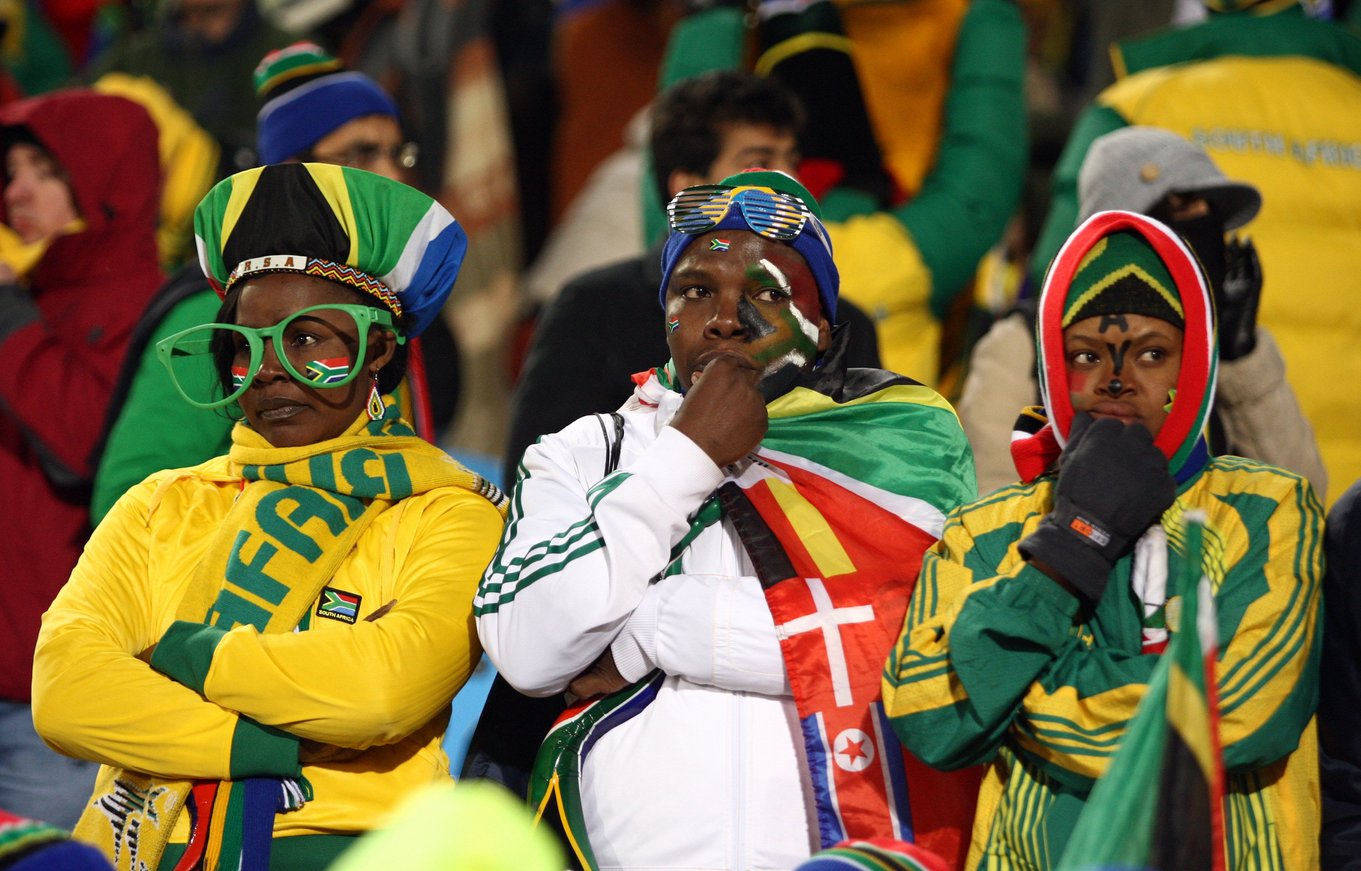
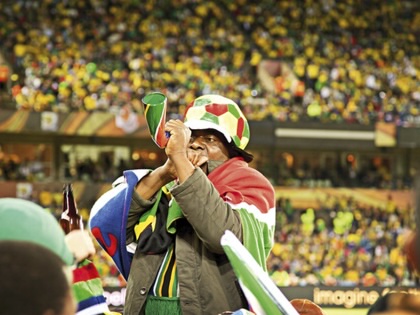
South African supporters react during Bafana Bafana’s 3–0 defeat to Uruguay at Loftus Versfeld Stadium in Pretoria during the 2010 FIFA World Cup, 16 June 2010. Source: Allstar Picture Library Ltd/Alamy.
“Abahambe!” (They must go!)
Gayton McKenzie shouts this at the top of his lungs at Orlando Stadium—the spiritual home of South African football, in Soweto—during a rally of his political party, the Patriotic Alliance (PA). It’s late November 2023, six months before South Africa’s general elections.
McKenzie, somehow, finds a way to raise the decibels.
“Abahambe!”
McKenzie continues screaming, jumping up and down, to the point that some of his shouts of “Abahambe!” are inaudible. He shakes the microphone while being showered in purple confetti.
“Abahambe! Abahambe!”
In his speech, McKenzie vows that when the PA is elected, his first act will be to go to the Rahima Moosa Mother and Child Hospital to “switch off the oxygen of illegal foreigners.”
The hospital is named after Rahima Moosa, one of the leading actors in the women-led march against the apartheid regime’s Pass Laws in 1956. It is the only mother-and-child hospital in the country, serving a wide, predominantly low-income catchment area.
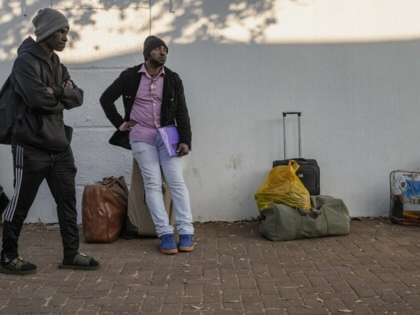
Hospital overcrowding—and not the government corruption that has brought the health sector to its knees—is one of the big talking points of the Abahambe movement, the anti-migrant group behind the spate of recent xenophobic attacks in South Africa.
McKenzie—whose party didn’t win the election, but got enough seats to be a kingmaker in the government of national unity—is now South Africa’s Minister of Sports, Arts and Culture, a position he received as a reward for siding with the ANC. The minister is one of the biggest voices, literally and figuratively, in the xenophobic wave sweeping Mzansi.
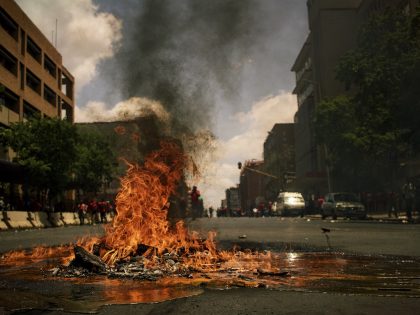
His “Abahambe!” sentiment lit the fire, which has been fueled by March and March, a self-proclaimed “citizen-led movement advocating for stronger immigration enforcement and protecting opportunities for South African citizens.” The leader of the movement, Jacinta Ngobese-Zuma, was fired from Durban-based radio station VUMA FM after commenting in a TV interview that foreign nationals shouldn’t use public hospitals. Her dismissal turned her into a martyr for the movement, amplifying her voice and presence.
Ngobese-Zuma has been given such a platform by the media that the South African Broadcasting Corporation—the country’s public broadcaster—went straight to an interview with her after President Cyril Ramaphosa addressed the anti-migrant sentiment. March and March have used unsubstantiated data to claim that migrants have overcrowded the health and school system to the detriment of South Africans. These figures and statements have been uncritically and widely disseminated by mainstream media. The organization has issued a warning to all undocumented foreign nationals to leave by June 30.
March and March and Abahambe! claim to only be against illegal immigration, yet their true intent has been exposed in their supporters targeting none other than a South African soccer player, currently representing his country at the World Cup. Ime Okon, a defender with the national team Bafana Bafana, was born and raised in Johannesburg to a South African mother and a Nigerian father. He came up through the South African football system, playing amateur football in Randburg before he was signed by SuperSport United, a South African Premier Division club. Okon’s father died when he was five. He has never been to Nigeria.
Notwithstanding, some supporters of March and March have said Okon shouldn’t play for Bafana because he is “Nigerian.” This is a sentiment that the team and the South African Football Association (SAFA) have not entertained.
But this isn’t the first occasion where Bafana Bafana has been caught in the anti-migrant storm. Several Africans have been hate-watching the team at the global showpiece due to the xenophobic sentiment in South Africa. That “hate watch”—a social media banter term for when a football fan supports the opponents of a team they dislike—has turned into actual hate. Bafana players have received significant abuse on social media, including direct messages from Africans angry with South Africa’s political climate.
“If you lose a game, and you don’t perform, you can take it as players,” Bafana captain Ronwen Williams said in the pre-match press conference ahead of the clash with Czechia in Atlanta. “You can put your hand up. But when there’s false information that goes around, then it hurts. I have been a target over the last few days over things I didn’t say. I didn’t speak anything about Africa, or people supporting Mexico,” Williams continued, addressing a fake quote attributed to him where he supposedly said he was hurt by Africans supporting Mexico and not South Africa.
I have always said that as Africa, we are one. We support each other in good and bad moments. We’ve all got our own politics, our own problems, and our own fights that we deal with back home. Every country has that. I don’t know where that stems from. It does hurt. I have been attacked. . . . my country as well, for things that are going on back home.
Williams continued:
Players are human beings as well. We go through it. Sometimes it gets a lot. You want to focus on doing your job, which is being a footballer, but then you get involved in politics even though you don’t want to get into that space. But the wonderful thing about sport is that it can unite, it can make or break you. It can bring people together. We are in Atlanta now, and I see so many Africans. . . . so many South Africans and people from Mexico, in one room. That’s the beauty of sport. That’s the beauty of football. So, let’s just enjoy and have a wonderful time, and we leave politics to the politicians. Let us just play football and enjoy ourselves. Criticize us for what happens on the field, but off the field things—we can’t deal with that, and it has nothing to do with us. As Africa, let’s unite and keep going because we are all in this together.
Bafana Bafana have found themselves paying the price for their country’s sins. But it’s not only the country’s posture that has turned them into a punching bag—the team’s apolitical stance hasn’t helped them, as people don’t know what they stand for.
South Africa’s national football association (SAFA) takes a political stance when it’s convenient, like hitting out at UEFA president Aleksander Čeferin for his statement that some of the games are “uninteresting,” hinting that widening the number of participants—especially from the Global South—is destroying the game.
SAFA, like most African associations, is firmly in FIFA president Gianni Infantino’s corner, and used this as a “Gotcha!” moment to expose the double standards of Čeferin, whose UEFA announced that Somali referee Omar Artan would take charge of the Super Cup—just after he was denied a visa by the US to officiate at the World Cup. SAFA didn’t utter a word about the weaponizing of visas by the US and dismissed questions of whether they should boycott the tournament.
McKenzie, a proud Israel supporter, was flippant when EFF leader Julius Malema called for a World Cup boycott:
How do you boycott the World Cup? It has everything to do with sponsors: our players who are playing overseas will be banned. It will be Armageddon. . . . Let me say this clearly: South Africa does not support a boycott. Football should not become a casualty of geopolitics. The FIFA World Cup is the biggest sporting event on earth. It is a celebration of the global game, and it belongs to the players and the supporters around the world.”
Meanwhile, the US, one of the co-hosts of the World Cup, has turned football into a casualty of geopolitics through its treatment of the Iranian national football team and Artan. McKenzie’s statement also ignored the African athletes who sacrificed their careers to boycott the 1976 Montreal Games, when the International Olympic Committee refused to expel New Zealand for touring apartheid South Africa. Instead of addressing America, the minister criticized Artan for using a diplomatic visa and hinted that he brought the treatment upon himself.
While the South African government has stood up to the US regime and challenged Israel about the genocide of Palestinians, some members of that very government have gone the opposite direction.
The national football team, caught in the middle of all of that, has stood for nothing. This is something that South African football in general has suffered with. When star midfielder Thembinkosi Lorch of Orlando Pirates—one of SA football’s most storied clubs—was convicted of assaulting his partner, South African football said nothing, and his club fielded him after a brief suspension.
The irony of this World Cup is that Bafana Bafana have felt most at home in the US. One contributing factor is the close bond that South Africa enjoys with Georgia—dating back to the civil rights movement and the fight against apartheid.
The South African league is one of the most important on the continent, developing African goalkeepers in particular, while Europe largely ignores goalkeeper talent from the continent.
But if Bafana Bafana continues to stand for nothing, they will continue to be associated with the current xenophobia sweeping the country, with the Minister of Sport being among the loudest proponents.