The right to belong imperfectly
In South Africa, one of xenophobia’s quieter moral mechanisms is the way foreign wrongdoing is made to carry more meaning than citizen wrongdoing.
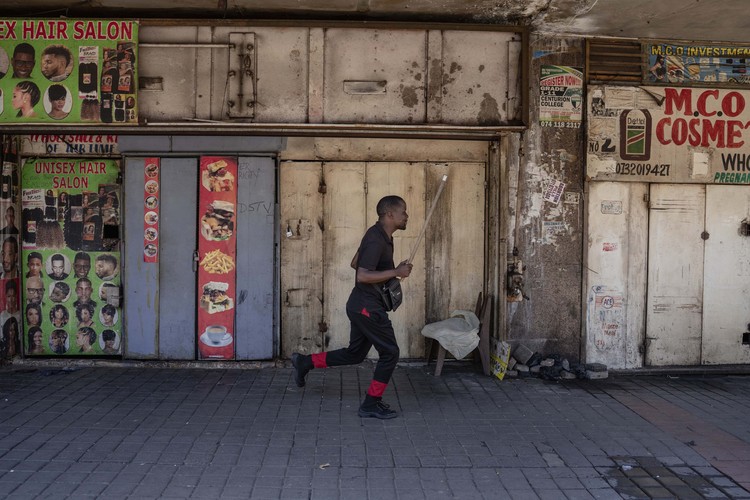
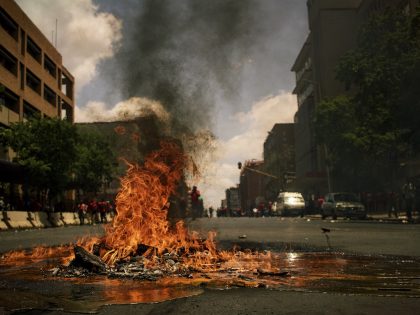
A protester runs past shuttered storefronts in Johannesburg during an anti-immigrant demonstration, April 2026. Source: Ihsaan Haffejee/GroundUp.
Xenophobia is not simply hatred of foreigners. It is a broader social and political orientation through which foreignness is made to appear dangerous, disordering, burdensome, or morally suspect. It can appear in overt forms: violence, slurs, intimidation, deportation campaigns, and openly hostile political speech. But it also operates through more respectable vocabularies: legality, crime, social cohesion, public resources, and economic competition. This is why it is often difficult to name: xenophobia rarely announces itself as the confession, “I irrationally dislike foreigners.” It more often presents itself as a defense of order, citizenship, fairness, law, and scarce national goods.
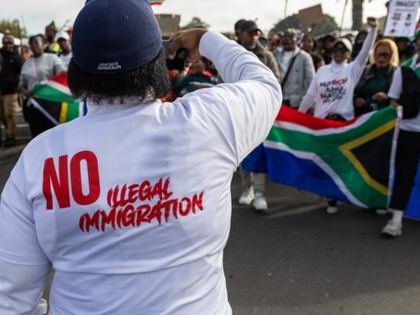
That difficulty is especially visible in South Africa in 2026, amid renewed reporting on anti-migrant protests, vigilante mobilization, and attacks on foreign nationals in major cities. These events sit within a longer national crisis of unemployment, poverty, crime, and the erosion and decay of public services and infrastructure. These are real conditions of distress. But xenophobia, as Julius Malema and Thabo Mbeki have recently maintained in different ways, works by giving real distress a false object. It translates failures of state, economy, and social provision into a moral indictment of foreign presence, betraying commitments to pan-African solidarity in the process.
South African scholarship on xenophobia has consistently pushed against the temptation to treat anti-foreign hostility as a sudden eruption of popular prejudice. Read together, the work of Francis Nyamnjoh, Michael Neocosmos, Loren Landau, Jean Pierre Misago, and others shows that xenophobia is produced where mobility, citizenship, state failure, and local struggles over authority converge. It emerges in a world that celebrates movement while policing poor African mobility; in a post-apartheid nation where citizenship remains tied to indigeneity (however illusory or contrived), entitlement, and the promise of redress; and in local spaces where exclusion can become a way of claiming order, resources, and political control. This literature also warns against easy explanation. Poverty, resentment, weak governance, and xenophobic beliefs matter, but not as isolated causes. They combine to make foreignness politically usable in moments of crisis. Xenophobia becomes a grammar through which belonging is ranked, mobility is disciplined, and removal is made to appear like repair.
One of xenophobia’s quieter moral mechanisms is the way foreign wrongdoing is made to carry more meaning than citizen wrongdoing. In anti-migrant crime rhetoric, the issue is often not only that a law has been broken, but that the foreigner’s presence is retrospectively cast as a mistake. The offense is made to confirm that they should not have been there in the first place. Citizens may offend and remain part of the national “we;” foreigners are more easily made to stand for danger, excess, ingratitude, or illegitimate presence. This is the hierarchy I describe as the unequal right to belong imperfectly. In South Africa, that burden falls unevenly, especially on poor African migrants, undocumented people, informal traders, and those marked as makwerekwere.
The central problem is not that citizens and non-citizens are treated differently in law. They are. States regulate entry, residence, documentation, voting, deportability, and access to certain benefits. A society can distinguish legally between citizens and non-citizens without being xenophobic. The problem begins when legal distinction becomes moral hierarchy: when non-citizenship is treated as a sign of lesser entitlement, lesser trustworthiness, or diminished legitimacy. Xenophobia enters when foreignness is made to mean more than legal status: when the outsider becomes not only legally distinct, but dangerous, burdensome, contaminating, or permanently suspect.
Crime rhetoric reveals this shift especially clearly. Crime by citizens is usually treated as an internal problem. It may be explained through individual failure, poverty, policing failures, unemployment, gendered violence, family breakdown, or inequality. These explanations differ, and some are better than others, but they remain within the horizon of national belonging. Citizen crime is crime among us. Even when citizens commit the very crimes commonly attributed to foreigners, they may be punished, condemned, imprisoned, or socially rejected. Still, their membership in the nation is rarely placed in question. Citizenship insulates belonging, not innocence.
By contrast, crime attributed to foreigners is frequently made to signify beyond the act. It becomes proof that the person should not have been here, and that foreigners, as such, bring disorder. The foreigner is not judged only as an individual actor. Their conduct is also made representative of a category: migrants, undocumented people, Nigerians, Africans from elsewhere, or anyone whose accent, name, language, neighborhood, or documentation status becomes a proxy for foreignness.
The broader literature on “crimmigration” helps name part of this process: the convergence of immigration control, criminalization, policing, punishment, and exclusion. But the South African case also invites a more specifically moral and hierarchical vocabulary. What is at stake is not only the criminalization of mobility, but the moral inflation of particular forms of foreignness: the same offense comes to mean more when attached to the racialized and classed figure of the African migrant, the undocumented worker, the informal trader, or the makwerekwere.
This is what I mean by citizenship as moral insulation. Citizenship does not prevent punishment; it protects the durability of belonging. Citizens can fail, offend, and transgress while remaining intelligible as part of the political community. They possess, in practice, the right to belong imperfectly. Foreigners are often denied that elasticity. Their presence is treated as probationary and revocable. Their wrongdoing becomes evidence that they never truly belonged. The result is a politics of precarious belonging: a way of organizing social space so that some people are always already questionable.
The harder objection does not deny the asymmetry I am describing but defends it from within a fortress of nationalist common sense. Citizens and foreigners, it says, do not stand in the same relation to the nation. The citizen’s belonging is presumed; the foreigner’s presence is conditional. Especially in the case of the undocumented migrant, wrongdoing is said to carry an additional burden: it breaches the law, but also the hospitality or tolerance under which presence was granted. From this perspective, the disproportionate weight attached to foreign crime is not a distortion. It is the point.
This objection matters because it pushes beyond the double standard exposed and makes moral inflation explicit: foreignness is being asked to do more than describe legal status. Legal status may affect legal consequences. But why should it alter the moral weight of the act? Once culpability is amplified by outsider status, judgment no longer tracks only the act. It begins to track anxieties about ownership, purity, threat, scarcity, and national space.
A second move is more subtle, and it often works like a motte and bailey. When challenged, anti-migrant rhetoric retreats to the narrower and more defensible claim that the issue is not foreigners in general, but undocumented migrants specifically. This narrower claim cannot be dismissed too quickly: states may reasonably distinguish between lawful and unlawful residence. But the wider rhetoric rarely stays there. It slides between undocumented migrant, illegal immigrant, foreigner, African migrant, and person who looks or sounds foreign. The narrow legal category becomes a generalized moral suspicion. What is defended as concern about documentation becomes, in practice, a way of making foreignness itself suspect.
The 2025 judgment in Kopanang Africa Against Xenophobia and Others v Operation Dudula and Others is important for precisely this reason. The court affirmed that private actors cannot appoint themselves as immigration authorities, demand documents, harass those they identify as foreign, or obstruct access to services. Its significance lies in the boundary it draws between lawful concern and vigilantism; between immigration governance and xenophobic punishment. Documentation matters, but illegality cannot become a license for intimidation, collective suspicion, or the denial of basic dignity.
The South African danger is that migrant crime rhetoric condenses several crises at once. Crime, unemployment, public healthcare strain, housing insecurity, policing failure, and the unfinished promises of post-apartheid citizenship are made to gather around the figure of the foreigner. The foreigner becomes the symbolic carrier of problems they did not create. Their removability becomes a fantasy of restored order: if they leave, jobs will return, clinics will function, crime will fall, and the nation will recover control. This is xenophobia as displaced politics of failed citizenship. It converts legitimate citizen frustration into a demand that the most precarious people bear the burden of social repair.
At stake, then, is what legal distinctions are made to do. When they organize rights and procedures, they belong to the ordinary machinery of law. When they inflate culpability, collectivize suspicion, and turn foreignness itself into evidence of danger, they become part of xenophobia’s moral grammar.
To resist that grammar is not to deny the pain of citizens. It is to refuse the conversion of that pain into a hierarchy of human worth. That is why the right to belong imperfectly should not be reserved for citizens alone. A just society may punish wrongdoing, regulate borders, and debate immigration policy. But it should not make foreignness itself morally unforgivable.