The footballing gods
Why are the religious practices of African footballers treated as strange when athletes around the world turn to faith and superstition to navigate the game’s uncertainty?
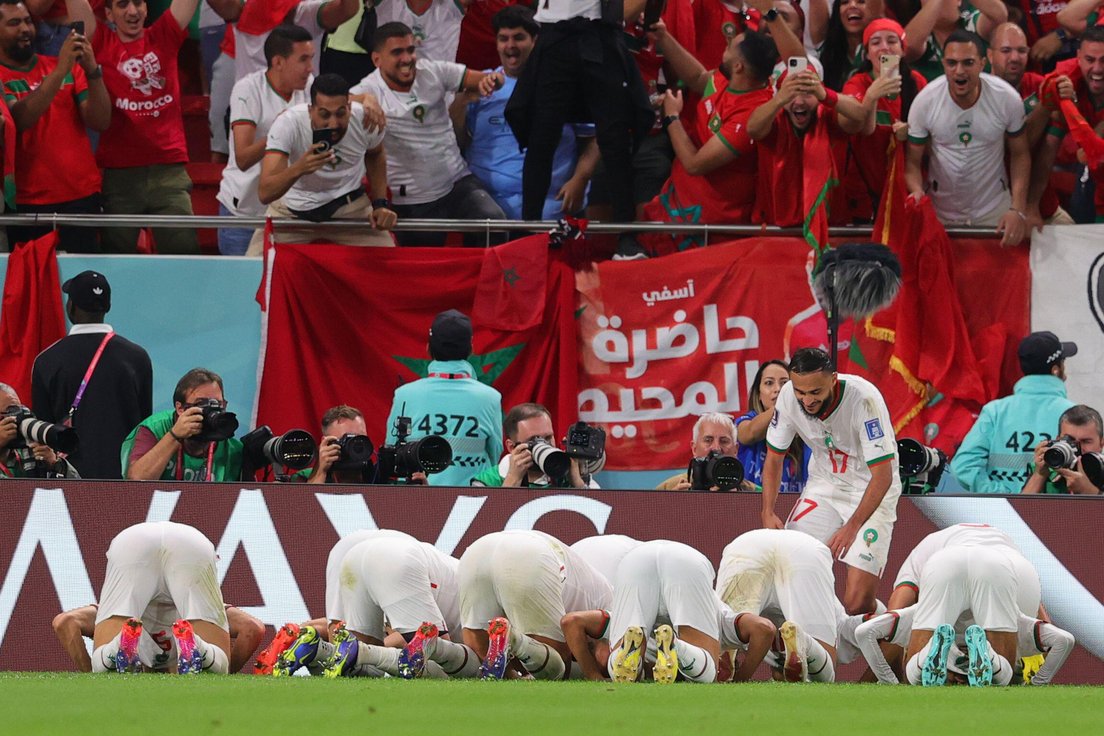
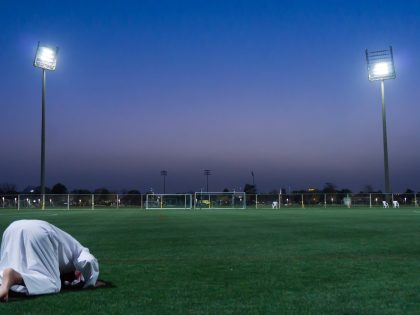
Moroccan players pray after scoring against Belgium at Al Thumama Stadium, Doha, Qatar on 27 November 2022. Source: Peter Dogvan via UK Sports Pics Ltd / Alamy.
For centuries, theologians have struggled to precisely understand the role of sports, including football, in God’s greater purposes. In a Christian perspective, the ancient Olympic Games were a celebration of pagan Gods. With athletes competing in the nude, serious-minded Christian Puritans saw no other option than to place sports completely outside of God’s realm.
In fact, it was not until the Industrial Revolution and the popularization of modern sports, including football, that Christians tapped into sports as a “potential classroom for morality and a platform for evangelism.” In recent years, scholars of religion have gradually turned their attention to sport, assessing contemporary sport for its quasi-religious aspects and as one of the most popular and significant dimensions of human experience in the 21st century.
In African contexts, ethnographic studies on religion and football have generally reflected the continent’s diverse and complex religious landscapes, with an overwhelmingly majority of research dealing with so-called African “magic”, “witchcraft,” or “sorcery.” This strand of literature is dominated by a psychocultural discourse, exploring the religious reasoning of football actors in their assessments of football matches, or put differently, analyzing the ways in which African footballers link the unpredictability of football with divine powers.
Importantly, however, taking football’s intrinsic uncertainties into one’s own hands through religious practices is on the rise all around the world, not just in Africa. Brazilian footballers are increasingly committing themselves to Neo-Pentecostalism, and in my own home country, typically regarded as a deeply secularized society, striker Kasper Høgh recently became one of the first national players to relate his recent accomplishments on the pitch to his Christian faith.
Football can be immensely arbitrary, and in an exercise that tests players’ fight for glory, pride, and place in the history books, the pressure can be overwhelming. Scholars have called players partaking in religious practices, not necessarily due to perceptions of a distant, otherworldly universe and their own role within it, but rather, because of very real-life circumstances in the here-and-now, religious pragmatism.
Religious pragmatism is growing in global football. Unfortunately, so is African exceptionalism.
As the 2026 FIFA Men’s World Cup begins, I can already sense the African exoticization and essentialization that will undoubtedly rear its ugly head as it does at every major tournament. The immense othering of African football, including its religious interpretations and engagements, is not new, but I am already dreading the same old routine.
Days before the tournament began on June 7, Kofi Iddie Adams, Ghana’s Minister of Sport and Education, went to mass at the Philadelphia Movement Church and “sought spiritual assistance” for the Black Stars ahead of the 2026 FIFA World Cup. Immediately after his appearance at the church, media outlets ridiculed his worship and incorrectly framed the visit as one that was exceptionally African in nature.
Bear in mind, here, the general tendency—which by far transcends the African continent—that religious practices in football have strong psychological and team-building qualities and thus serve a functional purpose in enhancing performances on the individual and collective level.
I have experience covering several Africa Cup of Nations tournaments in person, and the playbook is always identical. An African team, player, group of fans, or whatever will act in a certain way which will appear inherently dissimilar, perhaps even spectacular, to the outside, non-African observer who only encounters African realities every four years at the World Cup.
Subsequently, editorial desks in Europe will phone people like me on a radio program or podcast and give us a few seconds to summarize context-specific phenomena that are not even unique to African football.
Perhaps the clearest example of this occurred during the 2025 AFCON in Morocco, played last January. In the final, an incident with deep religious significance transpired between Morocco and Senegal.
I was present at Rabat’s futuristic Prince Moulay Abdellah Stadium that rainy Sunday evening when a ball boy, a Senegalese reserve goalkeeper, and a Moroccan security official dressed in a black suit fiercely fought for a wet towel belonging to Senegal’s first goalkeeper, Édouard Mendy.
In what has since been coined “Towel Gate,” the Moroccan ball boys eagerly prevented Mendy from drying his gloves, the presumed function of the towel. Meanwhile, Senegal’s second choice between the sticks, Yehvann Diouf, appeared and shielded the very same rag in an encounter that at one point saw Diouf tackled to the ground by the ball boys, who then dragged him around the wet pitch.
As expected, Towel Gate only exacerbated the ridiculing of Africa(n football) in the media I work for, and soon became a central talking point in my post-match coverage. The following morning, in the midst of an immense sleep deficiency from having watched the most pulsating game of football anyone could remember, I appeared on a handful of Danish radio and TV programs: “Why in the world did the Africans fight over a wet towel?” one radio host asked, not even hiding his condescending chuckle.
That condescension will soon fade. At the 2026 World Cup, one in five participating teams is African. And Africa, in recent years, has demonstrated that its football deserves to be taken ever more seriously.
I refer here not only to Morocco’s historic semi-final at the 2022 World Cup in Qatar, but also to the last few editions of the AFCON in which the level of football has improved drastically. In pre-World Cup friendlies these last few days, upsets by Cote D’Ivoire, who beat France in a friendly in Nantes, as well as Algeria, who won against the Netherlands in Rotterdam, showed promise for the African nations.
Eventually, Eurocentric media must ask itself: How do we engage with African football during the World Cup, and do we, really, insist on perceiving the continent’s religious systems as separate domains from how other footballers approach the uncertainties so fundamental to our sport?
Instead of the subject of ridicule, Towel Gate should be seen as the perfect case study into how African football has always been a space for cultural and religious contestation.
In Africa, the infusion of external religious beliefs has, in very general terms, turned the continent’s indigenous religious systems into largely negatively sanctioned practices. In some African states, legislation such as “Witchcraft Acts” has been upheld for more than a century, frequently promoted by political parties rooted in populist religious nationalism.
In African football, the tension between Christianity and Islam and indigenous religious systems has been observable for decades.
Players are seen performing Abrahamic faith rituals such as making the cross sign, pointing fingers towards the heavens, or collectively praying in huddles, while simultaneously participating in so-called juju (depending on geography, also known as muti, sihr, sorcery, magic, etc.) practices.
Generally perceived as a spiritual fight above the heads of the players, the Kenyan scholar Wycliffe Njororai has outlined 22 practices commonly associated with juju, including the spreading of coarse salt on the pitch, the washing of team jerseys by diviners and not equipment staff, and, interestingly, the goalkeeper hiding something inside or near his goalposts as witnessed on that infamous evening in Rabat.
More than anything, however, the religious practices that we’ll potentially witness in the United States, Canada, and Mexico in the coming weeks should not only be understood as syncretism but through the lens of neutralization.
Across Africa’s football arenas, religious neutralization is widespread.
On the Zambian Copperbelt, away teams reverse their team buses when arriving at stadiums locally known to possess special spiritual powers, while the anthropologist Arnold Pannenborg, in one of the most extensive studies on the topic, found that salt and urine are ideal anti-juju ingredients in Ghanaian football.
In other words, most football teams and players do not apply juju to attack their opponents, but to protect themselves in the face of what is interpreted to be the opponent’s use of this very practice.
The Moroccans would likely argue that they did not “believe”—whatever that word is supposed to mean—in any divine value of the said towel applied by Senegal’s goalkeeper in the final.
However, the North Africans implicitly acknowledged that the opponent potentially attributed the towel a spiritual meaning, and thus involved themselves in the type of parallel spiritual warfare that has characterized African football since its infancy.
During the World Cup, we are likely to witness an enormous amount of religious practices, all serving a rather similar purpose: that is, navigating the uncertainty of football. These practices may appear different, and they’ve indeed passed through very different histories and interpretations, yet they should all be regarded, as Peter Alegi holds it, as “domesticating luck”, or, in the words of Anne Leseth, “rationalizing the unpredictability of football.”
In anticipation of the 104 games awaiting us in North America, one humble, perhaps utopian, wish from this author would be to level the playing field. Let’s approach ourselves and others as nothing more than navigators of the uncertainty so fundamental to our sport.