A World Cup without the world?
The exclusion of Somali referee Omar Artan hardens the contradiction at the heart of the 2026 World Cup: a global tournament increasingly shaped by the politics of exclusion.
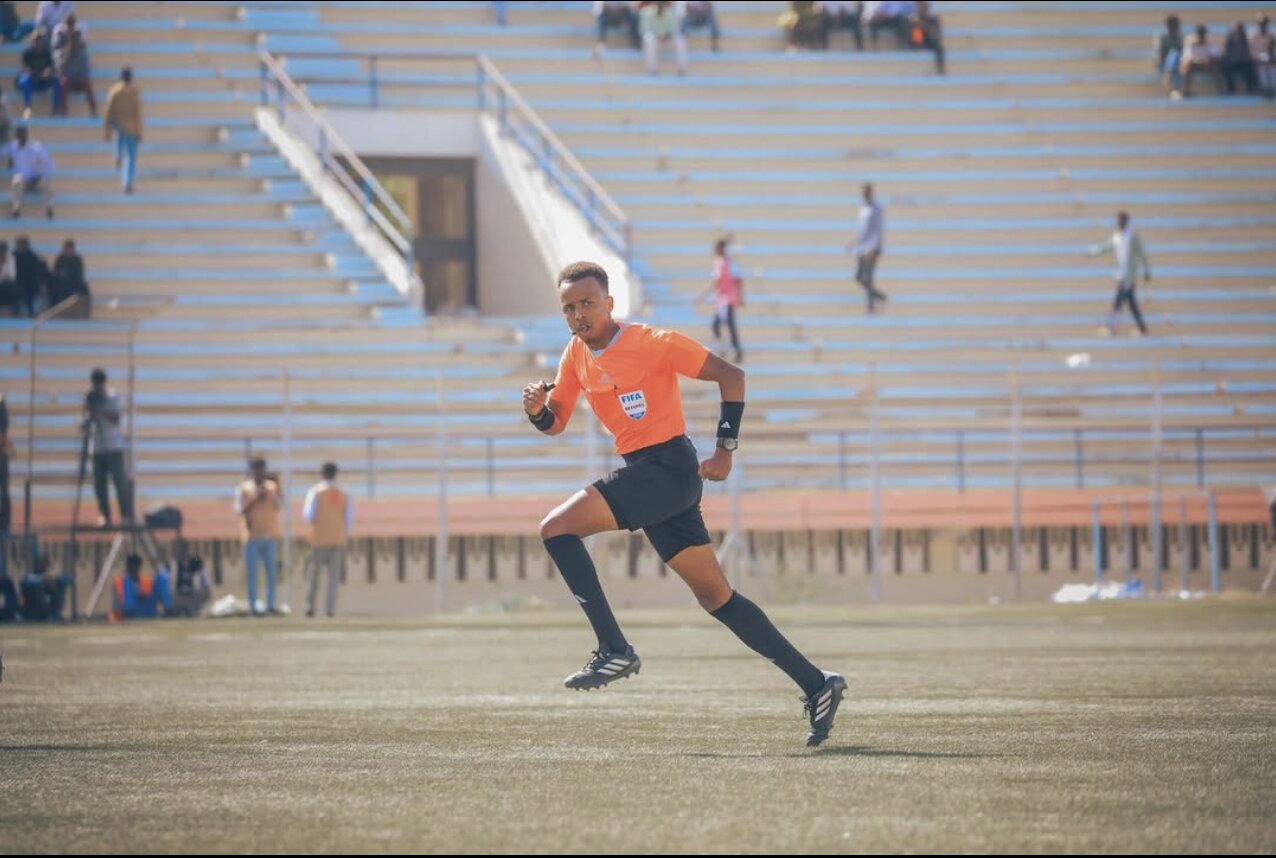
Source: Omar Artan via Instagram.
While the days leading up to the FIFA World Cup are usually marked by celebratory welcome ceremonies by host nations, the narrative consuming this year’s build-up has focused on the prohibitive entry conditions imposed by the Trump administration on various players, fans, and match officials.
It began a few weeks ago when Cameroonian-born Swiss striker and vice-captain Breel Embolo encountered last-minute issues with his Electronic System for Travel Authorisation (ESTA) application, forcing him to miss his team’s flight to America. Around the same time, Moroccan defender Zakaria El Ouahdi—voted the best African player in Belgium’s Jupiler League—faced the same problem and also missed his team’s departure.
The biggest scandal, however, emerged on Monday, June 7, when Omar Artan, one of seven African referees selected to officiate at the 2026 World Cup, was refused entry at Miami International Airport, en route to the city where the referees’ base camp was due to be established.
To be clear, Artan’s rejection had nothing to do with his competence. The 33-year-old is a rising star in African football. In 2024, he refereed his first Africa Cup of Nations tournament, in 2025, he was the only sub-Saharan African referee at the FIFA U20 World Cup, and just a few weeks ago, he was appointed to officiate Africa’s biggest club game: The 2025/2026 CAF Champions League final between visiting side Mamelodi Sundowns and home-side AS FAR.
In a raucous Prince Moulay Abdellah Stadium in Rabat, Artan showed why he’s quickly become one of the best. Despite the high stakes and the crippling pressure bestowed upon him, he demonstrated unflappable composure and game management skills, ensuring it was the players who decided the outcome of the match.
In addition to his competence, Artan also confirmed that all of his papers were in order. Speaking to The Athletic, he revealed that he was detained at the airport for eleven hours before being sent back to Istanbul.
“I had the right papers and everything. I had the right visa,” he said.
Throughout the 2026 FIFA World Cup bidding process, FIFA made explicitly clear that host nation visa procedures “must be applied in a non-discriminatory manner.” Yet, denying Artan entry was a plain act of national discrimination. Predictably, FIFA’s response to the Trump administration’s conduct has been toothless.
“FIFA is not involved in host country immigration processes, including visa adjudications, and has been informed by authorities that Mr Artan’s status will not be changed at present,” their statement read.
Indeed, the only justification that makes any sense for turning Artan’s away is a continuation of Donald Trump’s racist and vindictive campaign against the Somali community.
“I think that they have a problem with my country.” The Mogadishu native concluded.
Artan’s story is particularly sad, because it shows how a decade of hard work can be arbitrarily undone, and because his participation represented a rare opportunity for Somalis to feel genuinely present at the World Cup.
“Omar Artan is a gateway figure for a generation that needs to see itself in the sport,” says Abdirizak Ahmed, who runs the sports platform Somali Athlete.
Mohamed Salad, a Somali football journalist, recalls that, “His first match at AFCON was Namibia vs Tunisia in 2024. Thousands of us tuned in just to watch him. We were checking the refereeing schedules to see when his next game was—who does that?”
For smaller footballing nations, like Somalia, having an official at a major tournament is one of the few ways a country can genuinely feel part of the occasion. Seychellois football fans, for instance, took great pride in Eddy Maillet, who ranked among Africa’s finest referees for over a decade.
In Somalia, he has already become a figure of national pride. When he was named best referee at the 2025 CAF Awards, he received congratulations from both the country’s president and prime minister.
“When he was voted African Referee of the Year, it was one of the proudest moments in the history of Somali sport,” says Salad. “One of our own, born at home, working his way through the system honestly and proudly representing us. It was a beautiful moment.”
Due to a hateful political agenda, a real opportunity for Artan to shine on the international stage instead of the continental one has now been taken away from a young man who earned his place, and from a young nation that deserved to share in it.
“Somalis are a proud people. We don’t care what Trump or anyone else says. What is heartbreaking is that this agenda has cost a hardworking, honest young man his dream,” Salad finishes.
Artan is one of countless others from the Global South deprived of the opportunity to realize their dreams. For the billions cheering on from a distance, one question is becoming increasingly unavoidable: How long will FIFA let Trump’s United States of America spoil a celebration that is not theirs to spoil? How long will we let one man ruin the world’s game?