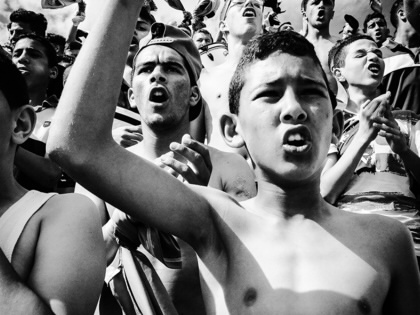
What is the World Cup for?
The World Cup was born from imperial rivalry and nationalist aspiration. Almost a century later, it still oscillates between mass hope and elite spectacle.
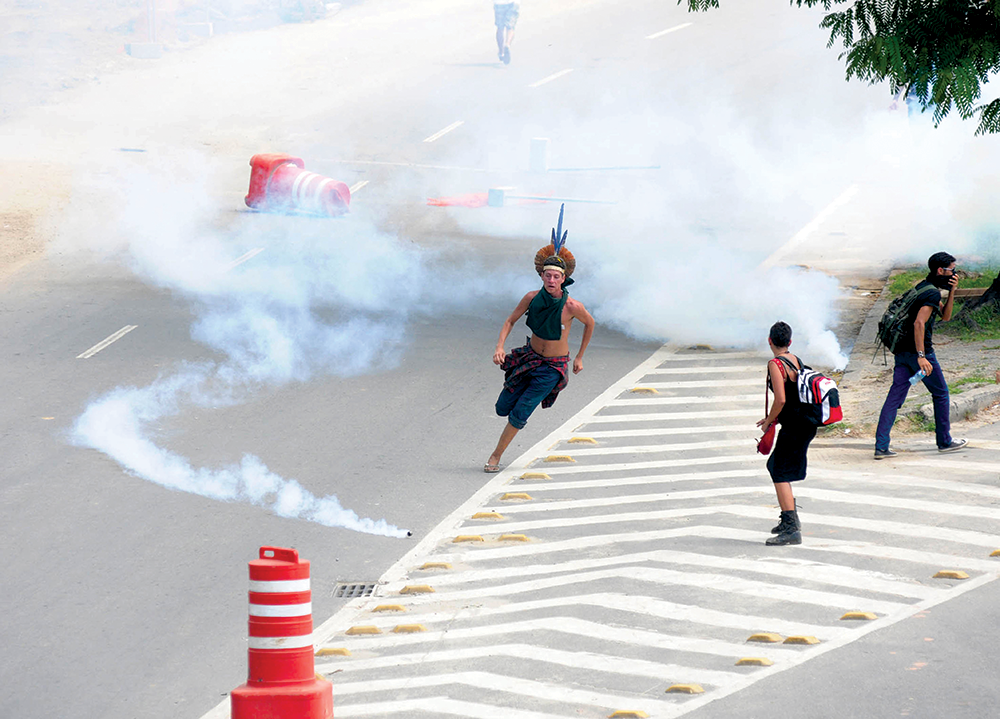
While demonstrating against the 2014 World Cup, protesters clash with police outside of Maracanã Stadium following the removal of indigenous Brazilians camped in Rio de Janeiro’s Museu do Índio. (Shutterstock)
In 2014, on the eve of hosting the World Cup, Brazil was on fire. For several years, under the stewardship of Luiz Inácio Lula da Silva and his Partido dos Trabalhadores (PT), the country had been the poster child of an early-century wave of new left leadership in South America. His administration was well-liked by the general population, with President Obama of the United States famously remarking that Lula was the most popular politician in the world. In the midst of a commodities-export boom and a social restructuring that saw the diversification of universities, extension of land rights to marginalized groups, and an expansion of the social welfare system, in 2007, the country was awarded the 2014 FIFA Men’s World Cup. It was the peak of the PT’s domestic and international goodwill.
However, after the 2008 financial crisis and the end of China’s commodity-buying spree, the Brazilian economy started to sour. Soon, the political mood went along with it. In August of 2012, protests against a proposed transportation-fee hike in Natal, called the Movimento Passe Livre or Free Fare Movement, spread to discontented citizens in other cities across the nation. International attention to the protests peaked at the 2013 Confederations Cup Final, where, while the world watched Brazil lift the trophy inside the famous Maracanã Stadium in Rio de Janeiro, police cracked down on protesters outside. In the early months of 2014, a political corruption scandal unraveled around a money laundering scheme called Operação Lava Jato (Operation Carwash). That scandal, centered on various state-owned companies and infrastructure projects, stretched across continents and would initiate a purge that swallowed many prominent businesspeople and politicians, eventually including Lula himself.
In the lead-up to the 2014 World Cup, the streets’ ire turned from bus fares to the corruption and misplaced priorities of the government, particularly around the country’s pending mega events (Rio would also host the Olympics in 2016). Square in the sights of protesters was the “padrão FIFA” or FIFA-demanded quality of white-elephant-stadium construction projects (many of which were wrapped up with Lava Jato), illegal housing removals and land rights violations, expensive and exclusive transportation projects, plus security measures that looked and felt more like violent repression than public safety. Calls for FIFA-quality schools and hospitals rang out on the streets across the country, and in football-crazy Brazil, the people shouted: “Não vai ter Copa!”—there won’t be a World Cup. If you were in Brazil at that time, you believed that their promise might just come to pass.
I was a resident of Rio de Janeiro by the time the Cup actually rolled around. On the day of the first match, the coastal city was overcast and shrouded in its usual June gloom. I hopped on a public bus with my partner and rode past all the “Fuck FIFA” graffiti scrawled on the concrete walls that climbed the city’s many hills, and headed to the officially sanctioned fan fest at Copacabana Beach. The city was quiet with the usually bustling streets eerily empty. As the bus approached the beach, you could see why. It seemed like the entire city had descended to watch the national team open the festivities.
We ended up in a spillover section, far from the official fan fest, but within sight of some flat-screen TVs temporarily erected onto posts. As the game started, there seemed to be a tension lingering in the winter air. Whether it was condensation left over from the devastation of the Maracanaço (the colloquial name for their defeat at the hands of Uruguay in the final of 1950, Brazil’s first time hosting the tournament), or from the unrealized promises of democracy brought into relief by economic contraction and foreign conciliation (“para Inglês ver” [for the English to see], being another useful phrase), I was unsure. However, as Brazil wrapped up a 3–1 win against Croatia, I could start to feel the tension evaporate, and a party mood seemed to suddenly possess everyone around me. The atmosphere took on the shape of a carnival bloco or street party, and must have been closer to how it felt at the beginning of the 1950 edition of the tournament, rather than the “FIFA go home” chorus of the previous months. The Cup had arrived, and the idea that it wouldn’t take place evaporated off into the clouds over the Atlantic.
While some anti-FIFA protests persisted in the early days of the Cup, the large street activations had mostly withered away. For the rest of the tournament, a majority of Brazilians seemed happy to support the national team (which was performing quite well), or at least enjoy the camaraderie with visitors from other nations (particularly other Latin Americans, save for Argentina). There were hints of the right-wing surge that would engulf Brazil in the coming years, especially inside the stadiums where the majority light-skinned attendees wore the bright yellow jerseys that by then had already become a symbol of right-wing nationalism. And, I remember while watching the home team’s match against Cameroon, one friend who, disillusioned from the sudden lack of resistance to FIFA during the tournament, chose to support the African team instead. But the party on the streets was real, and having watched the games across many of the country’s social divides, I found the experience was unifying in a way I had never felt before.
And here was the dilemma for even the most well-intentioned protestors laid bare. How were they going to keep the general public, and even themselves, away from the spectacle of a sport that had become so embedded in the mythology of the nation? From the early days of the republic, when tense rivalries grew between elite clubs in the modern and flashy urban centers of Rio and São Paulo, to becoming the only nation to lift the World Cup five times, Brazil had embedded football deep into its national psyche. Abroad, the country would forever be associated with a unique national style of play that was as poetic as it was effective: o jogo bonito, the beautiful game. It was a style that belonged to the people, nurtured in the patches of dirt at the edges of town, in the hundreds of rodas de altinha between friends at the beach, and in the concrete squares smashed between the self-built houses that climb the hills. It descended from African and indigenous American cultures of resistance to enslavement and colonization, or as the more Lusotropicalist-inclined would have it, the racial mixing of the plantation. It would etch names such as Pelé, Garrincha, Sócrates, Romário, and Ronaldo into the minds and hearts of people across the world, especially in the Global South, for all of history. Every triumph of the national team was a validation for whatever vision of Brazil was important to the beholder. It would have seemed impossible to shrink away from a chance to celebrate being hexacampeão, or six-time champions.
Eventually, the hubris of nationalism caught up with Brazil in the form of a 7–1 dismantling of the Seleção by Germany. It was the second great World Cup tragedy on home soil, the Mineiraço, which continues to serve as a colloquial metaphor for disaster today. Havía Copa, there was a Cup, but in the ensuing months, the discontent would return, the focus on mega events shifted back to corruption, and a general political turmoil, including the impeachment of Lula’s chosen successor Dilma Rousseff, would result in the election of aspiring right-wing dictator Jair Bolsonaro.
This contentious relationship with FIFA in one of the meccas of global football exemplifies a lot of the contradictions inherent to the World Cup. On the one hand, FIFA is a neoliberal institution, extracting profit from the masses and distributing benefits to elites. And many of its standards and operating procedures put the global and local structural inequalities we face on a day-to-day basis into stark relief. On the other hand, the international football it organizes is a galvanizing force, uniting divided nations and igniting the imagination of the masses, nudging them toward any number of visions for the possibility of the future. As inheritors of history, as recipients of stories from elders, as consumers of media, as receptacles for a past glory that we yearn to feel firsthand, we are not inoculated to such symbolism. Regardless of whatever nation represents us and the politics it embodies, we still seem to simultaneously want the beautiful game to manifest on the field through play, while also wanting it to work toward some greater meaning outside the pitch.
Reading David Goldblatt’s authoritative tome on the history of football, The Ball Is Round, it’s interesting to note that both FIFA and its World Cup emerged as a sort of pushback against imperial arrogance. The modern sport of football was codified at the height of the British Empire, and exported around the world through both hard colonial and soft cultural power. In much of the world, Britain equaled modernity, and the games the British played meant participation in the same power that brought new liberal ideas and technological advancement (alongside the extraction and genocide). So, when the modernizing world needed to organize itself in a vast number of fields of international cooperation, the world looked to the British to be the standard in football, as they were in timekeeping.
However, the paradoxical insularity of empire meant that the English Football Association (FA), a class of oblivious elites who sought to keep football as a politically neutral pastime, took little interest in the spread of the sport beyond the islands (not unlike the United “World Champions of What?” States of America and its attitude toward its major professional sports of today). The general attitude at the time can be summed up by the words of one League official:
I don’t care a brass farthing about the improvement of the game in France, Belgium, Austria or Germany . . . An organization where such football associations as those of Uruguay and Paraguay, Brazil and Egypt, Bohemia and Pan Russia, are co-equal with England, Scotland, Wales and Ireland seems to me to be a case of magnifying the midgets.
Enthusiasm for football still spread around the world, and the game started to take on local character traits reflective of the communities it was played in. And as resistance to British political and economic dominance grew, football became a field where nationalist fervor could incubate. So, in the decade ahead of the first World War, the founding of the Fédération Internationale de Football Association took place in Paris, and its first members were various nations of continental Europe, sitting across the water in direct opposition to British apathy and sporting hegemony.
In the lead-up to World War I, as old empires cracked and new ones fought to be born, every aspect of life in Europe became imbued with the symbols of the nation. As the contests between nations shifted from the playing field to the battlefield, football in Europe would go into hibernation. Isolation from the theater of war happening on the other side of the Atlantic would allow South Americans to continue to nurture their national sporting cultures, of which football was at the forefront, without interruption. Accordingly, at the post-war 1924 and 1928 Olympics, Uruguay would become back-to-back world champions in football at the only tournament available to figure such a designation out.
By then, the professional game had also blossomed, and FIFA decided that the contest to determine who was the best on the pitch needed its own forum beyond the realm of privileged amateurism that the Olympics afforded. So, in 1930, they founded the first truly populist international sports tournament, the World Cup. Naturally, the first World Cup took place not in the birthplace of the sport, but in the home of the reigning Olympic champions on the opposite side of the planet. Of course, the British still didn’t feel a need to debase themselves to the vagaries of international competition, they declined to attend.
In the wake of the Great Depression, Uruguay, a country with a population of less than 2 million, had a booming export-driven economy, a robust social democracy, and, along with neighboring Argentina, a vibrant footballing culture with its own flair and style. The hosting was performed as a nationalist gesture, a demand for legitimacy after being carved out from two larger neighbors in Brazil and Argentina 100 years prior. At a time when it was hard for many European nations to raise the money to send a team across the ocean, Uruguay was able to invest massively in stadium infrastructure, and their staging of the tournament would turn out to be a rousing success. In the end, the home squad would go on to lift the trophy, beating out their neighboring rivals Argentina 4–2, and a small country’s footballing triumph would make its way to the center of that nation’s soul as well. International football as we know it had arrived, midwifed into existence by Europe’s former colonies on the South American continent.
By the time the next edition of the World Cup rolled around in 1934, right-wing nationalism was at full tilt in Europe, and Fascist Italy took its turn at playing host. This was Mussolini’s chance to showcase his vision of the nation, and his hosting would imbue the tournament with all the mythmaking that his form of governance required. The stadium infrastructure and promotional materials merged the romances of the imperial past with the glory of the nation’s future. The media, the fans, and the regime all pointed to the team’s exploits on the field as proof of the superiority of their race. Il Duce even commissioned his own trophy that ended up being six times larger than the actual Jules Rimet trophy. Of course, Italy took home both.
As a platform to determine who is the best among a community of nations, as well as a showcase for the superiority of the host nation’s governance, the World Cup was always bound to get caught up in the pendulum swings between left and right populist nationalism. While there are examples of countries that took on a similar role as Uruguay, hosting the tournament as a way to proclaim an arrival to a modernity that was historically denied, like Mexico, South Africa, and Brazil. The parade of hosts that have been selected in recent years makes it seem like, after the 2014 protests in Brazil, FIFA has instituted an authoritarian sportswashing-only policy. After all, who better to host mega events than dictators with deep pockets?
And now, with full-throated nationalism back in vogue across the globe, we are facing a naive attempt to unite a politically splintered continent that features price gouging for tickets, walled fortresses for international visitors, and peace awards for hosts that bomb their guests (Mussolini, eat your heart out). This North American summer, which coincidentally is the 250th anniversary of the independence of the United States, will also surely feature plenty of problematic patriotism. Yet, despite all of the barriers to actually being at a game (teams included), the politics of the hosts, and complaints of football’s creeping Americanization, with the help of internet streaming and mobile phones, the 2026 edition of the FIFA Men’s World Cup will likely set viewing records. And amid calls for boycott, in a world where tech overloads harvest all of our behaviors as data fuel for a machine-learning empire, even controversy is good for the bottom line.
On the flipside, an increase in the number of teams has allowed more small nations and first-timers to participate, which in turn increases the potential for those unexpected upsets through which we channel our dreams of restorative justice (including a potential knockout round matchup between warring parties in the USA and Iran). This past March, I was up late at night watching the intercontinental playoff between Jamaica, ranked 71st by FIFA, and New Caledonia, ranked 151st. The game itself was slow, with New Caledonia parked in a low block for much of the contest and Jamaica happy to hold the ball with a 1–0 lead before the half. However, every time the small Pacific island nation would find itself in possession, the crowd in Guadalajara would chant, “Sí se puede!” And every time New Caledonia would put together a chance on a fast break, you could see hands go up in the stands and hear screams of delight. Football still has the power to inspire, and surely even at this World Cup, behind every flair of a dribble and flash of a kick, the triumphs of an underdog or the affirmations of the powerful will be lurking and waiting to take the stage of history. Just as Brazilians found in 2014, it will be hard for even the biggest skeptics to look away.
The dissonance between impromptu rehearsals of mass uprising and the controlled commercialized space they play out in, are what make contemporary football frustrating for so many. And if one were to compare the opinion editorials to the official press releases, the article comment sections to the pomp of the ceremonies, or the social media memes to the self-congratulatory smiles, it does seem like the FIFA brand is only surviving off the fumes of the goodwill it had built up from the myths and legends it allowed to flourish in the past.
So, I suppose then, the question for all of us with an eye on the future is: How necessary is FIFA anyway?
Of course, this question could be put forward about any institution that is a community of nations, as well as the concept of even marking ourselves as members of nations at all. Our current impasse over the warming planet is certainly indicative of the failures of both. (This year’s tournament will be happening on a continent whose summers are experiencing hotter days, bigger fires, and more destructive storms.) Before FIFA existed, outside of the Olympics (which has its own issues of corruption, extraction, and political naivety), international matches were staged directly between national associations. Communication and arrangements were completely dependent on the existence of direct diplomatic relations, the ability to host games, and fund travel between the two parties. As the example of England and early organized football shows, this arrangement primarily benefits the wealthy and well-connected. Continental-based organizations have emerged to counter some of this elitism, but they, too, have shown streaks of corruption, ineptitude, or compliance with FIFA’s whims. They certainly haven’t shown the ability to recalibrate the power imbalances between continents that have been inherited from the past.
So then, is it possible that the benefits of FIFA outweigh the drawbacks? What would alternative forms of international governance look like, football and otherwise?
Even as we decry the failures of the World Cup, we still must recognize that at least some redistributive good comes out of this iteration of FIFA. During the same international break that saw Jamaica and New Caledonia face off, FIFA facilitated a series of matches between non–World Cup participants in the FIFA Series tournament, a reorganization and rebranding of the international-friendly system. The whole tournament was free to watch online, allowing observers to witness invigorating stories of triumph by underrecognized nations like Aruba, Sierra Leone, and the Solomon Islands (who lost 10–2 to Bulgaria, but celebrated those two goals like they had conquered the planet), and enjoy the talents of players who wouldn’t otherwise get attention on a global stage. Perhaps this is what FIFA President Gianni Infantino is thinking about when he claims (albeit hyperbolically) that “without FIFA there would be no football in 150 countries.” And in fact, as The Athletic recently investigated, 90% of the $11 billion in revenue generated at the Men’s World Cup will apparently be invested into those most marginalized by the hypercommercialized men’s game. While FIFA’s premier event caters more and more to global elite society, poorer nations are poised to receive funds for investment in training, playing grounds, and travel, along with investment into programs for women and girls, youth, and differently-abled players. What new types of governance could mobilize resources similarly to target the well-being of the world’s most marginalized?
Whether or not the games go on this summer without any hitches (every headline about a US–Israeli bomb leaves a lingering doubt in my mind), one thing remains true. What will be sorted out inside the playing field will continue to symbolically reflect what happens outside of it. Because of this symbolism, the sport remains captivating.
As for Brazil, some say that this year’s Seleção is one of the worst in the nation’s storied history. Others recognize the immense talent of individual players and think that they could magically gel at the right time. Either way, one gets the feeling that inside Brazil, expectations are lower. However, rather than due to a sudden lack of talent in the country (there isn’t), or even due to poor performance in qualifying, perhaps expectations are lower because the stakes are lower for the country in general. After all, following some fairly tumultuous years, Lula is president once again, and Jair Bolsonaro sits in jail for attempting a coup d’état. Brazil is, at least for now, a beacon of democracy in the Western hemisphere, a hope for a brighter future that each day seems to be dimming more and more in the North (check out the press run and public reception to Brazil’s international award-winning anti-dictatorship films from the last couple of years for a taste of the mood). What’s really left to prove?
In October, Brazil will see presidential elections once again. That contest will see Lula face off against Bolsonaro’s son Flávio, who promises to free his father from prison and will certainly aim to undermine the country’s young democracy if the family gets a second turn at power. Whoever wins, I will be thinking of those who have protested and worked tirelessly for a more democratic Brazil over the last few decades. For clues to their reaction, we can look across the globe to another historical footballing powerhouse for inspiration. In the post-election evening revelry of Budapest, after authoritarian Viktor Orbán conceded the presidency to his opponent, one prominent Hungarian social media account exclaimed: “It feels like we won the World Cup!” Regardless of what happens in July, come October, many Brazilians will be drawing similar analogies.