Boss Player

The Newscaster Komla Dumor loved sports, basketball (he had skills), and, above all, the beautiful game. He especially loved his Ghana's Black Stars.
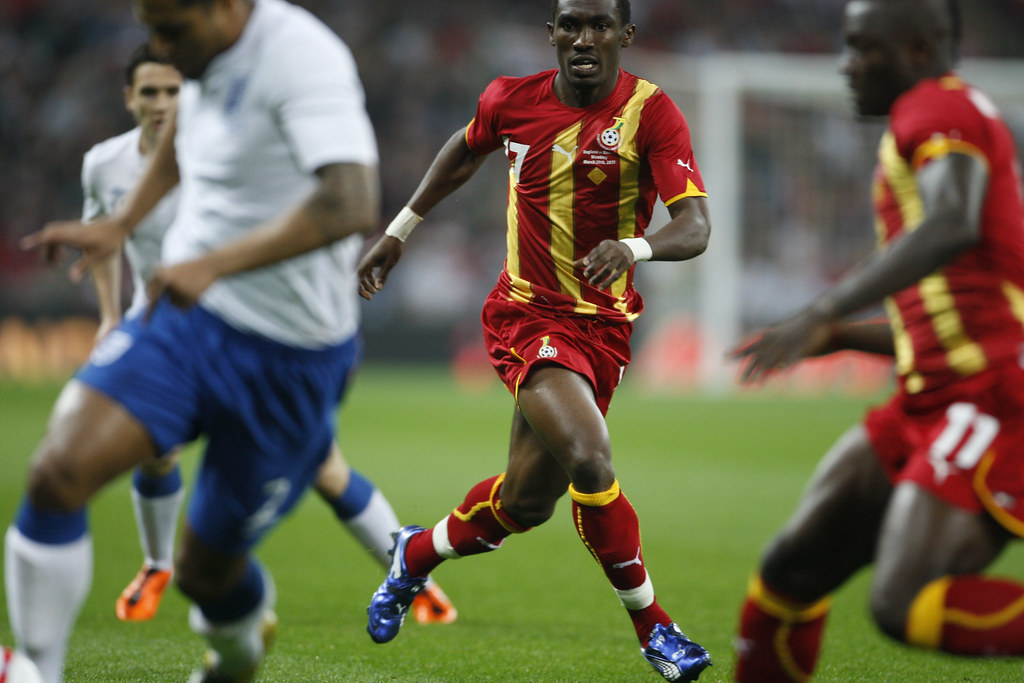
Ghana v England in a friendly match at Wembley Stadium in London, 2011. Image credit Akira Suemori for FIA Foundation via Flickr (CC).

The BBC news presenter Komla Dumor, who passed away this weekend from cardiac arrest, was an exceptional broadcaster; read Nigerian writer Chimamanda Adichie’s obit here. Everyone loved him. He was probably the most stylish newscaster, and he was well on his way to becoming the first globally recognized superstar news presenter originating from the continent. Dumor took journalism seriously. Just watch his last big interview where he took on Rwanda’s Ambassador to the UK about that country’s habit of murdering opposition figures.

Dumor, known as the Boss Player, also loved sports, especially basketball (he had skills), and, above all, the beautiful game. He especially loved his Ghana Black Stars.

For example, during the 2010 World Cup in South Africa, he ripped his shirt open in Superman style to reveal his true identity.

Or last November, when he celebrated Ghana’s qualification for Brazil 2014 by donning a lekarapa. And he seemed genuinely happy—like a fan—around footballers, like when he met Victor Moses (Liverpool and Nigeria) or thanked Sulley Muntari (AC Milan and Ghana) for gifting a signed shirt for his (Komla’s) son.

But it’s this videoin which Peter Okwoche, the BBC Focus on Africa sports presenter, challenges Komla to a game of keepie-uppie—that’s my favorite memory of the Boss Player.


Further Reading

Progress is exhausting

Pedro Pinho’s latest film follows a Portuguese engineer in Guinea-Bissau, exposing how empire survives through bureaucracy, intimacy, and the language of “development.”

The rubble of empire

Built by Italian Fascists in 1928, Mogadishu Cathedral was meant to symbolize “peaceful conquest.” Today its ruins force Somalis to confront the uneasy afterlife of colonial power and religious authority.

Atayese

Honored in Yorubaland as “one who repairs the world,” Jesse Jackson’s life bridged civil rights, pan-Africanism, empire, and contradiction—leaving behind a legacy as expansive as it was imperfect.

Bread or Messi?

Angola’s golden jubilee culminated in a multimillion-dollar match against Argentina. The price tag—and the secrecy around it—divided a nation already grappling with inequality.

Visiting Ngara

A redevelopment project in Nairobi’s Ngara district promises revival—but raises deeper questions about capital, memory, and who has the right to shape the city.

Gen Z’s electoral dilemma

Long dismissed as apathetic, Kenya’s youth forced a rupture in 2024. As the 2027 election approaches, their challenge is turning digital rebellion and street protest into political power.

A world reimagined in Black

By placing Kwame Nkrumah at the center of a global Black political network, Howard W. French reveals how the promise of pan-African emancipation was narrowed—and what its failure still costs Africa and the diaspora.

Securing Nigeria

Nigeria’s insecurity cannot be solved by foreign airstrikes or a failing state, but by rebuilding democratic, community-rooted systems of collective self-defense.