The average person in Uganda
Ugandans are confronted by a cultural and political paradigm which pushes a preference for Western lives and lifestyles from multiple angles.
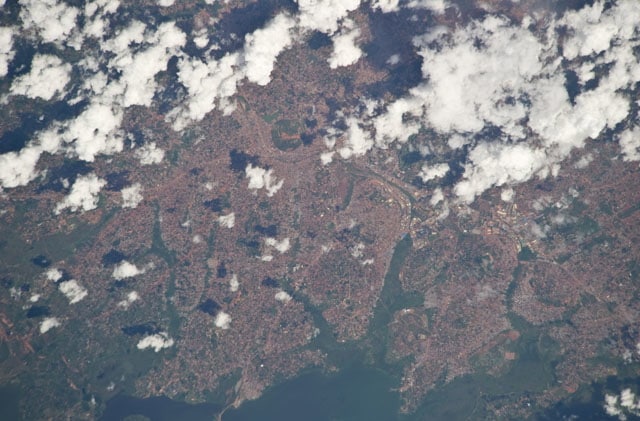
Kampala, Uganda viewed from space. Credit: NASA
I used to find some consolation in the fact that the average person in Kampala knows much more about North America than I knew about east Africa for most of my life.
“Which part of Canada are you from? The Prairies? Or from out east, near Toronto?” is a regular question. “Can you really go to the doctor for free in Canada?” my neighbor’s 7-year old daughter asked me yesterday. And Sam, a local boda driver’s self-appointed mission is to educate me on the gamut of Canadian music after deeming my knowledge on the topic to be painfully insufficient. (To date, our playlist on the drive to work has ranged from Joni Mitchell to Broken Social Scene.)
These kinds of interactions led me to initially believe that contrary to prevailing ideas about “the state of education in Africa,” Uganda’s education system and media were far superior to those back home, which regularly feature such riveting and politically important issues as local owl sightings.
But when you delve into why the Canadian Prairies receive as much attention as the Sahel in geography class here, a number of troubling explanations emerge. The first is an out-dated school curriculum shaped by the legacies of colonialism and its buddy, Eurocentrism (encompassing North America).
Although some efforts have been made to “decolonize” the primary school syllabus, the secondary school curriculum has stagnated for decades. As the head of secondary education at the National Curriculum Development Centre rightfully states, “we still talk of the prairies of Canada. This is outdated. We need to localize.” A reform process has been underway since 2012 to make the curriculum more relevant, but it is unlikely to be implemented until at least 2016.
Added to this is the formal classroom-based education system itself being a colonial inheritance, which many critics argue was and still is unsuited to local cultures, values, and livelihoods. For example, while agriculture still employs the majority of the population, it is only an optional course in most secondary schools, and remains highly theoretical. The proof? The highest grades in agriculture are achieved in schools which have no teaching gardens.
In Uganda, where 78% of the population is under the age of 30, an educational system which equips graduates with employable skills is vital requirement – but is far from the current reality. Eunice, a geography teacher in one of Kampala’s public secondary schools, explains: “what we teach in schools – and how we teach it – does not give students concrete skills or knowledge which they can use in jobs. And companies know this, so they do not hire young people, preferring those with actual work experience.” This is certainly one reason why the current youth unemployment rate stands at a whopping 64%.
The lack of employment opportunities is closely tied to the second explanation for the average person in Kampala being well-versed about “the West”: the desire to emigrate there, driven by a vision of the West as a “fantastic cosmopolis” of economic opportunity and freedom. This is of course fed by large-scale imports into east Africa of Western culture and ideas, ranging from American television and pop culture to economic aid.
The current obsession with the West stands in stark contrast to the days following independence in the 1960s, when Uganda was considered not only to have a better education system than its neighbors, but was also a hub for the pan-Africanism and African intellectualism movements. But dictatorship, first by Amin and then Museveni, crushed critical intellectual voices at the same time as opening the door to neo-colonialism by the West: after all, it was institutions such as the World Bank and the IMF who were keen to see their visions of “an educated Africa” realized were the ones who provided the resources to build the current educational system. And although President Museveni might not have agreed with this vision, he certainly was not going to object and ruin his long-standing mutual love affair with Western donors.
As a result, Ugandans today are confronted by a cultural and political paradigm which pushes a preference for Western lives and lifestyles from multiple angles. Of course, this comes at the unmeasured cost of all of the history, art, debate and news from Uganda – and Africa more widely – which remain un-recorded, un-published, un-taught, un-learned, and un-discussed.