
Bookends: Chinelo Okparanta
The Nigerian-American author of the novel “Harry Sylvester Bird” talks to the Radical Books Collective ahead of her appearance at their book club.
6432 Article(s) by:
Sheila Adufutse is a feminist activist and trained as a project manager.
The Nigerian-American author of the novel “Harry Sylvester Bird” talks to the Radical Books Collective ahead of her appearance at their book club.

Western conservation NGOs condemn violence against Maasai, but also don’t want herders or subsistence hunters on land they want to control and profit from.

While Chileans have defeated the post-authoritarian neoliberal regime, they face major obstacles on the road to a post-neoliberal social democracy.

We know an enormous amount about what precipitated the 2012 Marikana massacre, but relatively little about what is behind the violence there since.

Xiomara Castro’s leftist government must create capacity for self-determination in a state vulnerable to US pressure and constructed to serve monopoly capital.

The British-Somali poet Warsan Shire’s audacious yet uneven volume of poetry captures the quiet loneliness of African immigrant lives in the West.
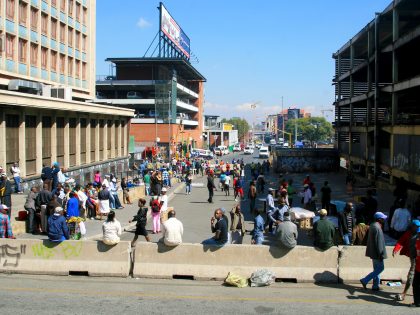
The Marikana Massacre changed democratic South Africa forever. It can also catalyze resistance to the current order.

The left’s win in Colombia signals that after more than six decades of war, people just want to live with dignity and in peace.

South Africa’s ruling party’s devotion to its policy of cadre deployment is an indication that it values its own power more than the public interest.

The novelist on 3 books he returns to: by Wole Soyinka, Ibn Khaldun, and a third on the history and the system of writing of an early 20th-century Cameroonian king.

Journalism has become a risky and dangerous business in Benin.

Africa’s engagement with the world before European colonialism holds unexpected episodes of un-colonial power relations.

Why languages, particularly black African languages, have become a battleground in postapartheid power and identity politics in South Africa.

Before the Soweto Uprising in 1976, students and workers organized one of the largest strike actions in South Africa’s history.

What happens to the contemporary explosion of moral panics, urban legends, and other paranoid narratives when they manifest in a place like South Africa?

This month on Africa Is a Country Radio, we continue our theme of sports and music, and look at the history of Olympic success in athletics of various African countries.

The CFA franc, pegged to a strong Euro, penalizes African economies as well as regional trade and facilitates the development of Western multinationals.

Must indigenous knowledge be science to be valid? Philosopher Paulin J. Hountondji shows that we must ask why Africa is scientifically and technologically dependent in the first place.

The ANC and Nelson Mandela’s turn to violent anticolonial struggle in the early 1960s, is the subject of a new book by historian of South Africa, Paul Landau.

From Operation Fiela to Operation Dudula, xenophobia in South Africa is bent on protecting the interests of politicians.