Somalia’s uncertain hand-off
As the UN and the US pull back from Somalia’s security architecture within months of each other, Mogadishu insists it is ready. The gap between that confidence and the country’s political reality tells a different story.
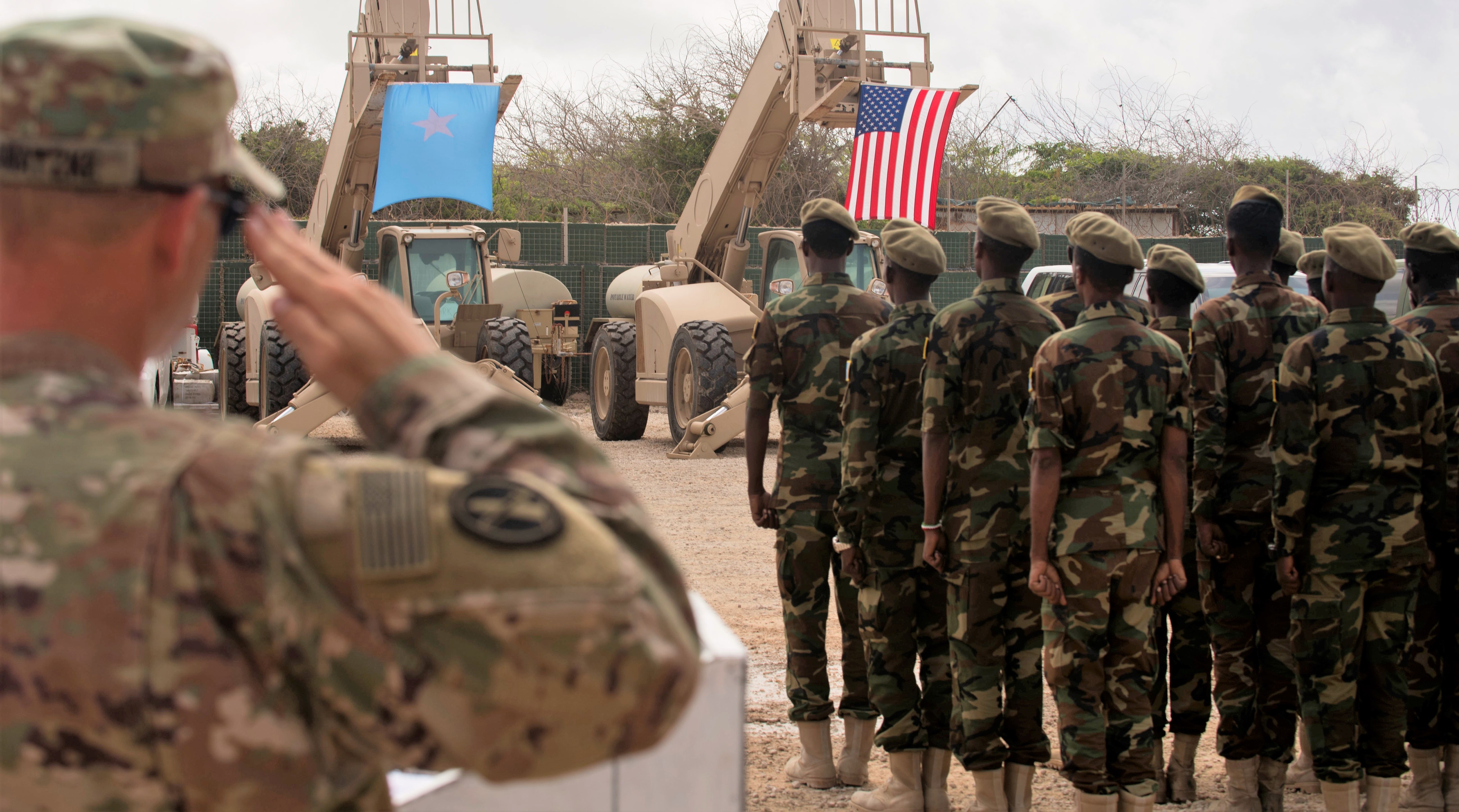
A U.S. service member and Somali soldiers participate in a flag ceremony during a joint military engagement in Somalia. Source: MC2 (SW/AW) Evan Parker / Defense Media Activity Europe Africa / U.S. Africa Command.
This week, the Federal Government of Somalia held a domestic security conference in Mogadishu, attended by senior government officials and representatives of the international community. The conference came at a particularly critical time, as Somalia faces a growing dilemma on multiple fronts—the gradual drawdown of the AU mission in the country, the expected closure of international support structures, and an increasing political deadlock between the federal government and some federal member states.
These issues have been compounded by another concern that has grown over the past several months—the continuing threat posed by al-Shabaab and questions over whether the Somali National Army has the capacity to fill the security vacuum that could emerge as African troops are reduced. However, the federal government is projecting far greater confidence in Somalia’s ability to manage the transition than many of its international partners anticipated.
Speaking at the conference, National Security Adviser to President Hassan Sheikh Mohamud, Aweys Haji Yusuf, who is also regarded as an influential presidential ally, said the withdrawal of international missions from Somalia was “the result of a long-term process” rather than a sudden decision. He noted that discussions and “assessments of Somalia’s ability to take greater control” of its own affairs had been underway for more than four years. According to Aweys, the government sought to determine when Somalia would be able to reduce its dependence on the UN, with assessments concluding that Somali institutions were increasingly capable of managing political and governance responsibilities that had previously received substantial UN support.
Somalia’s Minister of Religious Affairs and Endowments, Mukhtar Robow, who previously served as a senior figure in the militant group al-Shabaab before defecting, also addressed the gathering. Robow said Somalia’s security environment had “changed significantly,” adding that the country was now in a stronger position than it was in previous years.
The comments come amid increasingly assertive statements from President Hassan Sheikh’s administration that Somalia is preparing to assume greater responsibility for its own security and governance. Speaking at the Hananbure military training centre in Galgaduud during the graduation of thousands of new Somali National Army recruits, President Hassan Sheikh said international partners had played an important role in supporting Somalia’s fight against a prolonged insurgency, but stressed that reliance on foreign forces could not continue indefinitely.
Somalia is entering one of the most consequential reductions in international support since outside powers began rebuilding the country’s security and political institutions more than two decades ago. Two processes are now unfolding simultaneously. The United Nations Transitional Assistance Mission in Somalia (UNTMIS), the political mission that succeeded UNSOM, is due to cease operations on October 31, 2026, completing a two-year transition requested by the Somali government in the name of greater national ownership. Its responsibilities—including support for constitutional reform, elections, human rights, the rule of law, security-sector development, and the coordination of international assistance—are being transferred to Somali institutions, the UN Country Team, and other partners.
Separate from that process, however, is an increasingly acute crisis surrounding the nearly 12,000 African troops deployed under the African Union Support and Stabilization Mission in Somalia (AUSSOM). Those forces depend heavily on the UN Support Office in Somalia (UNSOS) for much of the infrastructure that allows them to operate, including food, water, fuel, aviation, medical evacuation, communications, equipment support, and troop transportation. The convergence of the UN political mission’s closure with growing uncertainty over the future of this logistical system means Somalia could lose layers of international political and security support within months of each other, even as al-Shabaab retains a substantial presence across southern and central parts of the country.
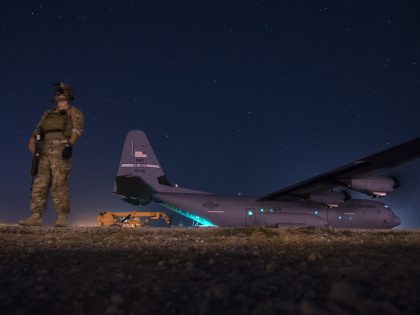
The most serious shock has come from Washington. On July 1, Reuters reported, citing a US diplomatic note, that the Trump administration had informed the AU that it would no longer support UNSOS beyond the end of 2026 and would oppose a Security Council mandate continuing UN logistical or operational backing for AUSSOM. UNSOS has an annual budget of roughly $500 million, and diplomats told Reuters that the African mission would be extremely difficult to sustain unless another mechanism replaced it. Washington said it had already provided nearly $2 billion in assessed contributions to UNSOS and its predecessor, and argued that Somalia had failed to assume sufficient responsibility for its security despite years of international assistance.
The decision also followed Washington’s earlier opposition to applying the UN Resolution 2719 financing framework to AUSSOM, which could have placed as much as 75% of eligible mission costs on predictable UN assessed contributions. The shift should not, however, be interpreted as a complete American retreat from counter-terrorism in Somalia. US Africa Command has continued an intensive campaign of air strikes in the country. Rather, Washington appears increasingly prepared to conduct narrowly defined counter-terrorism operations while withdrawing from the expensive multilateral architecture that sustains African peacekeepers and supports Somalia’s longer-term security transition. In a recent interview with local media, AFRICOM commander General Dagvin Anderson expressed frustration over the limited progress made so far.
That decision has triggered a scramble among African troop-contributing countries and the AU to determine whether the mission can be sustained through greater African financing, but the figures illustrate the limits of that approach. Uganda convened Burundi, Djibouti, Ethiopia, Egypt, Kenya, Somalia, and other partners for an extraordinary AUSSOM summit in Kampala, as questions mounted over the mission’s future. Uganda’s military leadership said UNSOS support had already been reduced by about 25% and warned that troop contributors would have to find political and financial alternatives.
The AU has increasingly urged member states to expand contributions to its Peace Fund, implement the long-planned 0.2% levy on eligible imports, and rely more heavily on domestic African resources. However, the scale of the problem was already evident in 2025. AUSSOM required about $196 million for the year, but by late September only $24.6 million had been pledged, including $20 million from the AU, while troop-contributing countries had kept personnel deployed for around 15 months without allowances, effectively subsidizing the mission themselves.
Europe, traditionally the financial backbone of successive AU missions in Somalia, has also become increasingly reluctant to carry the burden indefinitely. The European Union and its member states have provided almost €2.8 billion to AU-led missions in Somalia over roughly two decades, but European governments have been pressing for a gradual reduction in the international security footprint as costs have mounted and questions have persisted over when Somali forces will be capable of replacing foreign troops.
In April 2026, after roughly two years of negotiations over renewed financing, the EU finally approved €75 million for AUSSOM, making Europe the mission’s largest direct financial supporter and providing badly needed money for troop reimbursements and associated support. The contribution is substantial, but it does not resolve the underlying financing problem. The EU grant is far smaller than the broader logistical system operated by UNSOS, and European governments have shown little appetite for simply replacing Washington as the mission’s principal financier. The result has been a continuing search for burden-sharing involving the AU, EU, Britain, and other donors, but without the predictable multi-year financing arrangement African governments have sought.
The strain on AUSSOM is part of a much wider international retrenchment from Somalia. The dismantling of USAID and US foreign-aid cuts have hit programs supporting health, education, economic development, and government capacity. Funding available to aid organizations fell from about $2.2 billion in 2022 to roughly $300 million in 2026, while funding for the acute-malnutrition response fell by more than 80 percent and hundreds of health and nutrition facilities closed or faced closure. At the same time, the dedicated UN political mission that advised Somalia on federalism, elections, justice, security-sector reform, and institution-building is disappearing, leaving more of those responsibilities to a smaller UN country presence and Somali institutions themselves.
The emerging international model is consequently much leaner. Targeted military action against immediate terrorist threats may continue, as the continuing US air campaign demonstrates, but the expensive architecture of peacekeeping, stabilization, humanitarian assistance, and long-term state-building is contracting. For Mogadishu, this has created a mismatch—international partners are increasingly demanding Somali ownership and self-reliance at precisely the moment when the external financing, logistics, and institutional support that helped the state reach its current level of capacity are being scaled back.
The recent and increasingly assertive remarks from federal government officials are intended to demonstrate that Somali authorities are prepared to assume greater responsibility for both the country’s security and political affairs as international involvement declines. The message from Mogadishu is one of growing confidence. Yet the situation on the ground remains far less certain. Somalia continues to face a contested political environment, the absence of a broadly agreed and inclusive electoral framework, and a constitutional crisis that together have complicated efforts to build consensus around the country’s political transition. These disputes do not necessarily negate the federal government’s claim that Somali institutions have become more capable, but they underline the gap between assuming responsibility and achieving the political cohesion required to exercise it effectively.
The security picture is similarly mixed. The government has made important gains in strengthening security in Mogadishu and has expanded and trained elements of the Somali National Army, but al-Shabaab continues to pose a serious threat across large parts of southern and central Somalia and retains the ability to conduct attacks, pressure local communities, and exploit weaknesses in state control. We are also seeing increasing reports of a complicated and murky relationship between al-Shabaab and the Houthis in Yemen as the war on Iran intensifies. At the same time, piracy has re-emerged, despite the presence of multinational maritime forces in Somali waters. Against that background, the federal government’s growing confidence indicates a political signal, particularly as international partners scale back their presence, but it has yet to produce sufficiently tangible progress to resolve the wider doubts surrounding Somalia’s transition.
The central question is therefore whether Somali political and security institutions can consolidate and maintain security stability and build a sufficiently inclusive political settlement as the external structures that have supported the country for more than two decades continue to recede.