On the Somalia Pavilion
As Somalia makes its first appearance at the Venice Biennale, some Somali artists are questioning who gets to represent the nation — and on whose terms.
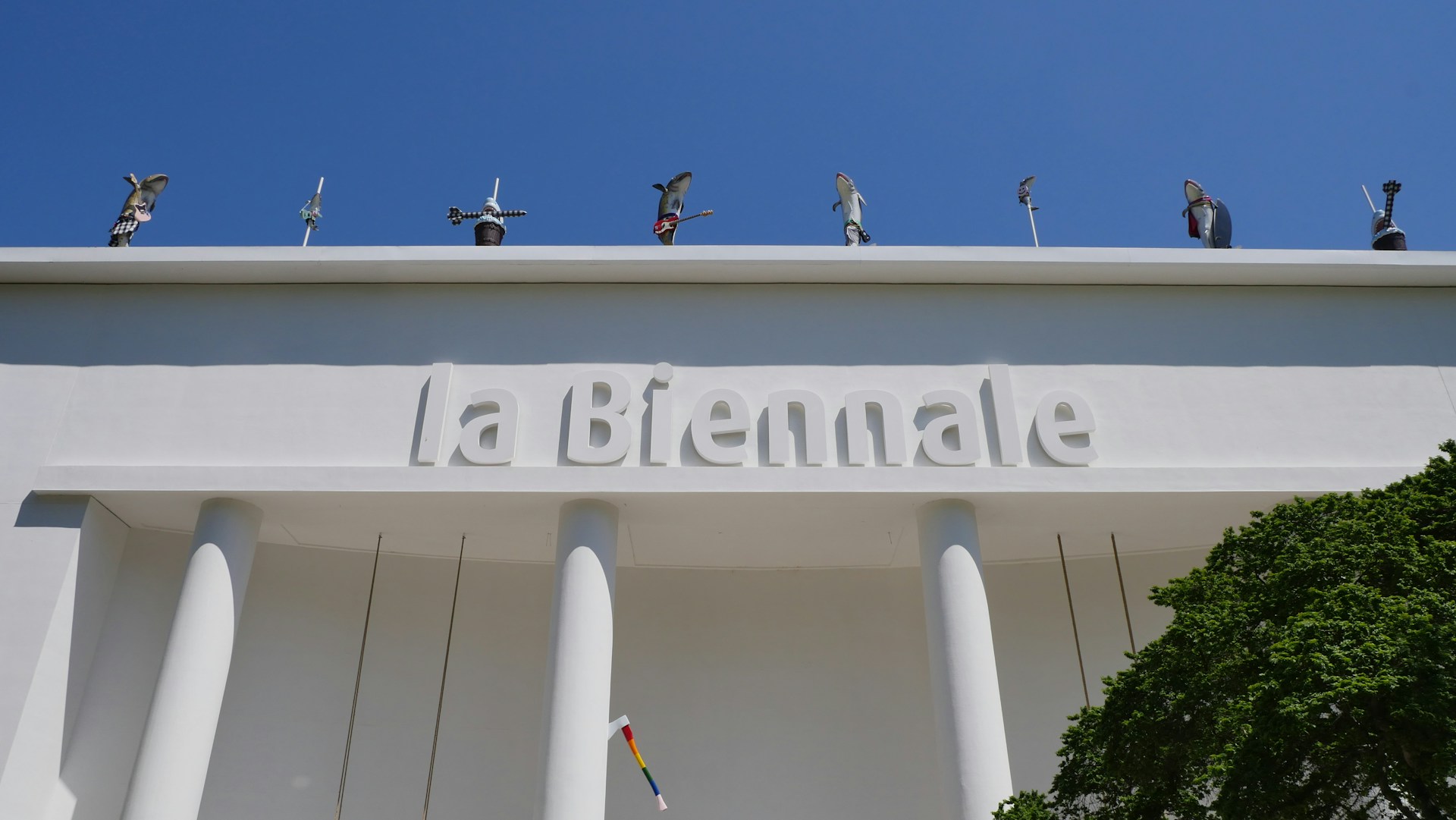
Photo by jens schwan on Unsplash.
- Interview by
- Yasmin Dualeh
At this year’s Biennale di Venezia, one of the most prestigious and celebrated international cultural events, Somalia was selected to establish its inaugural pavilion. Commissioned by Somalia’s government, it marks an important opportunity to present the beauty and richness of Somali culture, particularly at a time in which Somali people have been under attack by the president of the world’s leading superpower, Donald Trump. It also offers a chance to transcend the entrenched divisions within the Somali territories, which reached a boiling point via the Israeli–Somaliland recognition agreement in December 2025, calling into question matters of Somali sovereignties territorial boundaries, and neocolonialism in the Horn.
The Somalia pavilion thematic motif is Saddaxleey, the triadic form of Somali poetry and proverbs—utilizing scent, sound, and vision. It focuses on three strands of art: first, textiles, painting, and materials (illustrated by Somali Swedish artist Ayan Farah); second, film and performance (represented by UK-based Somali Danish multidisciplinary artist Asmaa Jama); and third, poetry and the oral tradition (helmed by renowned poet Somali British Warsan Shire). What seems progressive on its surface—the selection of women artists as embodiments of Somali artistry—conceals significant oversights by the pavilion’s curatorial team.
On Thursday, April 9, 2026, Warbixinta Cidda, a collective of queer Somali artists, curators, and culture workers, in conjunction with artists operating in the Somali territories and diaspora, leveled a robust critique of the pavilion as a purported representation of Somali culture. They released a public statement detailing their objections to the pavilion, which include: the overrepresentation of the Somali diaspora, who constitute the featured artists and the sole Somali curator (Stockholm-based Mohamed Mire); the advisory board composed entirely of Somali men; and perhaps most egregiously, the selection of an Italian cocurator of the pavilion, instead of the numerous Somali curators whose expertise could have been showcased.
Ahead of the Somalia pavilion’s opening on May 9, I spoke to Warbixinta Cidda about their critique and the ethical responsibility artists and culture workers have when claiming to represent their national culture on the world stage.
Yasmin Dualeh
What is it about the Somalia pavilion that specifically led to the mobilization of the collective of fellow artists and their statement?
Warbixinta Cidda
walaal/geeddow from Wabixinta Cidda saw the pavilion being announced on March 20th and was surprised. He assumed that there was a boycott of the event, as the genocidal settler-colonial apartheid state is platformed with their pavilion; there was not, but people were protesting the “Israeli” pavilion. Additionally, they shared the shocking revelation of the Somali curator, Maxamed Mire, inviting an Italian colonizer as a cocurator, so this what initially sparked the mobilization. As soon as we shared this news with fellow artists, one of them, namely Dahab, rightfully pointed out the lack of artists based in the Somali regions, and another fellow artist mentioned that the people in decision-making positions including the cultural advisors are all men.
Yasmin Dualeh
The presence of the Somalia pavilion taking place on Italian soil required the authorization of the festival’s management board to participate. The Biennale’s current president, Pietrangelo Buttofuoco, has had a long-standing strong relationship to the Italian far-right and neo-fascist movements, including to Prime Minister Giorgia Meloni. How do we reconcile the establishment of a Somalia pavilion, in light of the Horn of Africa’s history of Italian colonialism and the festival’s current leadership?
Warbixinta Cidda
One of the reasons we were unsettled by the announcement was the fact that this exhibition is taking place in a country that indeed caused our people so much suffering and violence. We don’t believe in representation for representation’s sake. Moreover, in this case it would actually obfuscate both Italy’s violent history and the current iteration of it, which as you mentioned, the current far-right and neo-fascist government is a big part of. We all know the deadly “border protection” work that Frontex does with support of European governments, which has caused so many Afrikans, especially Black Afrikans, their lives. And the Italian government will surely flaunt this so-called global inclusion, while denying the violent past. Enabling them to benefit from the same history of colonial subjugation they refuse to be held accountable for.
Yasmin Dualeh
In your statement, you raise the matter of the inclusion of Fabio Scrivanti, a former project manager for Venice Art Factory, as one of the two curators for the pavilion. You note that the selection of Scrivanti is affront to Somali curatorial expertise, squandering a great opportunity to promote the myriad of Somalis doing this work at home and in diaspora. Would you like to speak to the implications of this selection?
Warbixinta Cidda
It is already bad enough when Black Afrikans are forced to work with white colonizers because white art institutions demand it. It is so much worse when a Black person goes out of their way to not only include a colonizer, but give them curatorial credit.
We don’t want to get into “proving” that we indeed have capable curators. This is not the first time that Maxamed Mire did this; there is an exhibition called HOY which was the first contemporary art exhibition held at the National Museum of Somali in Xamar (Mogadishu) since the civil war. The same colonizer was credited as a cocurator at this exhibition as well—so Maxamed Mire has been actively supporting this colonizer’s shift into curation on the backs of fankeena iyo farshaxankeena (oral artistry, writing, visual artistry, and crafts) which this cadaan does not know anything about.
Yasmin Dualeh
As a Somali group of artists, cultural workers, and organizers collective bridging the gulf between diaspora and dalkeena (our homeland), you highlighted the absence of Somalis working and building the artistic landscape in the Somali territories in the pavilion’s featured artists and curatorial team. What is lost via this absence, and what does a diasporic care ethic look like within artistic production, particularly for Somalis?
Warbixinta Cidda
We would like everyone to go read the very powerful statement from a group of artists, cultural workers, and independent arts institutions based in the Somali regions, which was published on Monday, April 13. They lay out very clearly how they were sidelined in every aspect, while the exhibition claims to be representative of Somali artistry and artistic forms. Since the release of their statement, they have been subject to intimidation and coercion, which they addressed in their most recent communication.
When it comes to the role us Somalis in the diaspora should play, we would argue that it is essential to not reproduce the extractive and exclusionary practice that the colonizers engaged in and still do when it comes to our people back home. Instead we must actually engage and center the work of the Somali artists back home. We absolutely do not have enough knowledge of what is actually relevant to the artists creating art back home and how their artistic practice has developed and been nourished.
Yasmin Dualeh
The lack of a transparent call for participation or consultancy of Somali artists and artistic collectives leaves the pavilion’s team open to charges of cronyism and casts doubt over whether it can truly be considered a form of national representation. What lessons can be learnt from the pavilion? Can you suggest core principles that can guide future efforts to represent Somali art and culture internationally?
Warbixinta Cidda
The incident surrounding this qashin (trash) pavilion and the pattern that has led up to it has shown the necessity of having a robust ethic as diaspora artists, collectives, and organizers as a proactive practice. We will be publishing a manifesto of points in the near future, with the idea that other Black people are free to use it for their artistic practices.
A few things that are very important to us in our practices [are as follows]:
● not working with colonial institutions and cadaan (whites/Europeans)
● not allowing our work to be used to artwash genocide and other atrocities
● being critical of those engaged in cadaan raac (deferral to whiteness) that want to represent the Black experience
● making sure that we always strive for creating spaces that not only center Black people but are Black and exclusively Black
● enfranchising artists of African ancestry in artistic spaces so that we have greater autonomy to produce and exhibit our art
Yasmin Dualeh
What has the response to your statement been from Somalis interested in and involved in the art world?
Warbixinta Cidda
We have not received any response from the organizers of the pavilion, and they have not engaged with our public statement. However, they have been trying their best to vilify and discredit everyone involved in writing this statement. More specifically, they have even tried to use the fact that Warbixinta Cidda is a queer Somali collective against us, in an attempt to deny our right to our artistic heritage. With this, the organizers of the pavilion are reinforcing and reproducing colonial violence. We believe that the three artists who are centered in this exhibition—namely, Ayan Farah, Asmaa Jama, and Warsan Shire—have a huge responsibility to address the critiques publicly and to be transparent about how much of the unethical practices of the organizers they have been aware of.
Yasmin Dualeh
What has the response been from the broader Somali artistic community in the aftermath of your statement?
Warbixinta Cidda
It has been disheartening and enraging to see the majority of Somali artists in the diaspora either be silent or actively defend this colonizer and the other unethical practices of the people behind the pavilion. The harsh responses to our public critique were, mostly, if not entirely, by Somali artists based in the diaspora. They accused us of creating division, foul tactics, and engaging in critique for the sake of critique. They reduced valid critique to jealousy and regurgitated talking points based on scarcity. We saw artists that immediately identify with and have sympathy for the three artists that are centered in this exhibition. We have heard people say—publicly and privately—that it is important and necessary to make concessions.
It is an insult to our anticolonial ancestors. Somali artists have historically been critical of those in power and used their art as resistance, even when they were subjected to imprisonment and torture. We recall the historic Somali artists who produced powerful work under violent colonial occupation, such as Timiro Cukaash, Makaay Garaare, Xaawa Jibril and Maymuuna Biyow, who is famous for the Saddaxleey (the three-part Somali form that is used in Somali poetry), from which this pavilion has the audacity to choose as its title. And in more recent history, artists like Saado Cali Warsame, who was imprisoned and gave birth to her daughter Xuriyo (freedom), because she took part in the poetry chain Silsiladii Deeley. May they all rest in peace, love, and power.
All artists that have been or will be invited to engage with this pavilion should follow Ladan Osman’s example by declining the invitation and sharing this publicly.We call on Somali artists in the diaspora to reject caddaannimo (whiteness) and cowardice practice and instead to tap into their ancestors’ courage.
We end by invoking the righteous words of Maymuuna Biyow:
“gaal manoo islaam wadin nama soo galeen”
(the colonizer would not be in our midst if he wasn’t accompanied by one of us)