The rubble of empire
Built by Italian Fascists in 1928, Mogadishu Cathedral was meant to symbolize “peaceful conquest.” Today its ruins force Somalis to confront the uneasy afterlife of colonial power and religious authority.
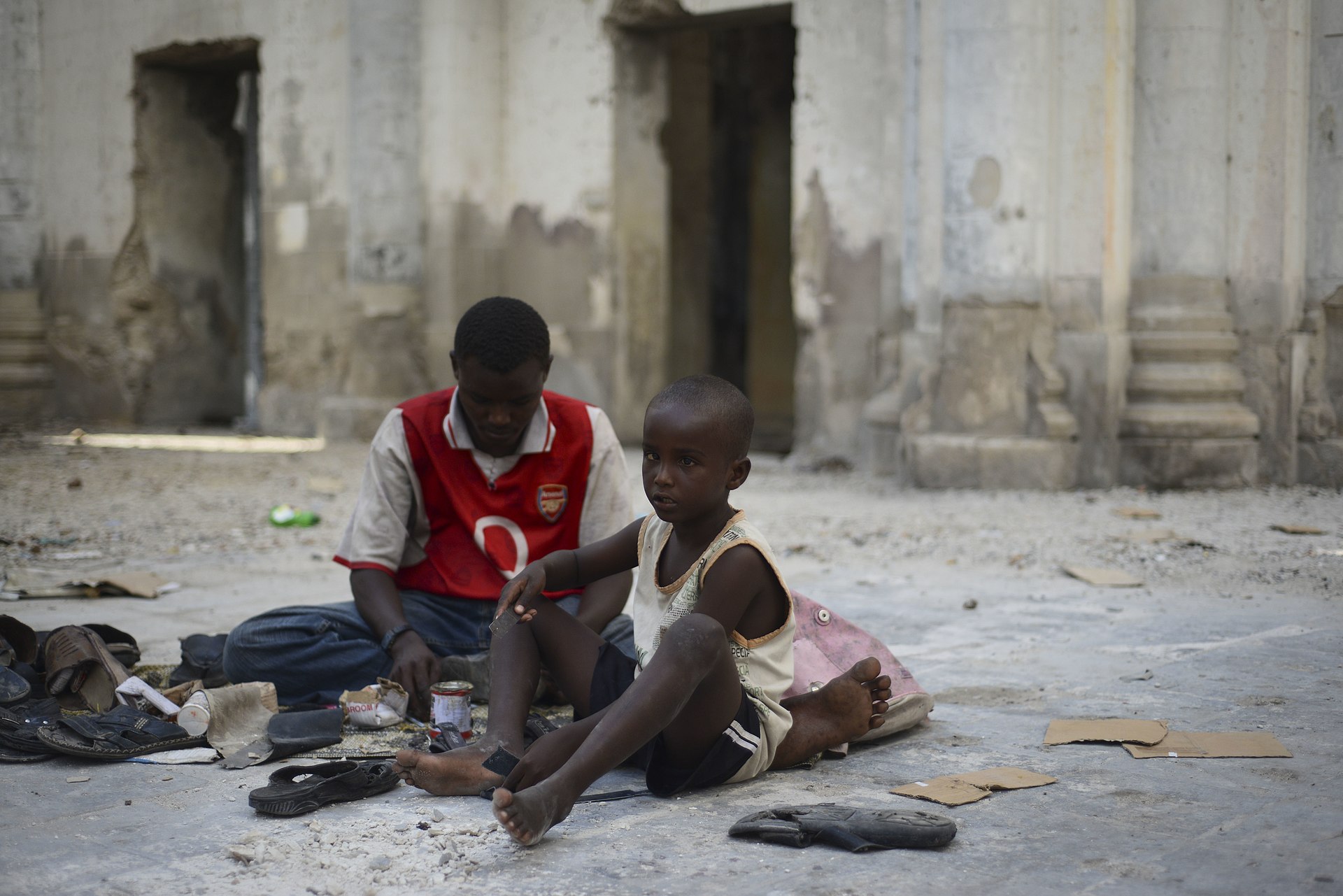
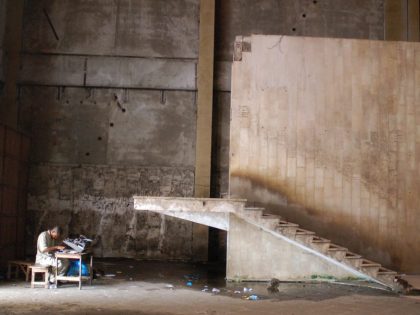
A father and his son repair shoes on the floor of Mogadishu’s old cathedral in 2012.
- Interview by
- Faisal Ali
Mogadishu Cathedral’s skeletal remains appear in nearly every photograph of the Somali capital’s ruins, a Gothic anachronism amid palm trees and coral-stone buildings. Its broken walls and roofless nave have become visual shorthand for the devastation of civil war. Yet, its contested legacy continues to fuel debate among Somalis about the country’s colonial past.
Built in 1928 during Italian colonial rule and once claimed to be Africa’s largest cathedral, the structure was designed to replicate the 12th-century Cathedral of Cefalù in Sicily. Its imposing presence—at 37 meters, the tallest building in Mogadishu—was no accident; it spoke to who was in charge. The choice of an “Arab-Norman” architectural style, which blended Christian and Islamic visual elements from medieval Sicily, was meant to project what the Italian colonizers called “peaceful conquest” in a predominantly Muslim territory.
Today, debate over the cathedral’s future reveals deep fractures in how Somalis reckon with their colonial past. When Somali-Italian architect Omar Degan posted images of the ruins online, he faced fierce backlash. A poll he conducted found that while 72% supported preserving colonial-era buildings as museums, many Somalis view the cathedral’s presence as a reminder of their subjugation.
Art historian Claire Dillon has spent years excavating the cathedral’s origins through archives at the Istituto Missioni Consolata in Rome. Her research reveals a building born of contradictory impulses; brutal colonial expansion disguised behind a facade of architectural hybridity. “The cathedral represents an alignment of religious and colonial power,” she explains, tracing how Fascist governor Cesare Maria De Vecchi pushed the project forward even as missionaries worried about its enormous cost and dubious purpose. Her academic paper titled Transforming Cefalù in Mogadishu can be read here.
Dillon’s work surfaces stories erased from official histories: Somali workers whose labor built the cathedral, prisoners who died in construction accidents, and the 1989 assassination of Bishop Salvatore Colombo that foreshadowed the building’s violent end. As she puts it, the monument asks a question still unanswered: “How does one deal with the rubble of history?
Faisal Ali
What drew you to research the Cathedral of Mogadishu, and what surprised you most in the Consolata archives?
Claire Dillon
I’m an art historian, and my research focuses on the Mediterranean; much of my work explores the dense networks of exchange between people of diverse cultures and faiths during the Middle Ages. I also investigate how medieval history is mobilized in modern political discourse, for instance, when the Crusades are evoked today to represent conflict between “East” and “West.”
These topics collide in the Cathedral of Mogadishu. It was constructed in the 1920s, but its design is modeled on the 12th-century Cathedral of Cefalù, which is located in northwestern Sicily. This connection between the medieval and modern churches had never been fully explained, and I wanted to understand why the Italian colonizers in Somalia had selected that specific medieval monument as their reference.
My greatest surprise was discovering that extensive documentation of the cathedral’s construction survives in the headquarters of the Institute of Consolata Missionaries in Rome, but the story had yet to be told. I was also struck by the missionaries’ initial anxieties about assuming responsibility for the mission in Somalia in 1924. They were worried about working with limited support and resources, especially in a predominantly Muslim society that resisted conversion. Even after they settled in Somalia and began the cathedral’s construction, they hardly shared news about it, and really only mentioned it when it was near completion. I interpret this silence as a sign of uncertainty, indicating that there were very real concerns that the project could have failed.
Faisal Ali
Can you explain what “Arab-Norman” architecture means and why Italians saw the Cathedral of Cefalù as a model to send a conciliatory message to the population of Mogadishu?
Claire Dillon
In general terms, “Arab-Norman” describes the art and architecture created during the Norman kingdom of Sicily (1130–1198). Before the Normans came from France and conquered the island, Sicily had been governed by a series of Arab emirates for more than two centuries. When the Normans inherited that legacy, they constructed buildings that blended North African, Gothic, Byzantine, and other visual languages that were found around the island and across the Mediterranean. “Arab-Norman” is an imperfect term that attempts to describe that complex style, which is often reduced to a combination of Christian and Islamic elements.
The Cathedral of Cefalù, which was the model for the Cathedral of Mogadishu, is one of the surviving “Arab-Norman” monuments. The bell towers resemble medieval minarets found in North Africa and southern Spain, and they’re just one example of the many ways that the Normans incorporated Islamic architecture—and also Muslim artisans, intellectuals, and communities more broadly—in their kingdom. That kind of integration is often interpreted as a sign of tolerant governance, even though the society was far from egalitarian.
About 800 years later, the “Arab-Norman” style became a powerful tool for the Italians in Somalia. It allowed them to capitalize on the medieval history that was shared between Christians and Muslims. By invoking this Sicilian precedent, in which different communities were united under a Christian authority, they sought to obscure the reality of colonization. These historical references were meant to represent coexistence and continuity, but they were used to legitimize imperialism.
Faisal Ali
Why did Governor Cesare Maria De Vecchi choose a Sicilian cathedral when other Italian colonies had northern Italian styles in their infrastructures?
Claire Dillon
The Cathedral of Mogadishu is interesting because it is very different from the other cathedrals that the Italians built around the same time in Libya and Eritrea. It is difficult to determine who first proposed the Cathedral of Cefalù as a model for the Somali capital. I suspect that many of these conversations transpired in person, and the surviving correspondence does not capture every stage of the process. What the archives do show is that a range of styles were under consideration. Some proposals emulated medieval architecture from northern Italy, which was used in other colonies. At one point, another design was rejected for looking “too much like a mosque,” suggesting that Italian officials were exploring Islamic styles of architecture, mindful of the predominantly Muslim population of Mogadishu.
The eventual selection of the Sicilian model is therefore unusual and significant. From the colonizers’ perspective, it was actually something of a compromise to build a cathedral with “Islamic” elements—namely, the minaret-style bell towers—but this was a very subtle and symbolic choice within an otherwise aggressive, colonial project. The design of the church was meant to complement the architecture of Mogadishu and resonate with local Muslim communities, even if the logic was flawed, to say the least.
Governor De Vecchi publicly claimed credit for the cathedral’s design, but I think it’s safe to say that much of the creative and practical work was executed by the architect, Antonio Vandone, as well as the missionaries who oversaw its construction. Nevertheless, De Vecchi certainly played a decisive role in choosing to proceed with a project of such magnitude. He insisted on building a massive cathedral even as the missionaries expressed serious concerns about the labour and expenses it would entail.
Faisal Ali
De Vecchi emerges as a central figure in your research. Can you introduce him to readers and explain his role in the cathedral’s construction?
Claire Dillon
De Vecchi was a prominent Fascist, and he was one of the four leaders of Mussolini’s March on Rome. He was a complicated figure in that his Fascist politics included fierce loyalties to the Church and Italian monarchy. He also became known for his brutality. It is thought that Mussolini sent him to govern Somalia as a sort of punishment that would remove him from Italy, after he was implicated in politically motivated violence in Turin. Once he arrived in Mogadishu, De Vecchi was determined to leave a legacy that would strengthen his career prospects back home. This, of course, involved a violent expansion campaign and much more.
The cathedral became one of the grandest expressions of his ambitions. He chose an expensive and imposing design, which seemed unrealistic in a colony with limited resources and a very small Christian population. Though the scale of the project caused deep anxieties for the missionaries, they also appreciated De Vecchi’s ardent religious conviction and the political and material support that accompanied it. With these competing agendas and unfavorable conditions, the cathedral was barely completed before it was consecrated on March 1, 1928, just a few months before De Vecchi departed Somalia.
Faisal Ali
How did his religious devotion coexist with his reputation for violence in Somalia?
Claire Dillon
As is well known, faith and violence often reinforce one another. De Vecchi’s Catholic commitments coexisted with his harsh treatment of the colony, and many missionaries operated in similar fashion: charitable and evangelizing work was frequently presented as an extension of empire.
With that said, De Vecchi’s ruthless actions in Somalia did provoke some criticism in the Italian press, but this was not necessarily framed as a religious issue. Some of his opponents argued that colonization should proceed more “peacefully” or gradually because it would be more effective, but they did not question the legitimacy of Italian rule itself. Ultimately, the cathedral represents an alignment of religious and colonial power.
Faisal Ali
Like a lot of postcolonial governments, Siad Barre’s went on a bit of a renaming spree and erected new statues in the capital in a bid by the country’s leaders to leave their imprint on the city. Why did the cathedral survive as a functioning Catholic church through Somalia’s socialist period?
Claire Dillon
My research primarily focuses on the colonial era, so I’m eager to discuss the years following independence with scholars of that period and people who experienced it first-hand. It would be great to have a larger conversation about why the cathedral survived Barre’s ascension.
With that said, to explore this question, I think that the Italian cathedral in Tripoli, Libya offers an interesting comparison. Under Gaddafi, it was confiscated, converted into a mosque, and renovated to fulfill its new function and obscure its Christian origins. This example illustrates the extent to which intervention is required to deconstruct the symbolic charge of a colonial church. These practical issues reflect how little the cathedrals resonated with local communities in Libya or Somalia: an explicitly Christian edifice was not as easy to reuse as the administrative offices and other Italian buildings that the postcolonial governments appropriated. The Cathedral of Mogadishu would have needed much more than a different name or new decoration to assume a postcolonial identity. I also imagine that the continued presence of the church, and the services it provided, could have had some value for Barre, whether material or diplomatic. This is a topic that would benefit from more research.
Faisal Ali
What happened when Bishop Salvatore Colombo was murdered at the cathedral in 1989? How did this connect to the building’s colonial legacy?
Claire Dillon
The bishop’s murder is still shrouded in mystery, but I would say that the incident is indicative of the cathedral’s legacy rooted in antagonism and colonial occupation. Even if the clergy and nuns curtailed their proselytizing and focused on providing direct services, it would have been difficult to distance themselves from the fact that their predecessors connected these activities to colonial expansion. While I don’t know the exact motives for the attack—perhaps the bishop was targeted as a representative of external interference, or wealth, or something else—this episode brings the church’s loaded significance into focus, and it suggests that it is difficult to shake off the weight of history.
Faisal Ali
Can you tell us a bit about the destruction of the church?
Claire Dillon
I should start by mentioning that from the time the cathedral’s foundations were laid in the early ‘20s, its maintenance and condition were always cause for concern. Construction was often delayed, and the building was not quite complete when it was consecrated. There were apparently complaints about the amount of money that was spent on the cathedral, especially considering that it had so many problems: the floor was still unfinished in 1930, and many details were hastily put together in unsightly concrete. Deterioration progressed as time went on, and the cathedral suffered serious damage as the civil war began. Later attacks further reduced it to a ruin. The cathedral was built to last for centuries, but it did not even survive one hundred years. It’s a compelling symbol of the failures of the Italian Empire.
It’s worth noting that this destruction not only affected the building itself but also damaged whatever documentation was stored within. Photographs can show us what the building looked like, but they cannot recover the written records that were lost without a trace. Although some important information had already been stored in Rome, such as the names of Somali workers who constructed the cathedral, we can only imagine what else was destroyed.
Faisal Ali
You refer to Somali scholar Iman Mohamed’s question: “How does one deal with the rubble of history?” What range of Somali perspectives exists about what should happen to this building, and how does Italian colonial amnesia complicate the conversation?
Claire Dillon
Of course, there are diverse opinions about the cathedral, and last year Mahbub Abdillahi wrote a piece for Geeska that summarizes some of these perspectives. The building can be a painful reminder of oppression, or a nostalgic symbol of the capital before the war’s destruction. Others see possibilities for its adaptive reuse and reinterpretation. I’ve been fortunate to speak with several architects about the cathedral, including Yusuf Shegow of Somali Architecture, who proposed that the site could become a space for education, commemoration, and tolerance.
Many scholars would argue that colonial amnesia is particularly acute in the Italian context, since Italy was not subject to the kind of decolonial reckoning that other European empires experienced. Memory often minimizes and sanitizes the unsavory dimensions of colonial rule, emphasizing the expansion of infrastructure, services like education, and other forms of “development.” This point of view ignores the painful past of a religious monument that today might seem innocuous, or even positive, from the standpoints of some Italians. Someone once responded to my work on the cathedral with the remark: “You can’t build your future without taking care of your past,” which suggests that Somalis have not adequately cared for the building.
Such a statement completely overlooks the brutal realities of imperialism and avoids the difficult question of whose histories should be protected and prioritized. That selective memory can distort contemporary discussions about preservation or restoration, which is why Somali voices need to be centered in this discourse. Any meaningful future for the site must take local perspectives into account, even if consensus is difficult to achieve. If my work contributes anything, I hope it provides historical context that enriches those conversations, and I would be happy to support such discussions wherever I can be useful.