The indelible African superfan
Part performer, part cultural ambassador, and increasingly, a political flashpoint.
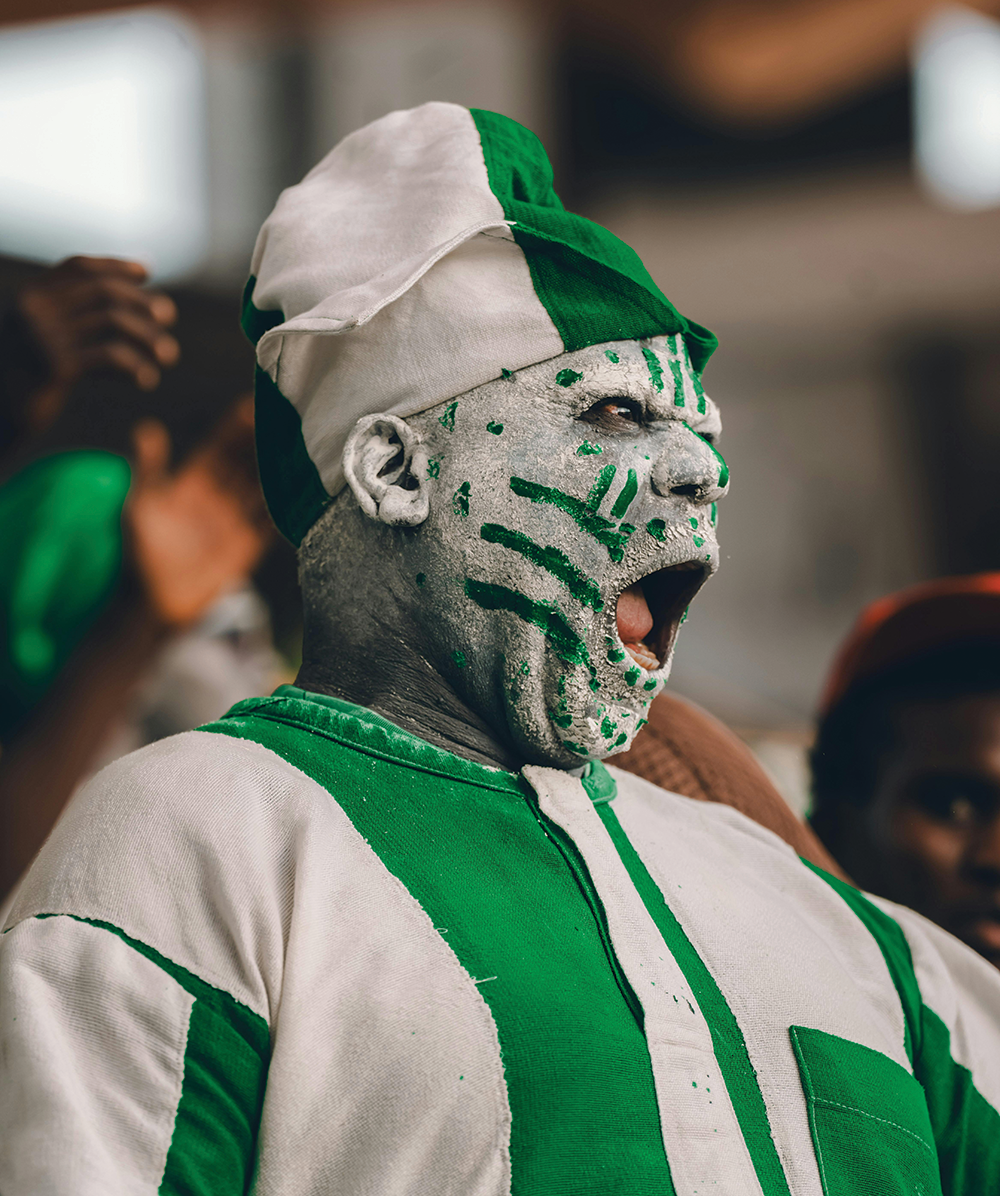
An animated Super Eagles fan. After failing to qualify for the 2026 edition, Nigeria will miss their second consecutive FIFA World Cup. (Jonathan Shembere/Pexels)
In African football, simplicity is a snooze. While a casual spectator might be content to sit and shout: “Yay!” to celebrate a late goal, for the superfan—the continent’s own brand of match-day superhero—expectations of exaltation are sky-high. The form these icons take is as unpredictable as the game itself; step into any stadium across the continent, and you’re just as likely to encounter a local witch doctor, a diy Avenger, or a reincarnated political figure.
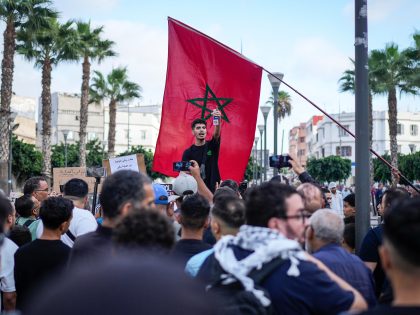
Long before pre-match commentary has begun, another force has already been at work. It does not step onto the pitch, yet it shapes the gravity of the contest. This is the energy of the “12th man,” expressed with unmatched intensity across the African continent. From Accra to Algiers and Kinshasa to Casablanca, support is continuous rather than reactive. Rhythm, voice, and motion fuse into a collective force that sustains teams through fatigue and pressure.
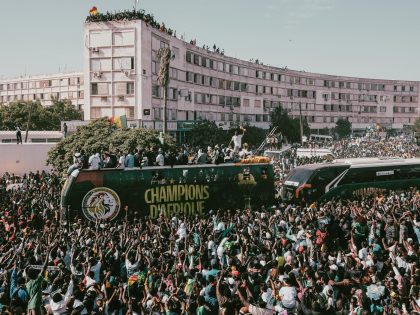
Arrive early to the stadium and the performances are likely already in full swing. Small clusters of supporters build into waves of sound that roll across concrete terraces. By kickoff, the match is already alive—not because the players have started a kickabout, but because the crowd has willed it into existence. Each chant overlaps with another, each drumbeat fills a gap in the air, and they create a layered atmosphere that pushes the game beyond tactics and into the realm of an ecstatic spirituality. Players often speak of “feeling carried” by the crowd, as though the energy in the stands reduces the weight of fatigue.
For the African superfan, support is a way of life. Travel, costume, coordination, and constant presence demand both time and resources. However, beyond the spectacle lies routine. They wake up early to prepare outfits, endure long road journeys when flights are out of reach, and squeeze into crowded shared accommodation when hotels are too expensive. The image seen on television—colorful, loud, effortless—often conceals a reality of sacrifice.
As one South African football journalist, who requested to remain anonymous, explained: “The ones who can afford [their tickets easily] cannot do what superfans do. Superfans must do everything to justify their tickets.” He made these remarks after observing the steady rise in the number of superfans in South Africa since their hosting of the 2010 World Cup. The imbalance is stark. Passion often resides with those least equipped to sustain it, forcing them into a constant negotiation between survival and support. In that sense, the superfan lives in two worlds at once: one of visibility and celebration, the other of uncertainty and personal cost.
This dual existence creates an unspoken pressure. The performance cannot slack off, because for many, presence at the stadium is about proving worth. Yet this devotion exists on a spectrum. For some, football remains purely an emotional outlet, a ritual of belonging repeated across tournaments and generations. For others, superfandom has evolved into something more complex: a platform for opportunity, and at times, survival. The lines between passion and profession are razor-thin, and the modern superfan is shaped by the demands to keep up appearances.
If the private lives of superfans reveal sacrifice, their public profile can bring opportunity or expose tension. In the Democratic Republic of the Congo, Michel Kuka Mboladinga, who dresses up as the country’s beloved first prime minister, Patrice Lumumba, has been fully embraced. His rise has been rapid. His image is widely circulated in the media, and his presence has become embedded within the national team’s identity.
Congolese journalist Darius Tshibangu describes that transformation succinctly: “Since the [2025] AFCON, where he became a star, his status has changed. He now has a manager who handles requests. . . . Today, he is one of the few fan leaders to have landed actual contracts.” What might appear elsewhere as commercialization is, in Congo, interpreted as recognition. “The government. . . . always covers the travel expenses for the animators,” Tshibangu explains. “Barring any surprises, Lumumba and the others will be on the trip to the United States.”
The implications are clear: a recognizable superfan earns institutional backing, and an understanding grows among the public that a performance in the stands is just as much a part of the spectacle as the game itself. As football grows increasingly commercial, superfans like Mboladinga demonstrate the benefits of participation. Media exposure and sponsorship bring opportunities, offering financial pathways that did not previously exist.
If Congo’s reaction to a celebrity superfan reflects institutional endorsement, South Africa’s relationship with one of its most recognizable faces reveals superfandom’s frictions. At the center of recent controversies in the country stands Mama Joy Chauke. Recently, South African Sports Minister Gayton McKenzie decided to end travel benefits for fans of the national team, and a back-and-forth between the minister and Mama Joy broke out in public view. McKenzie suggested her husband should pay instead of the state; Mama Joy responded that he was “undermining” her family, and vowed to attend the competition regardless.
The same South African journalist, who witnessed the conflict, was sympathetic toward the minister’s position. He described Mama Joy as entitled and suggested that she was being used as a political pawn. He said: “South Africa doesn’t have a policy of paying for fans. . . . the problem is that she is being used by certain people in football leadership.”
Visibility can be both an asset and a liability. And so as their profiles raise, the African superfan must navigate a paradoxical relationship with institutions. In the space between Lumumba’s embrace and Mama Joy’s confrontation lies the spectrum of what it means to be a superfan in Africa. On the one hand, the state formalizes passion, funds it, and exports it as national identity. On the other, visibility invites scrutiny, and support becomes something to justify rather than celebrate.
It raises a fundamental question: should fandom remain organic and self-sustained, or can it be structured, funded, and remain authentic? Across the continent, there is a growing skepticism toward high profile superfans. They are celebrated as cultural ambassadors, yet questioned as financial liabilities. Governments understand the symbolic return from their presence at international competitions. A single broadcast image—a painted face leading chants—can project a nation’s identity more powerfully than any official tourist campaign. It is soft power in its most organic form.
Yet, translating that value into policy is fraught. Funding superfans means making choices. It means justifying why public funds should support travel for a select group while broader populations face economic hardship. In some countries, this has led to structured systems to navigate these social tensions: registered supporter unions, official delegations, and capped sponsorship numbers. In others, it has triggered backlash, with citizens questioning whether the passion of fans should ever be institutionalized. At the heart of the debate lies a difficult question: can authenticity survive once it is funded?
Alternatives have emerged in Morocco and Algeria, where supporters’ groups are able to fund travel through a more independent model. There, groups of fans often fund journeys or raise money through informal networks and the local community. This autonomy offers flexibility, but also places the burden entirely on the public, rather than the state or federation.
If the debate over funding reveals fraught politics within Africa, the journey to this year’s World Cup exposes the harsh realities of intercontinental travel. For fans from many countries, the path to the tournament is riddled with systemic costs and barriers. Unlike previous tournaments, where proximity or loose entry requirements allowed for spontaneous travel, the US, Canada, and Mexico impose a far more difficult process. Visa applications to these countries require proof of financial stability, confirmed accommodation, and strong evidence of intent to return home. For independent supporters—many of whom operate within weaker economies—meeting these requirements can be as challenging as funding the journey itself. Additionally, the minimum expenses for a single supporter: flights, accommodation, match tickets, and internal travel far exceed what many can realistically afford. Multi-city scheduling across three host nations adds another layer of complexity, requiring careful coordination and additional transport costs. For organized supporter groups, the burden multiplies.
So, in this World Cup, it is diaspora networks that may prove decisive in rallying fans to support their teams. Large immigrant communities in both the US and Canada can be easily mobilized and stand in for fans who cannot make the journey. We’ve already seen as much from Congolese fans traveling from across North America to Guadalajara for that country’s intercontinental playoff in March. In Cape Verde’s case, long-established communities, such as the 70,000 Cape Verdeans living in Boston, could carry the nation’s presence without the need for large-scale travel from home.
For all its color and cohesion, African football fandom is not without its fractures. Just this past January, members of the Senegalese supporters group, Douzième Gaindé clashed with stadium security during an on-field argument over a penalty decision at the 2025 AFCON final. In the aftermath, 18 supporters were handed prison sentences. While some have since been released, the legal consequences remain poignant. Criminal records can complicate visa applications, placing future travel at risk.
Those moments of tension between supporters and security forces revealed a more volatile edge to African fan culture. Such moments complicate the image of the superfan as purely celebratory. They introduce a dimension often associated with ultra culture—where identity, territory, and emotion can collide. Yet the comparison between European ultras and African superfans remains imperfect. Across much of Africa, fan culture is less rigidly structured than in historical ultra environments. It is more fluid, more performative, and less defined by organized confrontation. When disorder occurs, it is often situational rather than systemic. Still, perception matters. As African fans prepare for the global stage, isolated incidents risk shaping broader narratives. The challenge lies in preserving the intensity and authenticity of support.
Due to the challenges of securing tickets to matches, or even arriving in North America, there is a growing possibility that the stands will feel more structured, less kinetic than Africans are accustomed to. And yet, absence is not inevitable. The question remains whether football, in its most polished and commercial form, is still built to receive these superfans. Because the African superfan represents something that cannot be manufactured. And if, on a summer day, that rhythm echoes through the streets, it will mean that despite cost, policy, and distance, something essential has endured—the part of football that refuses to be contained.