Do Ghanaians ‘still believe’ in Kurt Okraku?
Under the leadership of the president of the Ghana Football Association, the country’s football has become a study in contradiction, combining administrative modernization with competitive decline.
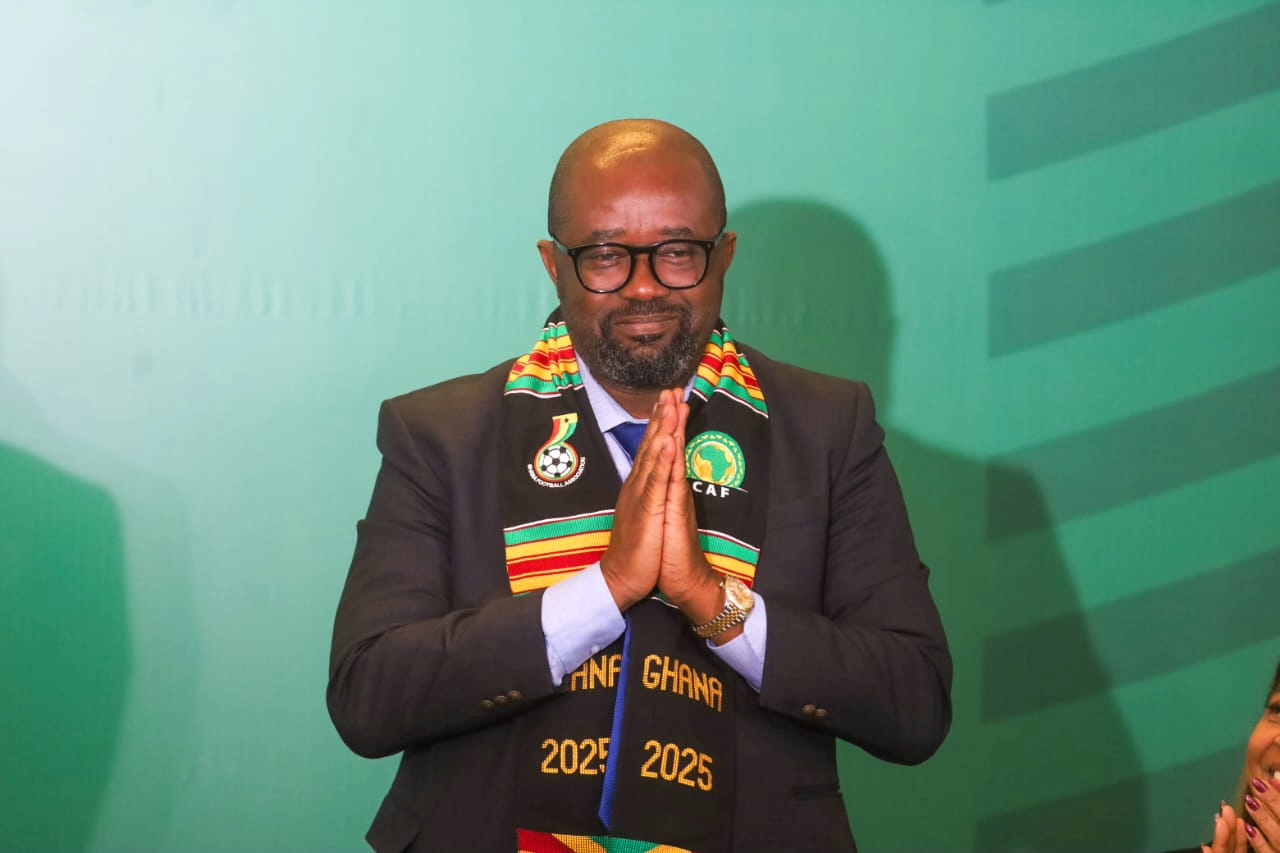
Kurt Okraku at the announcement of his appointment as CAF second vice president in Accra, April 2025. Source: Ghana Football Association (Fair Use).
On the eve of Ghana’s 2025 Africa Cup of Nations (AFCON) qualifier against Sudan, Ghana Football Association (GFA) president Kurt Okraku joined the Black Stars players at the dining room of their hotel in Accra.
He didn’t take a seat. He wasn’t in the mood to. He had come neither to greet nor to eat, but to speak. And what a speech it turned out to be: a 17-minute monologue, a monumental meltdown, filled with fury and frustration.
The players—the likes of Iñaki Williams, Tariq Lamptey, Antoine Semenyo, Mohammed Kudus, and Jordan Ayew—were all there, sporting a soulless stare, awkwardly fidgeting as Okraku’s eyes scanned their faces, his mouth scolding them scathingly.
Kurt was hurt. A month earlier, the Black Stars had started their qualification for the 2025 AFCON on a numbing note: a 1–0 loss to Angola at the Baba Yara Stadium in Kumasi, the team’s first loss at the venue in 24 years. A few days later, it got worse: they drew 1–1 with Niger.
“We drew 1–1 against Niger?! You’re making me crazy!” Okraku complained at the hotel, slapping his temples with both hands. “Sorry, total disrespect to Niger, for me, yes. But it’s crazy! I can’t understand it!”
The next day, October 10, 2024, it got crazier. Ghana went on to draw against Sudan—a side coached by former Ghana coach Kwesi Appiah, whom Okraku had sacked years earlier.
Fast-forward to November 18. Niger came to Accra for the second leg and defeated the Black Stars 2–1. It was the last day of the qualifiers, making sure Ghana was not going to be at an AFCON for the first time in 20 years.
That game had been a culmination of accumulated humiliation. The Black Stars had played a whole qualifying campaign for an Afcon—six straight games—without winning a single one. The AFCON in Morocco was going to feature 24 of Africa’s 54 teams, and the Black Stars—four-time AFCON champions, a team that finished in the top four of six consecutive tournaments between 2008 and 2017—had not been good enough to be a part of this 24. It was surreal and senseless, terrible enough to turn on another Okraku tantrum.
In truth, that rant at the hotel, as blunt as it was, felt like a stunt, not least because it wasn’t discreetly done. It was, in fact, officially filmed by the FA and shared on its social media platforms with the subtle narrative of a no-nonsense leader in control, a powerful, passionate perfectionist panning players for a poor performance.
The tirade was essentially a charade, which was unsurprising, because Okraku is a man who understands politics and its optics. According Muftawu Nabila Abdulai, who apart from being the reigning Sports Journalist of the Year in Ghana is also the biggest thorn in the flesh of Okraku’s administration, Okraku is a “smart politician.”
Okraku is a seasoned power player, without a doubt. He has earned his stripes, having been in the business of football administration for close to 40 years. This seems strange considering that he is only 55. But it can be explained by the fascinating fact that he founded Shooting Stars FC, a colts club in Accra, when he was just 17—a demonstration of his prodigious talent for the trade.
He is well qualified, too, having undergone a tedious trajectory in tertiary education, one that took him from Ghana (the University of Ghana and the Ghana Institute of Journalism) to the UK (Emile Woolf College, University of Liverpool, and Manchester Trinity College) honing his skills in journalism, marketing, and football industries.
Returning to Ghana, he worked his way up the ladder, building his reputation across various roles, before earning a big break as marketing director with giants Hearts of Oak. He then worked with the Ghana League Clubs Association (GHALCA), before going on to found his own club, Dreams FC, in 2009. Dreams, under his laudable leadership, became one of the most well-branded, most professionally run clubs in Ghana—a beautiful breath of fresh air in a system saturated with stale standards.
Deservedly, he got elected onto the GFA’s Executive Committee (ExCo) in 2015, and in 2016, began serving on the organizing committee of the Ghana FA Cup. This was the role that raised his ratings through the roof: Okraku was seen as the orchestrator behind the transformation of the FA Cup into the most attractive competition on the FA calendar—perhaps even more attractive than the Ghana Premier League.
In October 2019, from the debris of the demolition of the GFA, detonated by the “Number 12” corruption scandal that toppled the 13-year reign of former GFA president Kwesi Nyantakyi, Kurt Edwin Simeon-Okraku emerged.
In the heat of a close and controversial election, Okraku pounced on power, despite not being the most popular or preferred candidate. The top two candidates, Wilfred “Palmer” Osei Kwaku and George Afriyie, had suffered setbacks: The former was disqualified and disgruntled, while the latter was bleeding from a beef with Nyantakyi, whom he had served as a vice.
According to Abdulai’s insider information, Okraku’s fortunes for the elections dramatically changed on October 24, 2019, the night before the poll, when Kwesi Nyantakyi himself—the shadow kingmaker and puppet master of the elections, despite having been banned by FIFA—effectively anointed Okraku as his successor by rallying delegates to vote for him.
Okraku was ordained in 2019, and maintained in 2023. Before assuming power, he colorfully campaigned on the manifesto mantra “Game Changer,” and after assuming office, rolled out a social media slogan dubbed #BringBackTheLove—a promise to restore public affection for the GFA and the Black Stars. His advent was the classic savior story—the heralding of a hero hewn by hype and hope, ready for history.
Seven years down the line, however, things don’t seem fine. That failure to qualify for the 2025 AFCON—a fiasco so frightening and unfathomable—was not just game-changing, it was also the coffin in which love for the GFA and the Black Stars was buried.
It is inexplicable how Okraku, one of the brightest brains in football administration in Africa—a man who serves as a CAF vice president and chairman of FIFA’s anti-racism and anti-discrimination committee—has overseen what can only be described as one of the most enigmatic epochs in Ghanaian football history. Enigmatic here, by the way, is just a euphemism for disastrous. It’s been so bad that not even qualifying for two World Cups has done much for his record or reputation.
Before delving into the details of the disaster, however, there has to be some contextual clarity. The two trips to the Mundial are not isolated successes: Women’s football has seen great growth and visible vibrancy, culminating in the Black Queens finishing third in the Women’s African Cup of Nations (WAFCON) and the Black Princesses (U-20) getting gold medals in the 2023 African Games. The U-20 male team, the Black Satellites, were champions of West Africa and Africa in 2021, and gold medalists at the African Games in 2023.
Even a critic like Abdulai, who is currently locked in a legal tussle against Okraku’s GFA, admits that Okraku has done well in transforming the GFA into a world-class institution, mainly across management and marketing. “His leadership style has leaned on corporate governance principles: structure, committees and decentralization,” Abdulai says. “Administratively, there has been emphasis on transparency, with regular congress meetings and public engagements.”
The GFA says its leader “stands as one of the most influential and transformative figures in modern Ghanaian football,” which, to be fair, on some level, isn’t entirely praise-singing. But, as Abdulai explains, “his failures outnumber his successes.” This is hard to argue against.
If the temperature of a country’s national team is often indicative of the state of its overall football health, then Ghana is feverish—suffering from a serious disease of decline.
Not only did the Black Stars miss an AFCON for the first time in 20 years, the previous two Afcons were also the worst ever in Ghana’s history. At the 2021 Afcon in Cameroon, Ghana went winless, and finished 19th out of 24 teams. At the 2023 Afcon in Cote Ivoire, Ghana went winless again, finishing 17th out of 24 teams. Before those two tournaments, Ghana had never gone winless in an AFCON in its history.
When Okraku took over at the GFA, the Black Stars were ranked 47th in the world and sixth in Africa on the FIFA Rankings. Seven years later, the team has dropped 27 places down: 74th in the world and 14th in Africa—its worst rating since August 2004.
The Black Stars have won just 40 percent of the games (30 out of 75) played under Okraku’s administration, without ever making it out of the group in any tournament.
Okraku’s administration has a master of arts degree in the hiring and firing of coaches, having successfully completed four courses in the last six years: C. K. Akonnor (January 2020 to September 2021), Milovan Rajevac (September 2021 to January 2022), Chris Hughton (February 2023 to January 2024), and Otto Addo (March 2024 to March 2026). It was an expensive degree, too, costing “over $1.1 million” alone in severance packages, according to Abdulai.
As a leader, Okraku has been “ruthless”—as Abdulai describes—in his pursuit of success, as seen in this saga of sackings. Ironically, he would be the first to be sacked if the GFA presidency was subject to public determination; if the ruthlessness of Ghanaian football fans carried any weight.
Unfortunately, it doesn’t. The power to uphold or uproot Okraku’s administration is in the hands of the “football people,” as delegates within the GFA are known, and Okraku has these football people on a leash. They voted overwhelmingly to give him a second term in August 2023 and, two years later, voted unanimously in favor of an amendment to increase the presidential term limit from two to three, paving way for him to contest for another four-year term in 2027.
Domestically, the Ghana Premier League has suffered from a poverty of intrigue: There is a disheartening disconnection with the fans, attendances are at an all-time low, and murmurs of match-fixing still linger post–Number 12. The top flight is currently without a title sponsor: A promising three-year deal worth $6 million signed with betPawa in August 2022 was gone by November 2023.
Ghana’s CAF club ranking, which determines how many of its clubs can play in continental competitions, dropped from 19th in 2019 to 27th in 2024. It only shot back up to 14th due to a fairy-tale run by Okraku’s club, Dreams FC—a club that has brought him allegations of cronyism and corruption—into the semifinal of the CAF Confederation Cup. As chairman of CAF’s inter-club competitions committee, Okraku, more than anyone else, understands the pathetic paradox of a Ghanaian heading a body that oversees competitions Ghanaian clubs are barely qualifying for.
The perfect story to sum up the comedy of errors at the heart of the Okraku leadership is from January 2024.
In the wake of the dismissal of Chris Hughton at the helm of the Black Stars, the GFA said they were looking for a new coach who should be a “proven winner in coaching top men’s national teams,” and with at least “15 years of experience.”
Then they went on to hire Otto Addo, a man who had never coached any club or country in a substantive role, and whose CV roles read: “scout,” “talent coach,” “youth team coach,” and “assistant coach.” It was a decision that was beyond befuddling; blatantly bizarre—an appointment “through the backdoor,” as respected football administrator Kudjoe Fianoo put it.
Two years later, Otto Addo is gone, sacked 72 days to the 2026 World Cup. Yet Okraku stays, standing strong in a world of many wrongs. And like the motto of his club, Dreams FC, says, he expects Ghanaians to “still believe” in him.
Deep down, he knows that to expect this belief is to dream.