Against the ropes

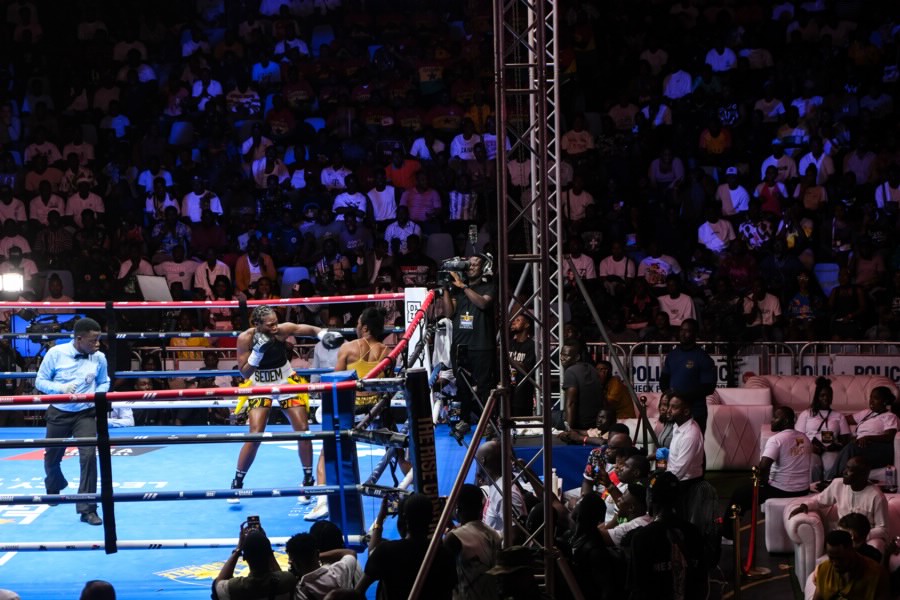
In Ghana, women boxers continue to pursue the sport despite the economic hardship and institutional inequalities they face in and out of the ring.

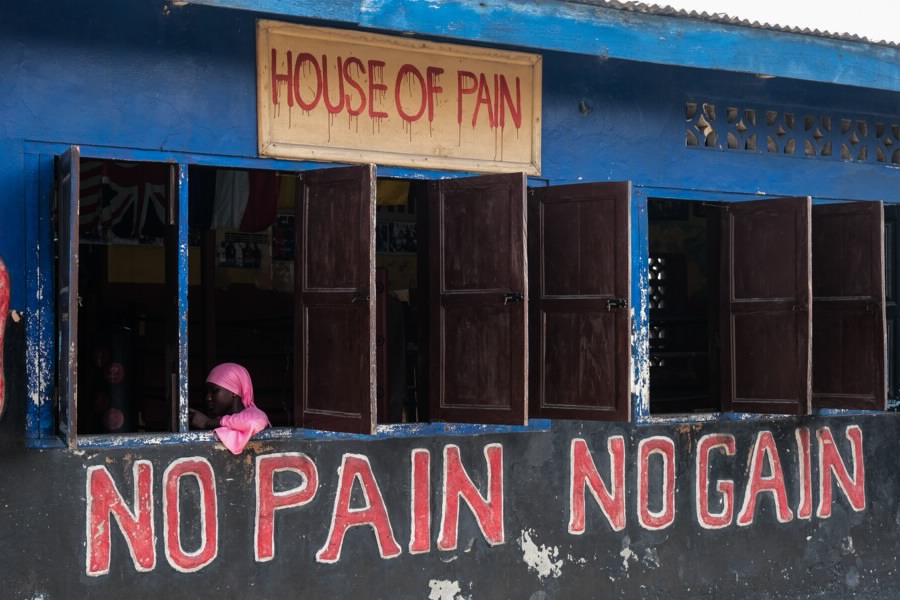
Young teenage boxer of Besesaka takes a break during the Ramadan at an ongoing training session at the House of Pain Gym, Jamestown Accra in March 2026. All images © Olaoluwa Olowu 2026.

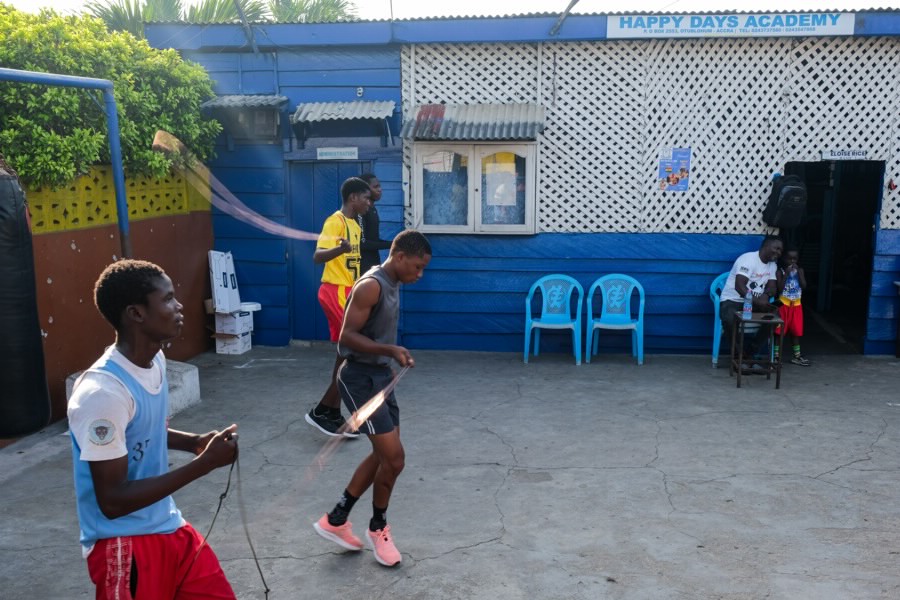
On a late afternoon in Jamestown, as schoolchildren stream out of classrooms and the sun begins to sink over Accra’s coast, the Black Panthers Boxing Gym comes alive. Inside the makeshift gym at the Happy Days School, young fighters wrap their hands and prepare to train, while lingering students are ushered home to clear space for sparring sessions.

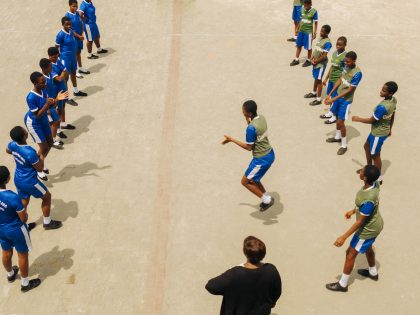
A group of boxers performing skipping drills in an open courtyard.
Young boxers occupy the Happy Days Academy in Jamestown British-Accra to train on April 2026.

Coach Ebenezer Adjei, known locally as “Coach Killer,” moves briskly across the courtyard, pairing fighters, correcting stances, and drilling combinations. Among the dozens of boxers under his watch, only two women train alongside the men: Abigail Quartey, Ghana’s first female world boxing champion, and fellow boxer Elizabeth “Kizzy Boakye.” Their presence reflects both the progress and the persistent inequalities shaping women’s boxing in Ghana.

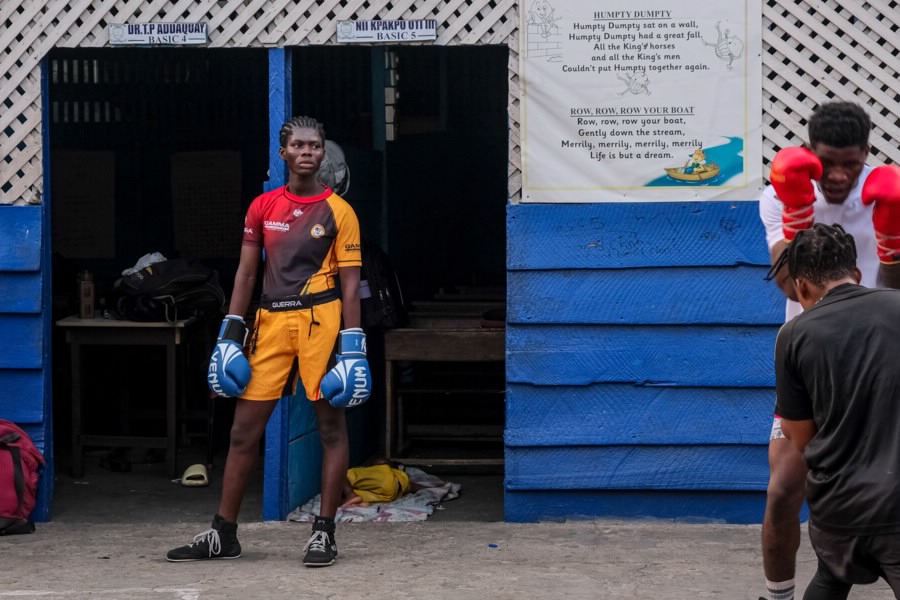
A boxer stands outside of a boxing gym, wearing blue boxing gloves.
Elizabeth, Ghana's amatuer female boxer at the Black Panthers Gym in the Happy Days Academy courtyard in Jamestown, Accra in January, 2026

Boxing has long occupied a central place in Ghanaian sporting culture, particularly in Accra communities such as Jamestown and Bukom, which have produced celebrated fighters including Azumah Nelson and Ike Quartey. Yet women remain significantly underrepresented in the sport, accounting for only a small share of licensed boxers and often training with limited financial support, sponsorship, and recognition.

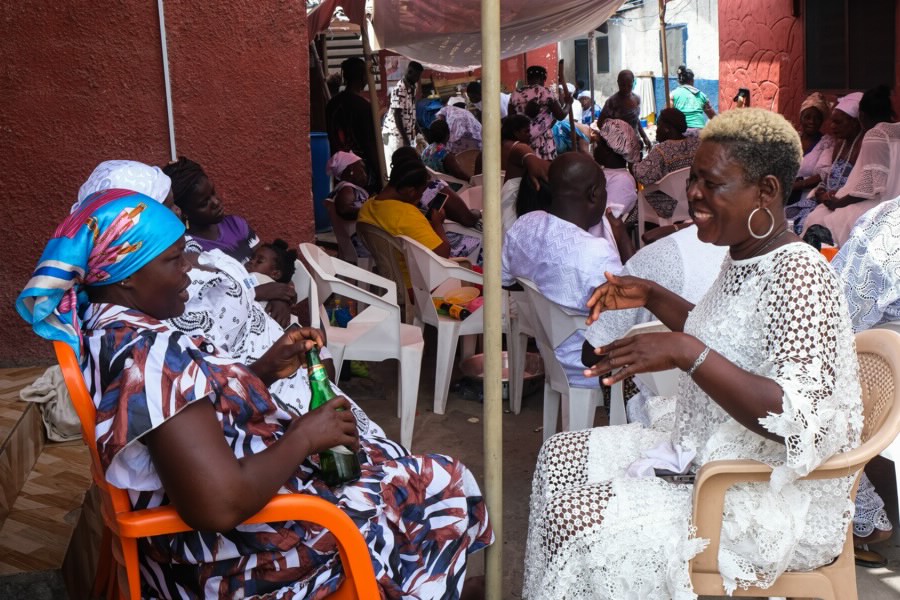
A group of women at a ceremonial gathering.
Women guests celebrating and honouring an elderly woman in their community, Jamestown, Accra on April 2026, for giving birth to ten children. Among the Ga people, mothers with as many as 10 children are sometimes celebrated later in life by their children, famailies and community.

Historians trace boxing’s roots in coastal Accra to Asafo Atwele, a bare-knuckle combat tradition within Ga society used to settle disputes, defend communities, and integrate outsiders. As colonial authorities increasingly regulated indigenous fighting practices in the early 20th century, boxing evolved into a formal sport. Women, however, remained largely excluded from participation and appeared mostly as spectators and supporters. It would take decades before female fighters entered the ring themselves.

Among the first were Yarkor Chavez, late 40s, widely regarded as Ghana’s first female professional boxer, and Naa Amerley Turkson, 54, Ghana’s first female boxing coach. Their emergence helped open pathways for younger fighters, including Janet Acquah and Abigail Quartey.

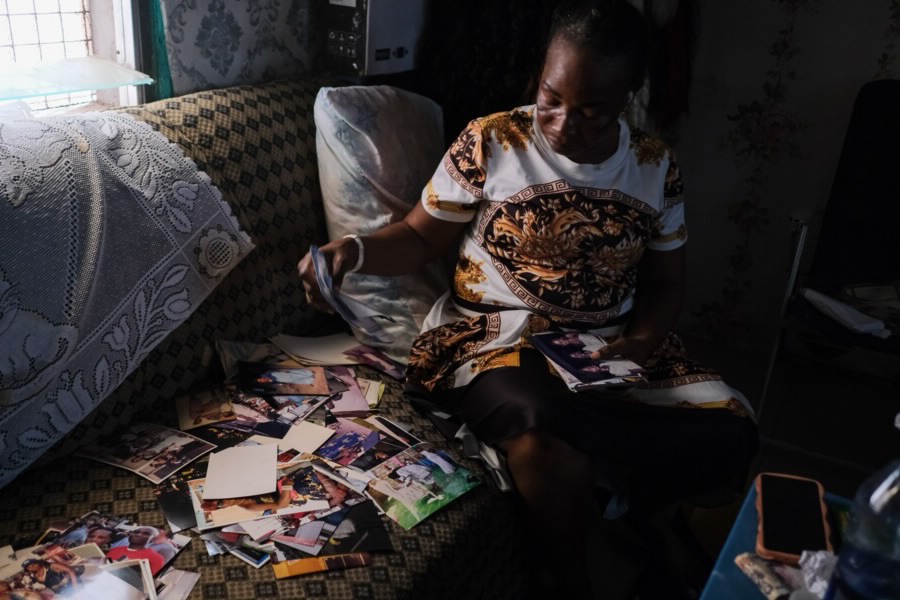
A women sifts through photographs and clippings, sitting on a couch in a darkly lit room.
Yakor Chavez, Ghana's first female professional boxer, and now Queen-mother, going through old photographs of her boxing days at her home in Jamestown Accra, in February 2026.

Now a queen mother in one of Greater Accra’s traditional areas, Yarkor Chavez recalls the hardships of pursuing boxing in the early 2000s. “I started boxing in 2000. My first fight was with Iyabo from Nigeria,” she said. “When I come back after fighting, I am hungry. No food to eat.” Sitting in a dimly lit room after returning from a hospital visit for headaches and chronic pain that she attributes to years in the ring, Chavez described a career that brought visibility but little long-term security.

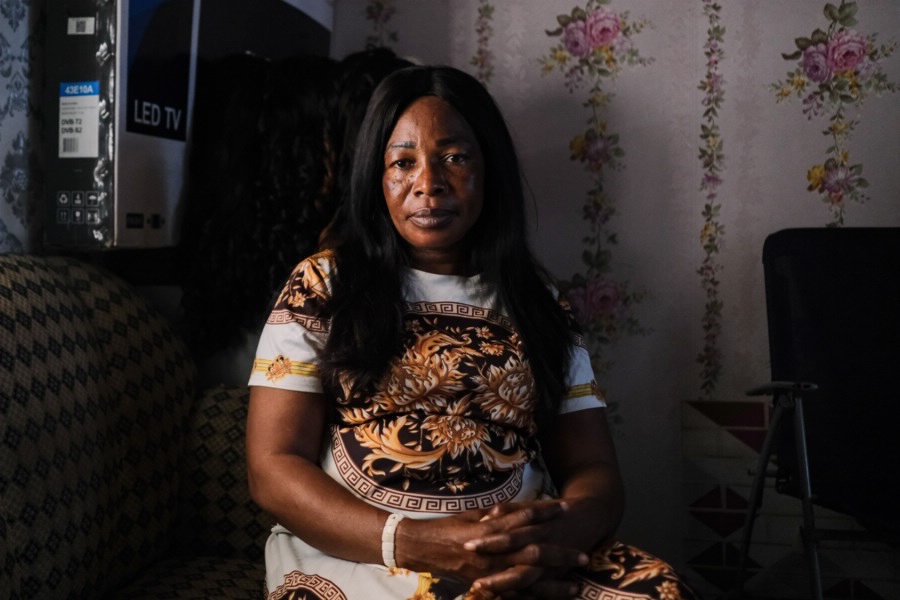
A portrait of a woman
A portarit of Yakor Chavez at her home in Jamestown in February, 2026.
A portrait of a woman
A portrait of Naa Amerley Turkson at her workspace in Jamestown Accra in February 2026.

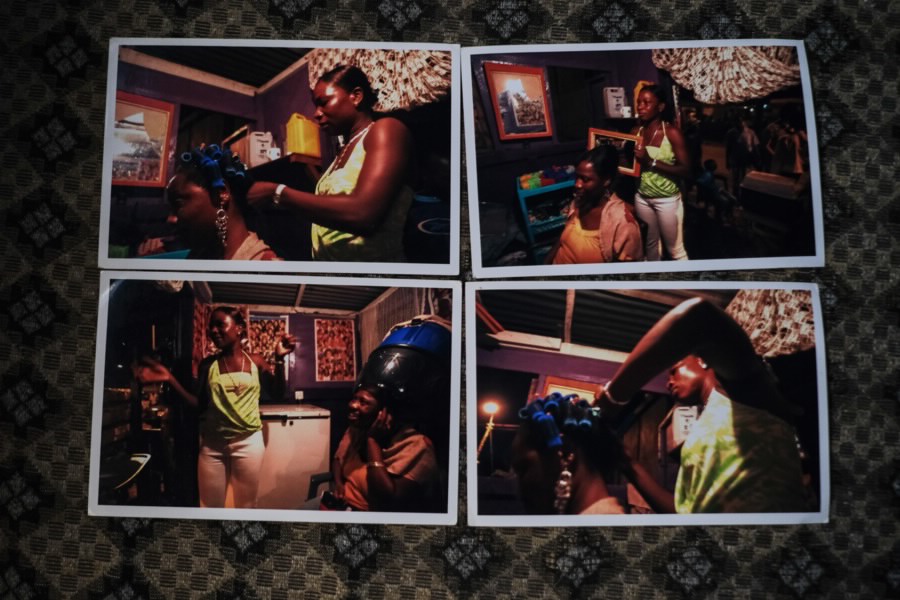
Published records show Chavez made her professional debut in 2002 and fought until 2022. Outside of boxing, she worked as a hairdresser, sold jewelry, and at times worked as a ring card girl to make ends meet. Since being enstooled as a queen mother in 2020, she said traditional restrictions have prevented her from continuing either boxing or hairdressing. She is now learning sewing, but says the ceremonial role provides no income.

Archival potographs displayed at the home of former of former boxer, Yakor Chavez working as a hair dresser during her boxing career Photographed at her home in Jamestown accra, Ghana in February 2026.

“I still have the aftermath of boxing,” Chavez said. “I have headaches and body pain. I go to the hospital most weeks.” At one point during the interview, she gestured around her grandmother’s home, where she now lives. “I did not achieve anything in boxing,” she said. “Sometimes when I think about my life, I feel like taking acid and dying because I wasted my life in boxing, and I don’t have anything.”

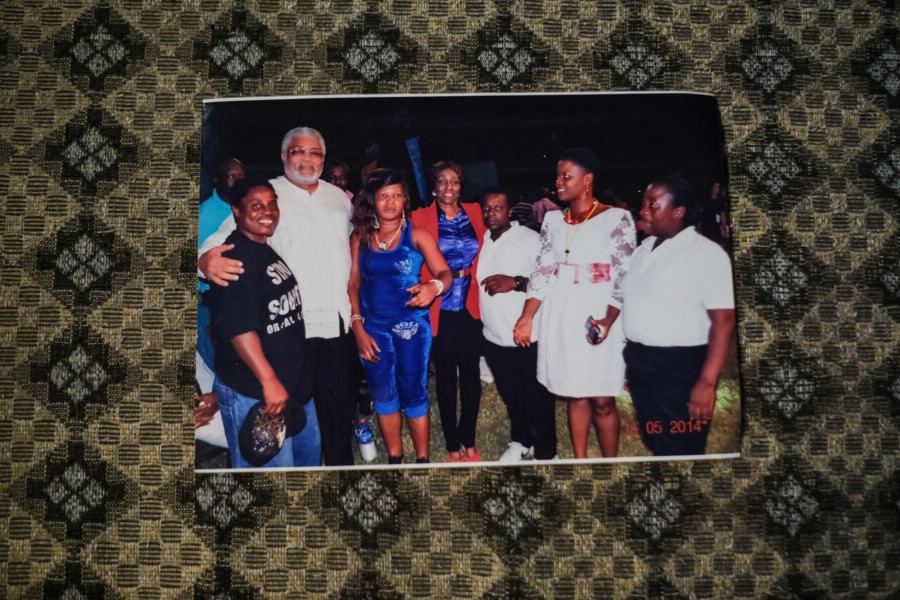
Archival potographs displayed at the home of former boxers, Yakor Chavez and Naa Amerley Turkson with Ghana's former president, Jerry John Rawlings during their boxing career Photographed at her home in Jamestown accra, Ghana in February 2026.

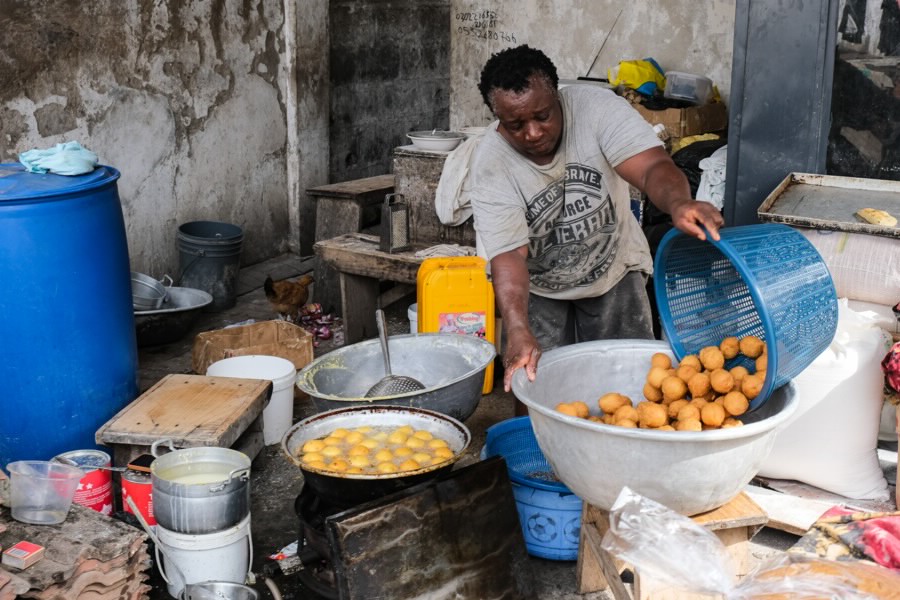
Naa Amerley Turkson, another pioneer of women’s boxing in Ghana, described similar struggles. She entered boxing in the late 1990s after participating in football, handball, and volleyball, and later transitioned into coaching and officiating. Growing up in Jamestown, she supported herself through catering and baking while training. She said women fighters often depended on coaches and family members for food, transport, and motivation due to limited institutional backing.

Naa Amerley Turkson frying some doughnuts at her workspace in Jamestown Accra in February 2026. A side job shat supported her career and still is.

Turkson recalled how planned trips to women’s championships in Cairo and Pennsylvania in 2001 were canceled due to a lack of funding. Rather than leave the sport, she became an assistant coach, then a referee and judge.

Despite these challenges, Turkson believes things will change and hopes that something better will come.

“I want boxers after my time to achieve what boxers of my generation could not achieve, because the legacy I left is that I fought the government, and today we have a female boxing national team. I have to fight for those who are coming. They have to do the Commonwealth Games, African Games, Olympic Games, and World Championships. I want to see them with their medals because in my own time, we were not able to achieve them.”

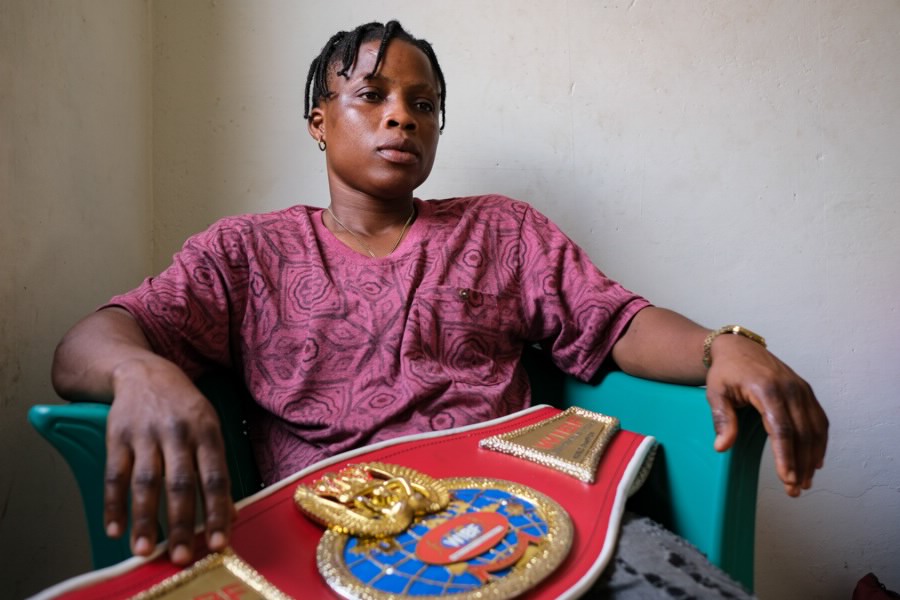
A portrait of Abigail Quartwy, Ghana's first female boxing champion in her home with her WIBF World Super Bantamweight tittle in Accra, Ghana in January 2026

For younger fighters, many of the same barriers remain. Abigail Quartey said she entered boxing in 2010 after switching from football at her brother’s encouragement. Relatives and boys in her community discouraged her from fighting, saying boxing was for men. At one point, financial pressures forced her to stop training and work as a lottery writer in Accra’s markets. Even after winning the Women’s International Boxing Federation (WIBF) Super Bantamweight title in 2024, Quartey said female fighters still receive less support and recognition than male boxers. “If you want to be a professional and you don’t have somebody to help you, you can’t do it,” she said. “We are doing the same job.”

Janet Acquah, 30, another member of Ghana’s national women’s boxing team, balances training with helping her mother at the market and making dreadlocks to cover transport and living expenses. Acquah won bronze at the 2024 African Games in Accra and hopes to qualify for the Commonwealth Games and the Olympics. “At the beginning, some of my family told me to stop because they thought boxing was only for men,” she said. “But I kept going.”

Officials within the sport acknowledge the structural challenges facing women’s boxing. Patrick Johnson, secretary general of the Ghana Boxing Authority, said promoters are often reluctant to invest in female fighters due to concerns about profitability and career interruptions. “You can have a contract with a female boxer; all of a sudden, she can be pregnant, and your investment is lost,” he said. Critics argue that such views reinforce the perception that female athletes are financially risky rather than professionally viable.
Sarah Lotus Asare, founder of the Girls Box Project and a boxing matchmaker, said women’s boxing requires deliberate investment and opportunity to grow. “The focus is on men,” she said, adding that many people still do not want to see their women, mothers, or sisters fight. At the same time, she said female fighters have demonstrated they can succeed if given the same support as men. “It is not only the men that can be successful, but the women can too.”

Projects such as Besesaka, which combines boxing with education, scholarships, and mentorship for young athletes, are attempting to reshape the future of the sport by providing structured support systems for fighters beyond the ring. The initiative reflects a broader shift in thinking about boxing in communities like Jamestown, where the sport has long been tied to identity, opportunity, and survival.

House of Pain Gym, Jamestown Accra, where students of Besesaka trains, in March 2026.

Across generations, women in Ghanaian boxing have fought not only opponents in the ring but also financial hardship, social stigma, and institutional neglect. While inequalities persist, their growing presence in gyms, competitions, and leadership roles signals a gradual transformation in a sport that has historically sidelined them.

About the Author

Olaoluwa Olowu is a Nigerian writer, photojournalist, and documentary photographer based between Lagos and Accra. Their work explores African culture, migration, gender, and social change.

Further Reading