Remember AFCON?
Behind the refereeing drama and rising revenues, AFCON 2025 exposed a tournament increasingly shaped by global capital rather than the long-term health of African football.
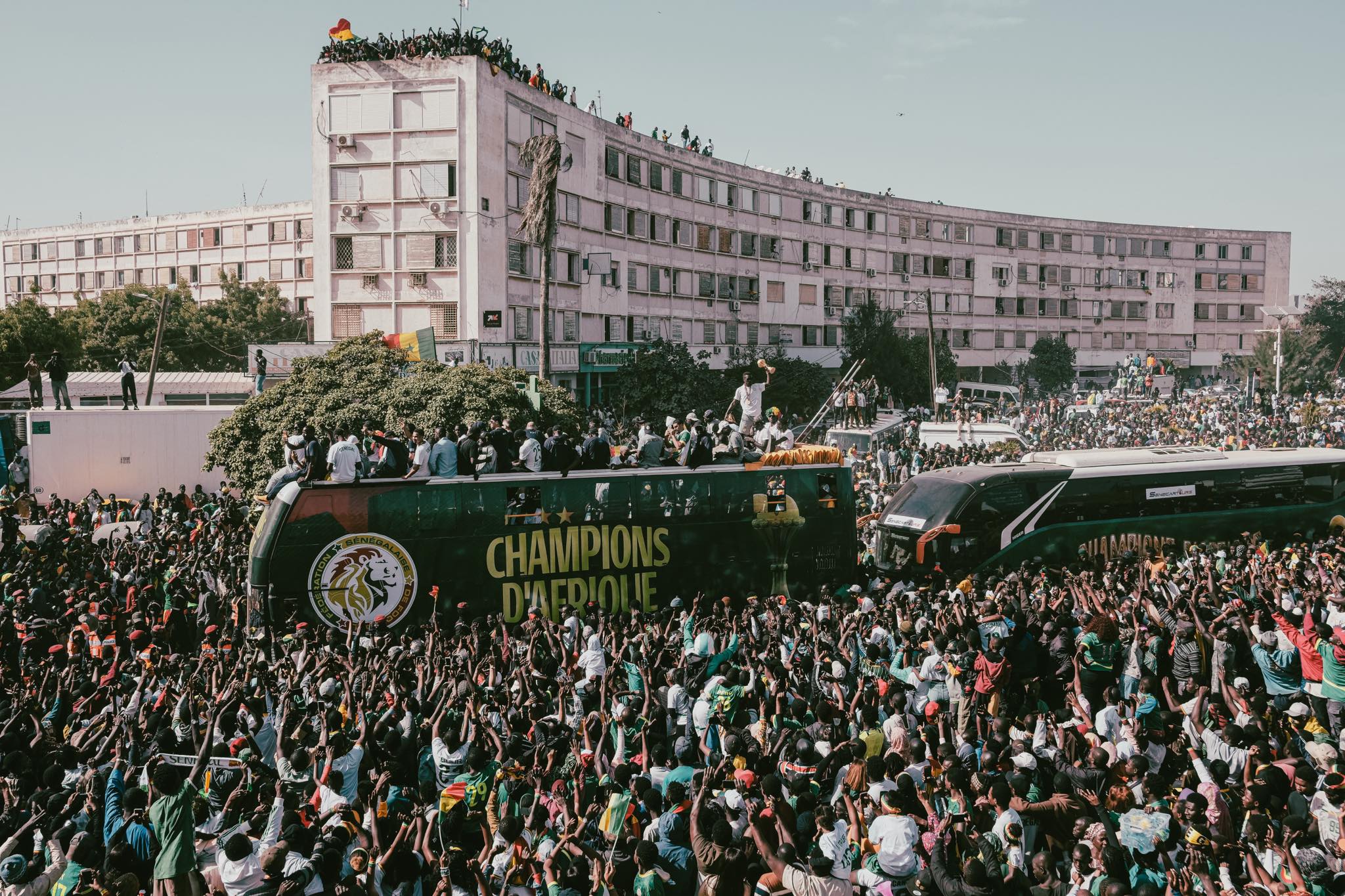
Fans fill the streets of Dakar as Senegal celebrate their victory parade following their triumph over
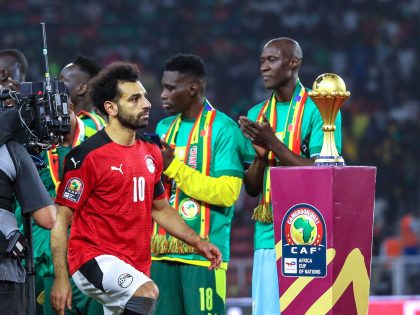
The 2025 African Cup of Nations is over. Millions of fans, including myself, are relieved after the refereeing chaos of the AFCON final, but are asking critical questions regarding the state of the game. Sadio Mané’s greatness of mind and sportsmanship, as well as Pape Gueye’s absolutely magnificent goal worthy of the most exhilarating moments in African football, could have redeemed AFCON 2025, but sadly they did not. Off the pitch, complaints about inadequate treatment of some delegations, allegations of corruption and unsavory actions by certain lobbies and local sports leaders, key players suddenly became sick for the final, and the death of Mohamed Soumaré, a famous Malian sports journalist known for his analysis, courage, and outspokenness, tarnished the image of AFCON 2025.
The Confederation of African Football (CAF), which has organized AFCON since 1957, was a tool for asserting the African quest for identity and independence, and for fighting against racial discrimination in Rhodesia and South Africa. Over time, with an increasing number of votes in FIFA, CAF turned out to be an instrument for the African continent to claim its rightful place in world football. It slowly and painstakingly succeeded in increasing African participation at FIFA competitions. AFCON symbolizes a biannual unique theater for celebrating African players, personality, and culture.
In terms of the game itself, AFCON incorporated specific characteristics of our personality: a love for beautiful play made of improvisation and fanciful actions of distinctive iconoclasm. The same aesthetics prevail in music, theater, and fashion across the continent. Currently, our football prioritizes physicality over finesse and produces very few creative players.
Economically, AFCON has sadly evolved from a competition in which the vast majority of African footballers are trained locally to one in which federations scout bi-nationals and foreign-based players to represent the “nation.” Local players are confined to a second-tier championship called CHAN (African Nations Championship), which will be replaced in 2029 by the Nations League, the latest brainchild of CAF, sanctioned by FIFA.
CAF, like many African federations, lacks a long-term vision to create a healthy and sustainable ecosystem. In most national leagues, football does not offer professionals a decent living. It does not generate sufficient revenue, even when aggregating ticket sales, sponsorships, or television rights.
For several federations, AFCON is a major source of income that they manage, with little focus on the long-term. Governments should not intervene in the management of federations, but paradoxically, they pay for the national teams’ travel expenses (food, accommodation, transportation, medical care, etc.). The Senegalese government used 5.125 billion CFA Francs for the Lions’ participation in AFCON 2025. As winners, they collected $10 million in prize money and received a total reward package of 2.1 billion CFA francs.
Another paradox is that while FIFA encourages non-governmental and apolitical federations, its director, Gianni Infantino, is a regular presence in corridors of power, meetings, and homes of powerful politicians, sheiks, and other celebrities around the world. Awarding the Peace Prize to the President of the US and attending the 2026 Davos World Economic Forum are other controversial issues.
According to several analysts, the decision to change AFCON to a four-year cycle was made by a clique (perhaps the term “junta” would be appropriate here). This decision (like others), as analyzed by sports economist Gérard Akindes, primarily serves the interests of European football and would not have passed if it had been put through the CAF General Assembly.
CAF has now become an institution that spares no effort to anchor our football to major global neoliberal circuits, rather than serving its interests. Patrice Motsepe, whose tenure at the helm of CAF, has been marred by mismanagement and financial misconduct, boasts of CAF’s growing revenues and higher allocations to winners and federations. However, opacity surrounds how decisions are made, for whom, and how revenue is used. The following two examples demonstrate how costly and degrading some commercial deals can be.
First, AFCON is the only major competition in the major confederations to have sold its name to a corporation:TotalEnergies. This type of title sponsoring provides TotalEnergies a ready-made audience, high visibility and exclusive control over the experience itself. TotalEnergies, a colonial company, operating in Africa since 1956, has a legacy of environmental devastation in Mozambique and Uganda in particular. After suspending their operations for five years in Mozambique over security concerns provoked by militant activity against the TotalEnergies liquefied natural gas project in a very poor region of the country, the Mozambican government and TotalEnergies announced its resumption last month.
Second, in May 2025, CAF signed a “historic agreement” with the European Commission to support the men’s and women’s AFCONs as well as CAF’s African School Football Championship in 2025 and 2027. It begs the question of the role of the African Union and African capitalists in our development. Why is the European Union sponsoring African continental sports events?
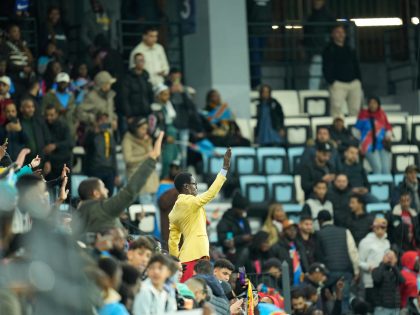
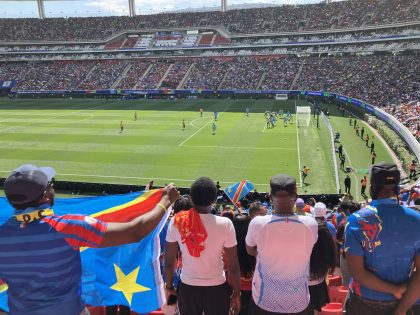
One of the most magical and significant episodes of AFCON 2025 was when Democratic Republic of Congo (DRC) fan Michel Nkuka Mboladinga, impersonating Patrice Lumumba and dressed in a suit in the colors of the DRC flag, remained motionless throughout DRC’s matches. His gesture, intended to reconcile memory and the fight against injustice, revived a powerful moment of the continent’s anti-colonial history, reminding us. Lumumba (Mboladinga), dignified, returns to the stadium to tell the continent not to suffer from collective amnesia. He reminds us that the struggle for independence continues, especially in the DRC, where Congolese people have been dying for over a century: more than 10 million in King Leopold II’’s brutal personal colony through massacres, forced labor, torture, and diseases; and more than 10 million more since independence on June 30, 1960, in internal and border wars. Meanwhile, the country’s coltan, cobalt, copper, gold, lithium, and other mineral resources enrich multinationals and some neighboring countries. CAF remains silent on the persistent and pernicious racism that African and Black players experience continuously in Europe and other parts of the world. Yet, these players made up about two-thirds of AFCON 2025 squads, with the other one-third coming mainly from three countries: Botswana, Egypt, and Tanzania. In the final, all but two Moroccan players were based abroad.
Notwithstanding, AFCON 2025 was a success. Journalists, administrators and players praised the organization and the quality of the pitches. The Moroccan government invested a lot in football infrastructure over the years, to support the development of the game, but also in preparation to host the World Cup in 2030. Commercially, sponsorship and media rights accounted for about 90% of the revenue generated at AFCON 2025. It was clearly well-marketed worldwide and profitable. But that is not enough. This economic success actually should not hide the deep issues the historian Peter Alegi mentions in this article. Perhaps if our players were grown and groomed on the continent, they would play differently and more beautifully. At least, we would make football a viable “industry” for players and communities. For now, our football is in an elite, trickle-down mode, outward-oriented, hooked to European leagues, with very little dripping down to develop the communities where our football stars are born and bred.