Empty stands are not the whole picture
Why focusing on attendance figures at the 2025 AFCON is the wrong way to measure the tournament.
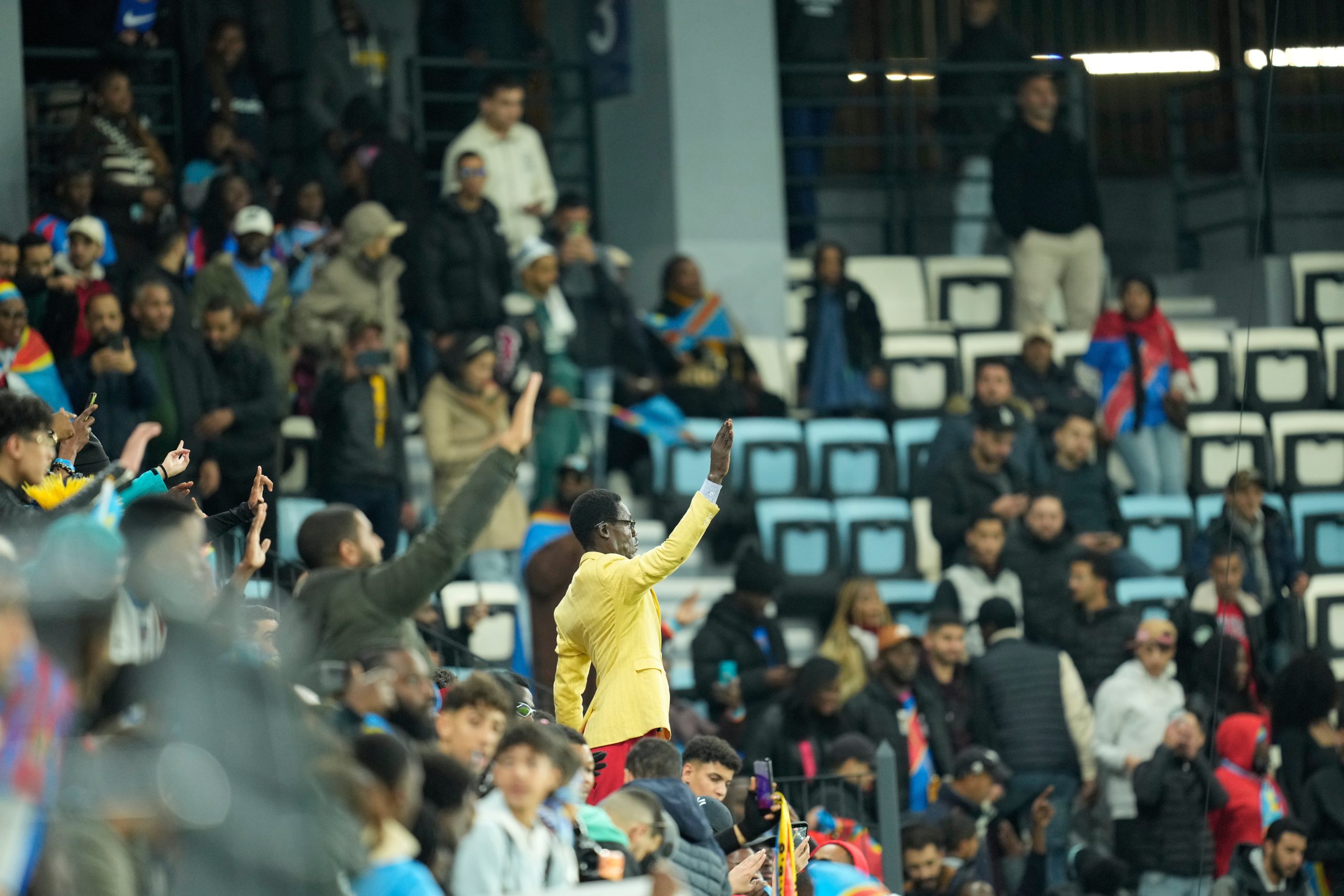
Michel Nkuka Mboladinga, a DR Congo fan impersonating Patrice Lumumba, during the Africa Cup of Nations
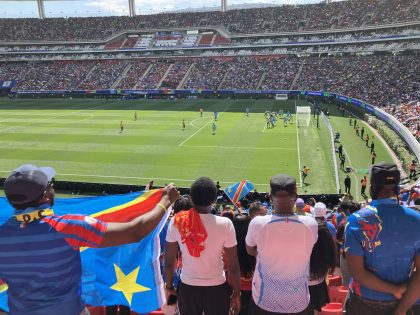
Reading the Africa Cup of Nations through its stands alone means missing what it produces socially. The stands give the tournament a visible form, but they offer only a partial account of how the tournament is lived. The stands bring together, in a single place, gestures that give meaning to the tournament. Michel Kuka Mboladinga’s performance, which reproduced the posture of Lumumba, is a striking illustration of this. Such a scene resonates because it condenses, in a single moment, a political memory and a sporting event. The stadium offers a stage to gestures that then take on a different dimension. It concentrates, and makes legible what would otherwise remain diffuse.
This is why the stands continue to occupy a central place in how a tournament is perceived, evaluated, and judged. But a decisive part of the tournament’s experience unfolds in more ordinary spaces, where engagement takes other forms. In cafés, public spaces, and informal settings, often well before the question of going to the stadium even arises. A recent study by the Sunergia Group shows that a large majority of the public in Morocco did not buy a ticket for AFCON, while still remaining engaged with the tournament. This figure is often read as a sign of distance or lack of interest. It deserves a more nuanced reading. As soon as we look at everyday practices on the ground, the picture changes.
During the quarter-final between Algeria and Nigeria, the match is broadcast on the televisions of a restaurant. Plates arrive. The meal and the match unfold together. Watching AFCON does not require changing place or breaking with routine. The tournament inserts itself into existing practices, into temporalities already shaped by work, family, and everyday sociability. For many, this is the most suitable form of engagement, allowing a continuous collective experience, requiring neither displacement nor disruption.
Sparse stands, when read through television images alone, tell us very little about the tournament’s place in society. A Zimbabwean professor who recently settled in Tangier explains it to me simply, “I work until 9 pm.” The same answer comes from my mototaxi driver, Mouhcin, when I ask whether he has attended a match at the stadium. He answers with a single word: “work.” These responses express neither rejection nor disengagement. Both tell me they follow the matches with interest. These answers point instead to ordinary trade-offs, to everyday priorities. Absence from the stands, on its own, says nothing about the intensity of attention given to the tournament. The stadium thus becomes a possible step, but not a necessary one. The stadium is no longer the natural entry point into engagement and is now part of a broader set of practices and trajectories. Public space, too, extends this experience.
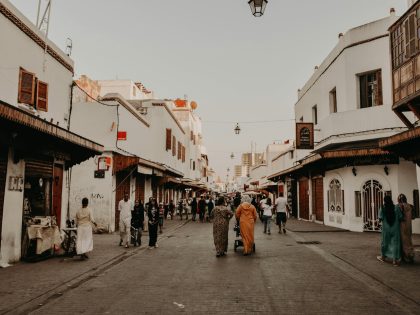
At Bab El Had Square in Rabat, collective celebrations emerge after matches. Most are improvised, and people gather there implicitly. Mobilization takes shape because the place and the moment allows it. The public gathers and sings, and vendors circulate. After the final whistle, the match continues in the city. These scenes are not captured by statistics and ticketing figures and broadcast audiences are not designed to capture these forms of engagement. Yet these scenes produce a shared memory, made of collective celebrations. Major football tournaments leave us primarily with memories. They unfold as much in the stands as in urban landscapes, often less during the match itself than in what precedes and extends beyond it. After Senegal’s 1–0 victory over Mali at the Grand Stade of Tangier, rain is falling. The percussionists leave the stands and settle in the exit corridors. An improvised concert begins. People stop, gather, dance. They sing Senegal’s qualification for the semifinals. Celebration spills beyond the planned framework and gives rise to new forms of celebration that take root in the margins. The memory of the tournament is built there, in these interstices.
The stands remain central. This is where certain images condense, where certain gestures become visible before entering the tournament’s memory. At the same time, they no longer constitute the natural entry point of engagement for a growing part of the public. The AFCON experience is fragmented. It is distributed across the stadium, cafés, public space, transport, and the scenes and moments of communion before, during, and after the match. This fragmentation is a central feature that needs to be accounted for.
Understanding the real impact of a tournament like AFCON requires looking beyond standard indicators of attendance and broadcast audiences. Close attention to lived experience, to everyday uses, and to ordinary choices becomes necessary. Otherwise, a decisive part of what the tournament produces socially remains out of view. The stands do not tell the whole story. Much of what gives AFCON its social meaning unfolds beyond them.