Between fandom and dissent
Eritrea’s recent progress in AFCON qualifying offered a rare feel-good moment, but new player defections underline how fragile that progress remains amid the country’s political realities.
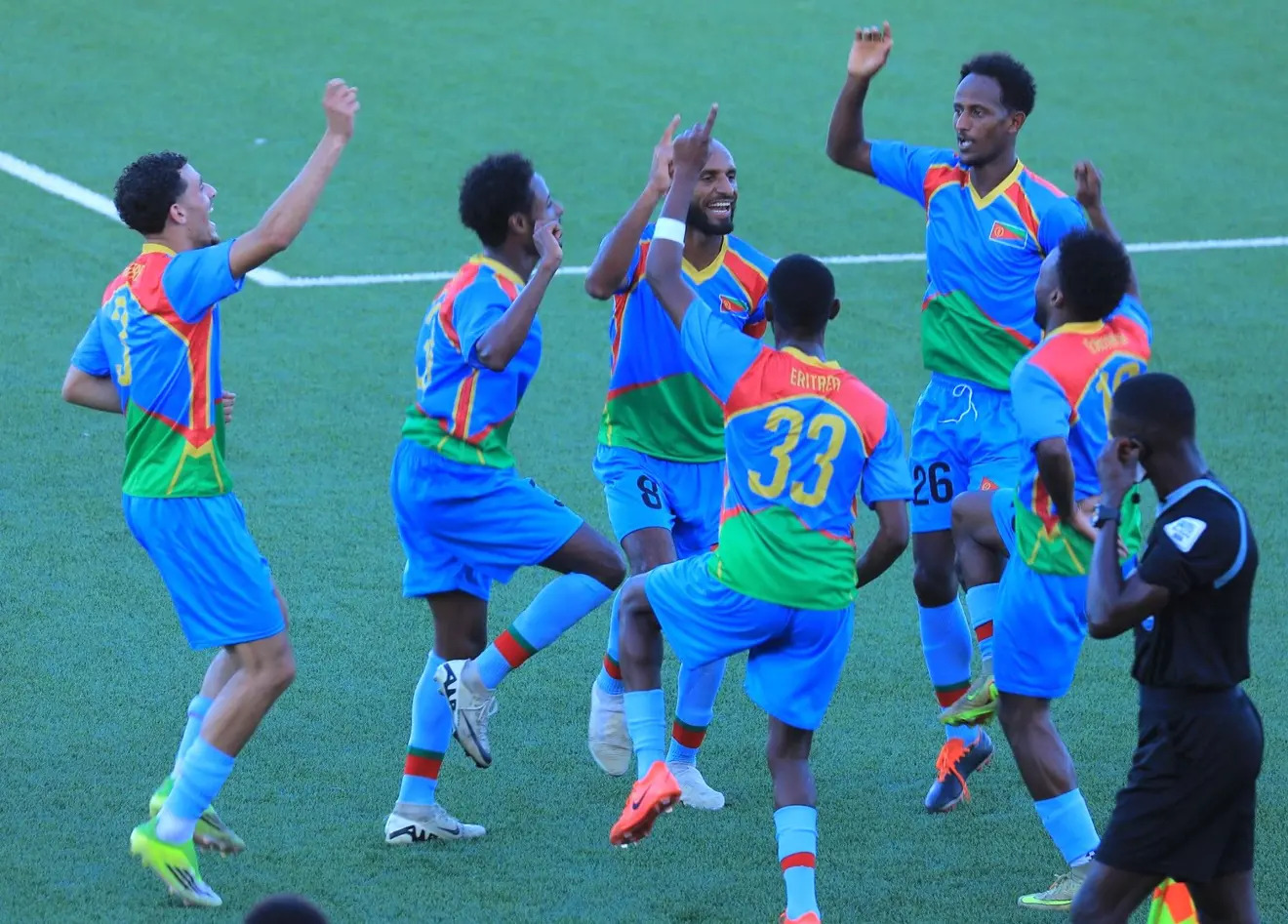
Eritrea players celebrate during their historic aggregate victory over Eswatini to reach the next round of
James Baldwin once wrote that he loved the US more than any other country in the world, and exactly for that reason, he insisted on the right to criticize her perpetually. As an Eritrean-American, it’s equally painful as it is validating to be in a lineage of Black-American artists committed to patriotism through the lens of dissent.
I was sitting in a stadium in Guadalajara on March 31 when DR Congo qualified for the FIFA World Cup after 52 years. While violence and displacement continue to plague Eastern Congo, the DRC squad have been incredible advocates for those still suffering in the region. On the same day, Iraq also qualified for the World Cup in Monterrey, and their coach said he hoped the result would change how the world sees his country. And on the same day these two teams won in Mexico, Eritrea progressed past the preliminary stages of qualifying for the Africa Cup of Nations (AFCON) after a 19-year absence.
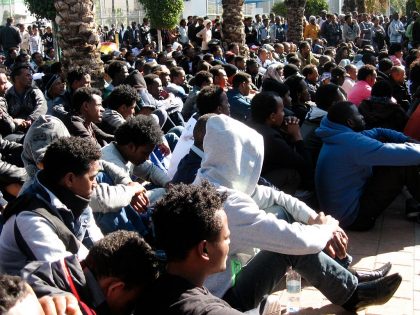
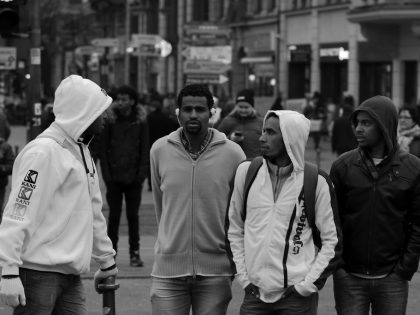
Some framed this as a homecoming, a renaissance, and even proof of development. What it’s actually proof of is that Eritrea’s best footballers have fled—reflecting the tens of thousands of Eritrean nationals who flee annually, with risk of being shot at the border as they leave behind loved ones who remain hostage to enforced silence. This diaspora team is not a symbol of progress—it is a census of flight. Case in point: less than a week from Eritrea’s decisive win against Eswatini, it’s been reported that seven out of 10 local players defected from the national team in South Africa.
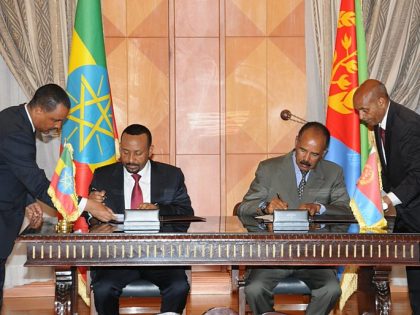
Eritrea is a country of roughly three million people that has nonetheless become one of Africa’s largest sources of refugees, with up to one-third of the Eritrean-born population living in exile. The justification for indefinite military conscription—a system that human rights scholars have compared to slavery—has always been the threat of Ethiopian invasion. That threat, once largely manufactured, is now increasingly real: Ethiopia has explicitly claimed access to Eritrea’s Red Sea coast as a national imperative. Despite a three-decade-long fight for independence from Ethiopia and the “shoot to kill” border policies, Eritreans continue to flee across this very border.
While Ethiopia maintains the highest population of Eritreans outside of the country, ongoing tensions between the two countries have led this population to be transient and often continue high-risk journeys where they are vulnerable to extortion, torture, enslavement, and arbitrary detention—like the mass detentions witnessed in Egypt earlier this year. Exit visas are required to leave the country. They are nearly impossible to obtain, leading Eritreans to succumb to the dictatorship’s demands, as the government maintains power over critical documents required to legalize status or travel legally. Dictatorship supporters often leverage these conditions to paint the picture of migration as one of economic mobility—like many African nations—rather than systemic abuse and silence that extends far beyond Eritrean borders. Many who are established in the diaspora opt to pay a 2% tax and directly fund the regime—some out of genuine support and others to be able to support their families.
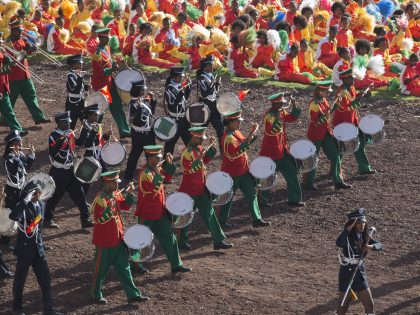
Under these strenuous circumstances, I feel immense empathy and frustration. While some diaspora face obstacles to speaking up, such as their families bearing consequences, many who have the choice remain complicit. Social media posts showing Eritrea’s Red Sea coast are weaponized as rage bait to shame those who speak out. TikTok and Youtube tourism videos have increased, illustrating the lack of internet access and renovation in the capital as vintage rather than evidence of decay.
Enforced silence then extends into the diaspora. I was once fundraising for Eritrean human rights at The Africa Center in New York City when an Eritrean man approached me and intimidated me until security had to escort him away. This is not exceptional. Look at the comments under any activist’s post. The government’s network of supporters abroad has long policed dissent across borders—players who defected described living in fear years after resettlement because “agents and supporters are everywhere, and our families remain at home.” The Eritrean state holds a monopoly on narrative domestically—since 2001 there is no free press, no open internet, no opposition—and its supporters work to extend that monopoly wherever Eritreans gather.
The cruelest part of this dynamic is the binary it imposes: if you critique the government, you are painted as anti-Eritrean, perhaps even a puppet of Ethiopian interests. But this has never been true. There have always been Eritreans who cheer the national team and denounce the dictatorship in the same breath, who understand that sovereignty deserves respect and that a people deserve to live, and that these are not contradictions.
Organizations like PEN Eritrea hold space for voices across linguistic and political distinctions. Eritrean activists celebrated the football progress while continuing to demand justice for Eritrean-American Ciham Ali Abdu, imprisoned as a teenager in 2012, and Eritrean-Swede Dawit Isaak, the longest-detained journalist in the world. Ciham and Dawit demonstrate in the most explicit manner that a foreign passport will not protect you from the realities of the dictatorship.
I often think about what Eritrean culture could be. Ethiopian jazz has flooded the streets of New York while Eritrean identity remains largely invisible in the mainstream. It’s not because there is nothing there—there is everything—but an undeniable gap in culture has been created by a regime that has denied youth paths to higher education, let alone the arts. The Congolese players advocate for their people from the pitch. Iraq’s coach asks football to carry the country’s image. For Eritrea, football cannot even carry its players home.
I refuse the false binary between silence and disloyalty—it will not be the first time truth has been called betrayal. In a country with no freedom of expression, there is no amount of sources, data, or testimony that will ever suffice. Dissent is a threat to the state where blind allegiance is the price of belonging.
I write anyway—cognizant of the privilege and responsibility that comes with being a diaspora-born Eritrean—even at cost to community. Like Ciham Ali-Abdu, I am an Eritrean-American who was born in California. Who would speak on my behalf if I were disappeared in Eritrea?
As Zora Neale Hurston said: “if you are silent about your pain, they’ll kill you and say you enjoyed it.” The government maintains silence. The diaspora enforces complicity. I write anyway.