Reading List: Anooradha Iyer Siddiqi
What if migrant environments, so often cast as scenes of abjection, border transgression, criminality, and placelessness, are instead repositories of knowledge, craft, and refined domesticity?
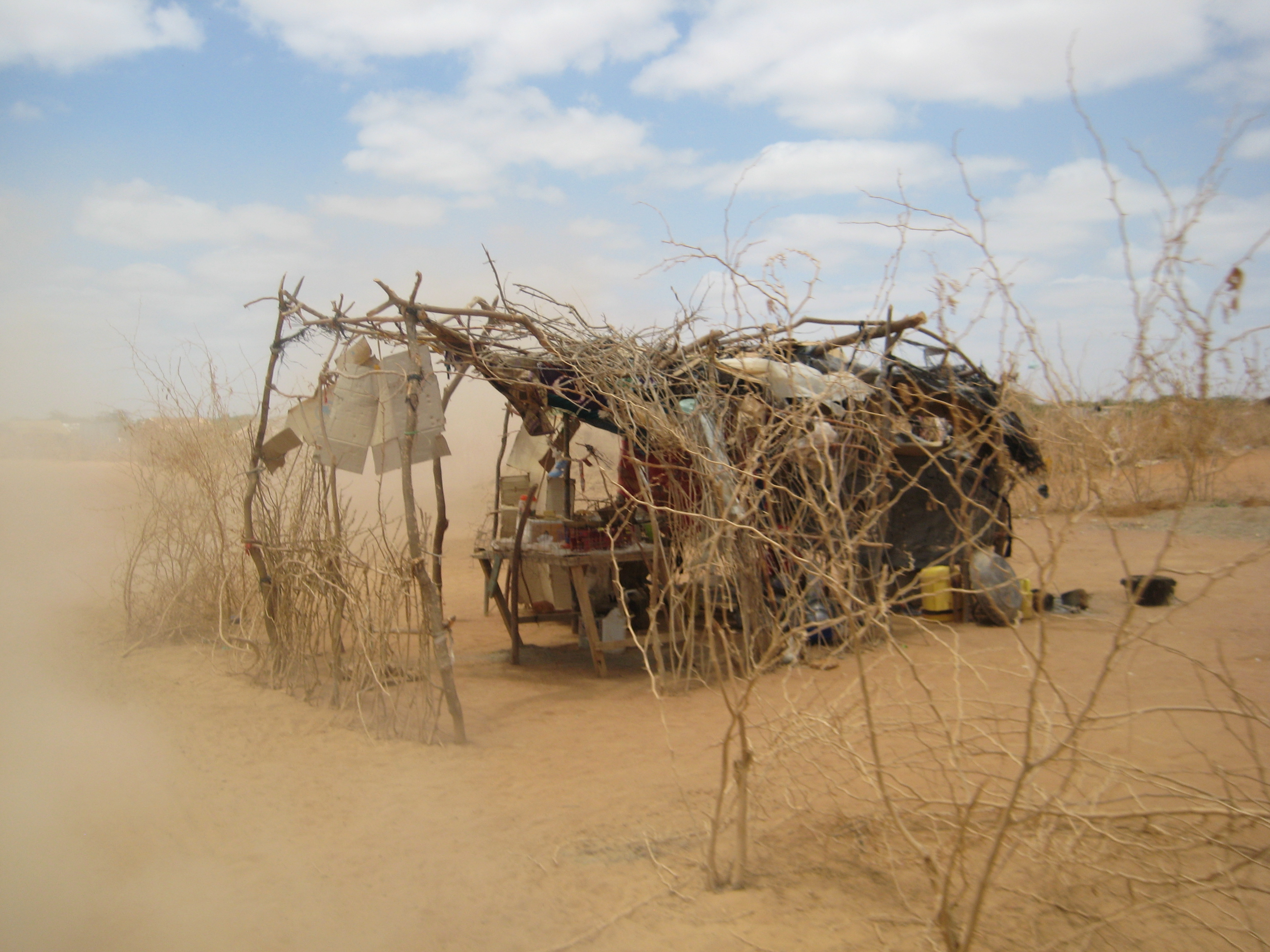
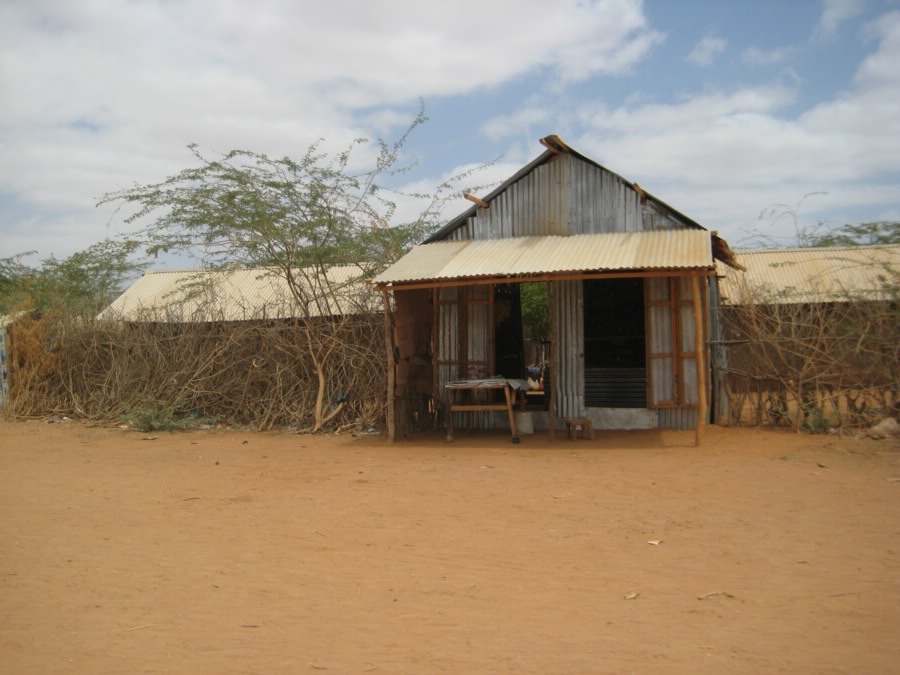
A provisions shop near Ifo camp, where migrating people encounter settlement at Dadaab. Photo by author, 2011.
We are taught to think of a refugee camp as an object produced in an instant, only in response to an emergency—one brought on, perhaps, by those seeking refuge. We are taught that refugee environments are provisional and abject, moreover, to be naturalized as such within the African landscape—as the African landscape. We are taught to misread migrant spaces as lacking history or architectural expression. To counter these misdirections, Architecture of Migration: The Dadaab Refugee Camps and Humanitarian Settlement looks closely at the complex settlements, ecologies, domesticities, archives, and material aesthetics. In Ifo, Dagahaley, and Hagadera camps, established in 1991 by the Kenyan government and the United Nations High Commissioner for Refugees at Dadaab, Kenya, in lands shared with Somalia and Ethiopia, the book finds African, Muslim, and Afro-Asian aesthetic worlds and a historical repository of partition, sedentarization, and migration. Dadaab forms a material afterlife of events long unfolding, through colonial and postcolonial time and space, and in multiple registers, aesthetic as well as social.
My book is grounded in 14 years of feminist and critical collective practice and research (see Cohabitations, Dadaab Commons, Feminist Architectural Histories of Migration, Insurgent Domesticities, and Settlement). While researching in dozens of archives and libraries in Africa, Asia, and Europe, and interviewing hundreds of women practicing architecture and art, representing governments, cultural institutions, and nongovernmental agencies, or living life in refugee camps, I read many books! If the anticolonial thought in Frantz Fanon’s Black Skin, White Masks and Walter Rodney’s How Europe Underdeveloped Africa anchored my work, its everyday tugs and buoying came from feminists.
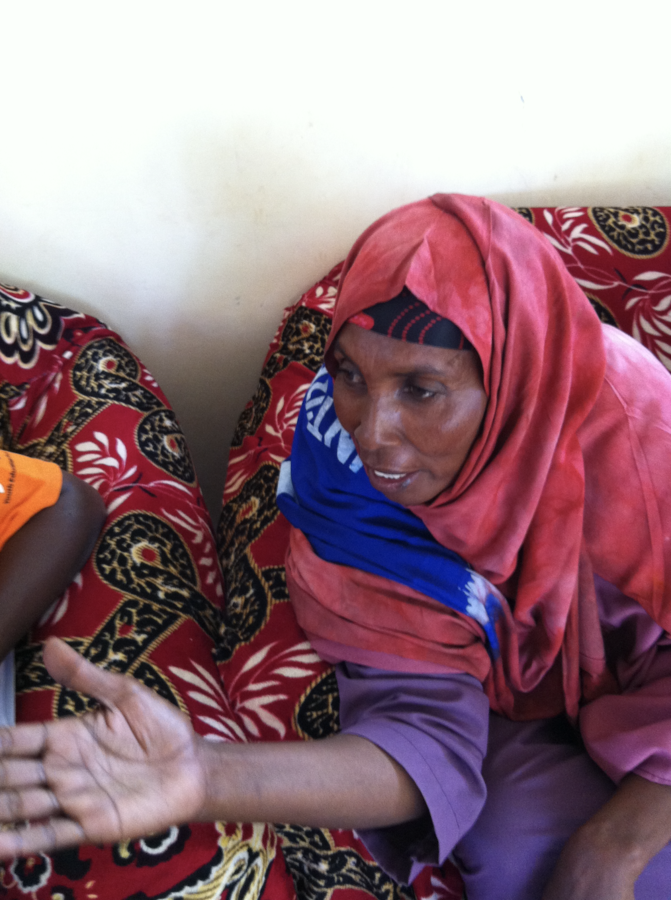
My study of the handcrafted acacia camp environments and interviews with many of their builders—including Ifo Chairlady Isnina Ali Rage and shopowner Shamso Abdullahi Farah, and Dagahaley farmer Maganai Saddiq Hassan—gave shape to a consciousness rooted in the social and ecological worldmaking of African, Muslim, and Global South feminists. Let me begin with three. Sylvia Tamale not only insists on decolonizing master narratives that suppress multiplicity in Decolonization and Afro-Feminism, but through her years of activism in Uganda and beyond, plants the working and thinking of African feminists on the ground, in the natural environment. This perspective is hardly limited to African feminists, as Radha D’Souza demonstrates in the Court for Intergenerational Climate Crimes—based on her book What’s Wrong with Rights?: Social Movements, Law and Liberal Imaginations—which foregrounds the workhorse labor and the place of the indigo plant (Comrade Indigo) within majority-world feminist intellectual commitment; she dispenses with reductive “West versus Rest” critiques through the perspectives of European underground and Third World intellectuals in the co-edited Decolonizing Knowledge: Looking Back, Moving Forward (open access). Further articulating the vitality of social difference to inform constructions of knowledge, Saba Mahmood argues that those constructions must assert against universalizing epistemes, secular as well as religious, in her foundational work on Cairo’s women, Politics of Piety: The Islamic Revival and the Feminist Subject.
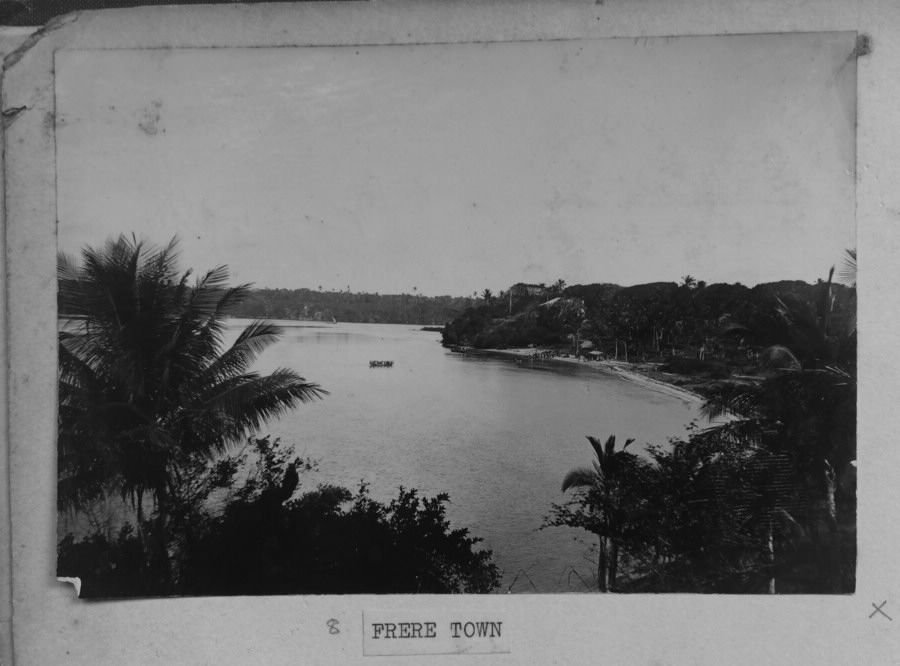
From there, global Black feminisms were my north star. Yvonne Adhiambo Owuor’s Dust dwelt within the landscapes of Kenya’s Northeast, the erstwhile colonial “frontier” constituted of migratory lifeways and marabou storks; her habitations haunt my book’s histories of land, emergency territory, and sedentarized pastoralists. Lose Your Mother: A Journey Along the Atlantic Slave Route, Saidiya Hartman’s attempt to fill in the blank slate of the historical record and her own life, helped me think with the stories of enslaved children freed from Indian Ocean dhows, raised near Bombay, and resettled near Mombasa: the negotiation between rescuer and rescued in the East African abolitionist settlement of Freretown that forms Dadaab’s prehistory. My book stands on the shoulders of Mabel O. Wilson’s work on: (1) spatial agency, as rooted in the bodies of builders and the physical labor of construction, in an essay on the “provisional demos” of the African American protest camp in Design, Displacement, Migration: Spatial and Material Histories, and (2) the inseparability of racial thought from modern subjecthood and the architectural discipline, which grew together out of Enlightenment reason and abstraction, in Negro Building: Black Americans in the World of Fairs and Museums and the co-edited Race and Modern Architecture: A Critical History from the Enlightenment to the Present.
My book argues that the humanitarian environment, intended as temporary, paradoxically affects settlement. Architectural historians develop a feminist provincialization of their field in grappling with migration’s immanence to settlement. In Fallow Fields: The Remnant Landscapes and Residual Architectures of Imperial Germany’s Settler Frontier, Hollyamber Kennedy articulates the displacement and unsettlement of people in German South West Africa (Namibia) and Eastern Prussia (Poland) together, within the nineteenth-century development of state policy to sedentarize and fix populations, eradicating migratory ways of life. Open Architecture: Migration, Citizenship, and the Urban Renewal of Berlin-Kreuzberg by IBA-1984/87, Esra Akcan’s study of the International Building Exhibition (a historical landmark of both architectural modernism and social housing), is a story of migrant inhabitation. In The Remittance Landscape: Spaces of Migration in Rural Mexico and Urban USA, Sarah Lynn Lopez tracks economic flows in built environments on either side of a fraught border.
My book argues that longstanding refugee settlements—aid environments long utilized to slowly confine migrants and police the border—are not de facto architectures to be understood teleologically, as if brought by people upon themselves, but instead predicated upon foundational partitions. This thinking draws on Vazira Fazila-Yacoobali Zamindar’s positioning of partition not as an event but as a concept, in The Long Partition and the Making of Modern South Asia: Refugees, Boundaries, Histories. In it, the violence of a partition is not a vague consequence of border conflict, but the direct result of bureaucratic shaping, as states attempted to resolve political uncertainty—debunking the myth that India and Pakistan somehow emerged fully formed as partitioned states, but rather, partitioned through a process of urban shaping. This is so with Palestine, Ireland, and Somalia itself. Safia Aidid’s Pan-Somali Dreams: Ethiopia, Greater Somalia, and the Somali Nationalist Imagination shows a political imaginary of possible futures based on territorial unification, conceived in reaction to a colonial present; Greater Somalia was not merely a nationalist movement but, following Raymond Williams, “a structure of feeling.” My book argues in favor of such feeling, which overcomes the partitioning principle, toward a straddling collectivity.