It’s not the refugees, it’s the austerity measures!
Rather than the cause of Africa’s economic crises, refugees are themselves victims of the political and economic decisions that produce displacement, deprivation, and insecurity.
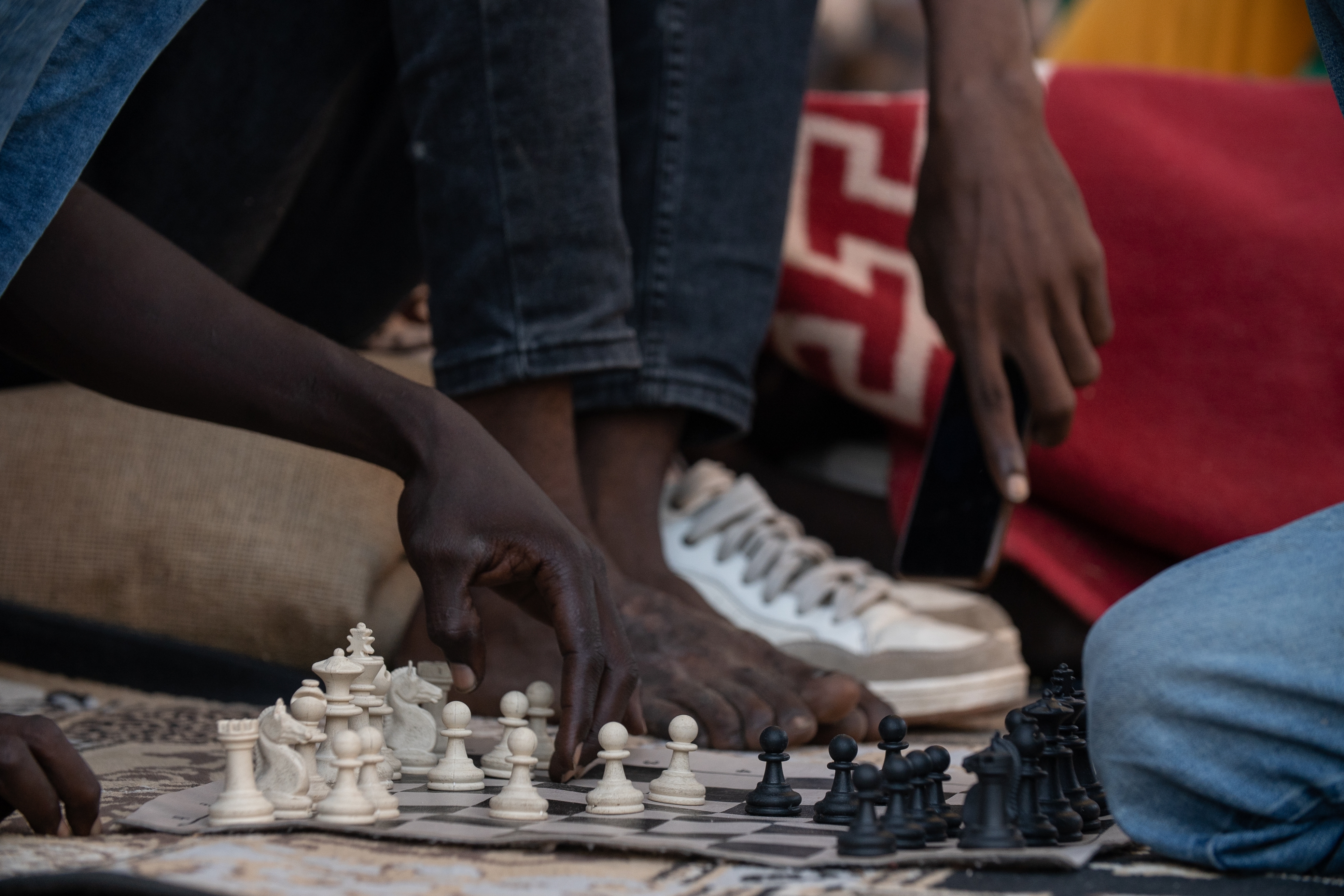
Migrant women and men wait by the United Nations High Commissioner for Refugees (UNHCR) headquarters on in Tripoli, Libya in October 2021. © Hussein Eddeb / Shutterstock.com
A Sudanese journalist, with whom I worked for two years at the same newspaper, told me when I contacted him to check on his situation after the last wave of attacks against refugees in Libya: “We are trapped in our homes. We can’t leave. I didn’t send my kids to school since the beginning of this wave of violence. The situation is difficult beyond imagination.”
The Sudanese who left Sudan seeking refuge in Libya, amid very violent clashes that started in April 2023 and continue to this moment, are facing violence, danger, and hatred in what was supposed to be a safe refuge. But this reality is not exclusive to Sudanese refugees, and the violence is indifferent to other nationalities who are fleeing conflicts, war, and instability at home: Ethiopians, Eritreans, and refugees from the Central African Republic.
In Libya, African refugees faced waves of violence, the latest in June this year. Despite competing for power, Libya’s rival authorities in the east and west have united in stoking anti-migrant rhetoric and launching a violent campaign of mass detention and expulsions against migrants and refugees, as a recent Human Rights Watch report has indicated.
In Egypt, a crackdown campaign led by security forces, accompanied by social media hate speech against Sudanese and Syrian refugees, intensified on the ground, blaming them for the rise in living costs, mainly rents, groceries, and basic life needs. As a result of systematic brutality, between January and June 2026, 12 Sudanese passed away in Egyptian detention centers and police cells, including a child of 17. Refugees processed for deportation are forced to sign voluntary return declarations.
Sudan hosts one of the largest refugee and asylum-seeker populations in Africa, mainly South Sudanese, Ethiopians, and Eritreans, who currently face detention and forced deportation from the capital, Khartoum, to refugee camps close to the borders with their countries of origin, after the Sudanese Armed Forces (SAF) regained control of the capital. This step was taken following a growing political rhetoric that profiled them as criminals and blamed them for the Rapid Support Forces (RSF) controlling Khartoum. Accordingly, they were deported to refugee camps in White Nile State, Al-Gadarif State, and Kassala State, camps that lack all basic human needs and restrict freedom of movement and the right to work. Many South Sudanese mothers were deported while their children were not allowed to accompany them, leaving them in limbo.
Such rhetoric, mainly produced and shared by pro-SAF individuals and platforms, provides the military establishment with a popular cover to reproduce its symbolic authority. It is also used by some actors within the army as a tool to bolster its legitimacy against the Rapid Support Forces, portraying it as the guardian of national sovereignty and the representative of the “authentic Sudanese” against the “foreign threat.” This reflects a deeper attempt to regain control over the state and society at a moment of total collapse of political and legal frameworks.
For many of these refugees, especially the Eritreans, returning is not an option, considering the human rights situation in Eritrea. But according to media reports, both Eritrea and Sudan are complicit in the repatriation of civilians from Sudan back to Eritrea.
Whether it is the systematic violence against Sudanese refugees on the continent, or the deliberate violence against African refugees in Sudan, these incidents reflect one broader reality in which violence is used and reproduced either by state actors or by the citizens of the host countries to whom the refugees sought safety within the African continent. This reality raises a critical question about how to understand such incidents, the politics behind them, and why we are seeing them now.
Shifting the blame
Have the refugees led to the economic crises in Egypt, Libya, or Tunisia? Or are these crises a direct result of the state’s social and economic policies?
In Egypt, the last ten years have witnessed a high level of dependence on debt; Egypt has become one of the IMF’s largest borrowers, while social expenditure, including social protection, health, and education, has shrunk, accompanied by political oppression. Those debts have been invested in projects lacking a developmental dimension, such as the new administrative capital project, which is expected to cost up to $300 billion by the time it’s finalized. The new capital is home to Africa’s tallest tower, the world’s longest monorail, and a new presidential palace commissioned by President Sisi. This tells the story of the political crisis through spatial isolation: Government ministries and parliament have been moved kilometers away from the historic urban spaces where demonstrations and revolutions were shaped. It is also heavily securitized through surveillance and the military, shifting budgets away from serving the people toward strict monitoring. State resources and national debt constrain the broader economy and exacerbate poverty and social inequalities.
Higher external debt interest payments, in addition to the cost of arms imports, which increased by 215 percent in 2013–2017 compared to 2008–2012, led to an economic crisis. Debt has also been a tool for maintaining a grip on citizens, while the military’s economic empire has expanded. It’s also worth noting that 1,365 conditions were imposed by the IMF and World Bank on MENA nations over the last 15 years, enforcing austerity, privatization, and deregulation. Conditionality has shaped the social and economic realities in many countries across the globe.
The state has slowly moved away from the bread subsidy system over the past ten years of International Monetary Fund–guided policy adjustments. This economic crisis has also contributed to the rise in immigration rates among Egyptians to Gulf countries and beyond.
This pattern aligns with Samir Amin’s critique: Peripheral states are integrated into global capitalism in ways that prioritize capital accumulation and elite prestige over popular welfare.
In Libya, the political and economic crises have intersected, creating a hostile environment for refugees. The cash-flow crisis stemming from multiple changes to national currency notes, high unemployment rates, deterioration of social services, electricity instability, and a health-care system that is not adequately accessible to the population have compounded the situation. All of these crises are a direct result of years of conflict and political instability.
It’s also a direct consequence of imperialist intervention in Libya. NATO and US military operations in Libya, the sanctions, and the border-engineering policies financed by the EU have all resulted in building a racist architecture. Resources received from the EU were used to establish influential militias, including the Libyan Coast Guard, now running smuggling and human trafficking economies that are sanctioned by the UN, even as they continue to receive EU funding and training.
Similarly, Tunisia has been trapped in debt. The social justice demands that ignited the 2010 revolution were not addressed; instead, an oppressive system is maintaining itself.
Such crises have led to high unemployment rates and rising poverty, fueling both the desire among young people to emigrate and scapegoating narratives against refugees promoted by those who stayed.
The South African case provides a clear example of this shift in blame. In a country with an unemployment rate of over 43.7 percent, protests against migrants have intensified in recent months, primarily led by the March and March movement, blaming African migrants for unemployment, poverty, crime, and lack of public services like education and health care. They called on the government to deal with the influx of migrants and protect opportunities. While it’s understandable that material despair and fear drive these protests, the root causes of this compounded crisis cannot be ignored. That includes the legacy of apartheid and the lack of economic justice post-independence. The white population, which constitutes 8 percent of the whole South African population, controls around 80 percent of the land, leaving the majority of the population, Black and coloured, with no ownership of land or means of production. With little being done to implement the social justice agenda in the post-apartheid state, wealth has remained concentrated among the same elite class, while the majority remain impoverished.
Adopting social and economic policies that impoverish people and limit their access to social services and basic needs is a key feature of the approaches in Egypt, Tunisia, Libya, and South Africa, among many other countries. This strategy is universal and aims to collectively punish populations to protect the systems that exploit them.
Refugees are being blamed for the difficult material conditions of citizens in crisis-affected countries, even though these conditions have their own political and historical structural causes and are closely linked to the political economies of states that are often highly dependent on the profiteering monetary and financial policies of international financial institutions.
Politics of hate and fear
But how are the political and economic crises entangled with hatred or fear of refugees?
Sara Ahmed’s The Cultural Politics of Emotion sheds light on how an anti-refugee sentiment is built, encouraged, and used to justify violence against them, and how building a national identity comes at the cost of the safety of refugees.
Fear is employed as a tool of political economy and as a technique of governance. In the Egyptian case, fear of refugees burdening the state’s budget is used to justify current social and economic crises and to trap people into relying on the political elite, represented by those in government, to resolve the refugee dilemma. Sudanese, Palestinian, and Syrian refugees have been labeled as such, and Sudanese refugees have lost their lives due to the security policies and interventions that forcibly deport them. A recent anti-refugee narrative relates to fear of what is called the “Afrocentrism discourse,” as many social media accounts share concerns over deliberate efforts by Black refugees to change the culture and demography of Egypt.
Fear of demographic change is echoed more loudly in official political speeches in Tunisia. President Kais Saied reflected on this specific issue during an official speech, while the crackdown on human rights activists continues, and voices that criticized the economic situation in Tunisia are silenced. Additionally, a Tunisian MP used racist language to deny reports on female refugees being sexually assaulted in Tunisia.
In Libya as well, such discourse spreads on social media, provoked by politicians seeking to build constituencies based on this fear.
On the other hand, Egyptian media portray refugees as the main cause of the crisis and as a burden on the social infrastructure, such as health and housing. On social media, these campaigns were led by pro-regime influencers, as some fact-checking platforms have indicated.
Syrian refugees and immigrants in Egypt also suffer from this manufactured fear through campaigns, including calls to boycott their businesses, accusing them of hijacking market opportunities.
Similarly, in Sudan, long before April’s war, refugees have faced accusations of immorality and been labeled as a danger to the Sudanese community’s values and social cohesion. Burdening refugees with the responsibility of security and treating them as a threat to national security are also narratives used, especially by the Sudanese army, to justify the forcible deportation of refugees to camps.
Such narratives act as a political strategy: Fear is engineered to elicit collective emotions and utilized in political discourse to mask the flaws of political regimes.
Fanon’s critique of postcolonial elites is relevant in the contexts above; he argued that elites turn the people against imaginary enemies. In this case, refugees are those imaginary enemies.
The failures of neoliberal policy
The shared economic model of these states centers on austerity and privatization policies that aim to limit state spending on social infrastructure and services, while using securitization and violence to suppress any attempts to protest against these policies. This explains why Egyptian arms deals increase as the economy deteriorates.
Refugees are usually forcibly displaced by economic collapse, structural adjustment, climate harm, and governance failure. They are then governed through restrictive asylum regimes, border controls, and humanitarian management. So neoliberal policies help produce displacement and then shape how displaced people are subsequently controlled.
In other cases, we have seen the externalization of borders as a strategy that has allowed states to avoid direct responsibility for violating refugees’ rights. The EU is infamous for leading such strategies. Such policies often come with loans and financial support to the targeted origin and transit countries.
Tunisia has also received such support, leading to a refugee crisis, as thousands are trapped in Tunisia, most of them from sub-Saharan Africa, in a very dire situation, while some have been dumped into the Algerian desert to face their fate.
Previously, the Rapid Support Forces received EU support to control borders in eastern and western Sudan. The Khartoum Process, which evolved into a regional agreement, brokered this deal and provided funding for border externalization.
The European Union Horn of Africa Migration Route Initiative (the Khartoum Process) is a political cooperation platform launched on November 28, 2014, in Rome. It connects countries along the migration route from the Horn of Africa to Europe.
Libya’s decision to ban the entry of citizens from four African nationalities—Sudan, Eritrea, Ethiopia, and Somalia—is also understood as part of these broader policies. Libya was actually among the first countries to receive EU funds to control the influx of refugees at its borders. Meanwhile, Greece is recruiting mercenaries to push back refugees. Alongside these trends, the EU Parliament’s recent law reveals a similar stance, with members shouting “send them back” as a law to return refugees was adopted.
From Europe, to Africa, to Southeast Asia, refugees are facing violence, exclusion, and impoverishment. These are the direct social damages of neoliberal policies, generating economic exploitation and social exclusion, and stripping refugees of their dignity and their lives, as is happening right now in Egypt, in Libya, and on the coasts of the Mediterranean Sea.
The Sudanese refugee crisis was ignited by the ongoing war in Sudan; it’s rooted in a long history of conflicts that have driven thousands to leave their homes in search of refuge and dignity. The crises in Sudan that have led to conflict can’t be understood without tracing the histories of austerity, uneven development, and state violence.
Sudanese refugees deserve safety and protection, just like refugees on the African continent and beyond.
Political rhetoric centered on anti-Blackness and blame-shifting must be dismantled to center critiques on the role of capitalism and neoliberal policies. Systems that exploit refugees as cheap labor and as bodies that should produce surplus value must be exposed.
Instead of considering refugees as the problem, we should view them and their vulnerabilities as manifestations of social and economic crises manufactured by neoliberalism, and as direct products of political decisions that fail to center care, justice, and economic sovereignty. The nation-state survives by dividing people, provoking hatred and fear, and stoking competition. We, the oppressed people, must resist.