How a child inherits care
Across generations of displacement, struggle, and war in Sudan, ordinary acts of care become a form of inheritance that no violence can erase.
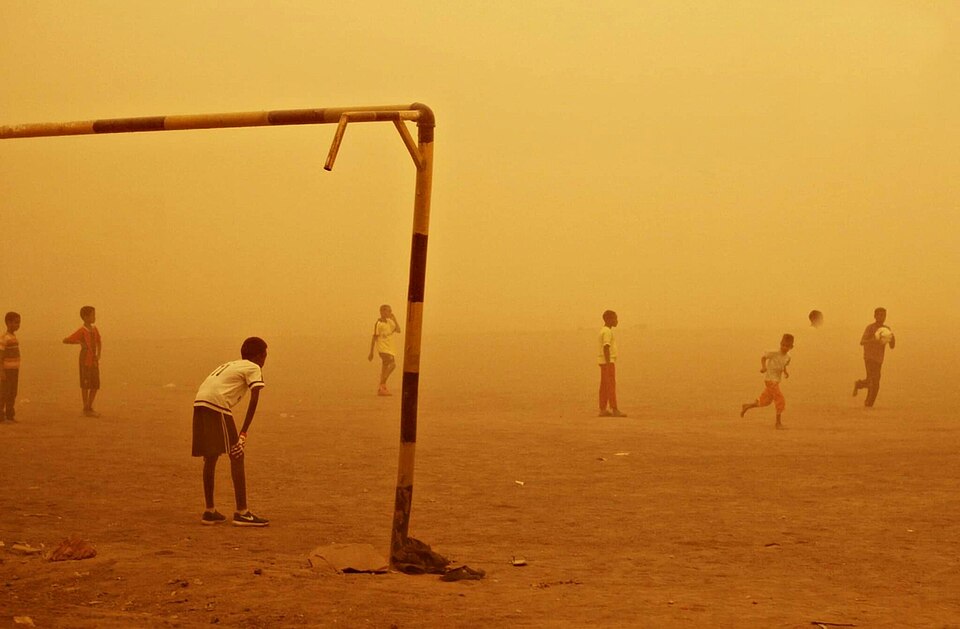
Children play football during a sandstorm in Sudan, March 29, 2018. Source: Mohammed Abdelmoneim Hashim Mohammed/Wikimedia Commons (CC BY-SA 4.0).
We are sitting at Gallal. It’s in Madinaty, on the edge of Cairo where the buildings are all new and the streets are too wide. The tea is too sweet the way Sudanese tea is supposed to be too sweet when someone else makes it for you. Mahmoud is across from me.
I don’t remember either of us standing up. Only the hug itself, which went on long enough that an Egyptian girl at the next table put down her phone and started crying. She didn’t know us. She cried because whatever passed between two men holding on to each other in the middle of that cafe was apparently visible even to a stranger who had no context at all.
Mahmoud went red immediately—a Sudanese man has no idea what to do with a stranger’s tears—so he pulled out his phone, opened Facebook, and muttered that she was probably crying over some relationship, while the screen in his hand played footage of Khartoum burning. We’re good at that silence now. The silence of being physically tethered to one place while completely living inside another. I kept thinking: Does everyone I love do the same? Carry so much that they stop feeling it, until a stranger has to cry for them?
The screen lights up. The wallpaper is a photo of my grandfather’s class in Wadi Halfa, built after the water took Halfa Dagheim. The first time my grandmother told me about it, she didn’t say “displacement.” She said, “We left the house, and the water took it.” Halfa Dagheim was going to drown for the High Dam—a decision made far away by people who would never bear its cost. When they moved to Wadi Halfa, there was only dust. The first shared project families built was a school. The teacher was my grandfather Ahmed, an English teacher. He gathered children under a tree and started. I inherited that before I understood it. Not money. Not land. The habit of starting under a tree when the official map says your town should no longer exist.
The waitress calls me ya walad even though I am 29. That word makes me think of my mother. Her father died during her certificate exams. She carried grief silently and kept studying until she earned admission to veterinary school at the University of Khartoum. She graduated while pregnant with me. I came from that lineage of exhausted people who kept choosing endurance.
When I entered the University of Khartoum in 2015, I thought I was entering a sanctuary. The conversations that shaped us happened beside roads, under trees, around tea stalls that surrounded campus from every direction. The women who ran them knew who was always late, who never had money, who argued too much, who quietly listened. They knew us better than the administration.
For a long time I thought we had to be hard to win. I thought we had to stop feeling to keep going. I was wrong. The only thing that ever saved us was the opposite. The tea. The sitting together after. The hand that was out before you asked. They can turn violence into money. They can turn gold into weapons. They cannot turn care into money. Care refuses to be bought. That is why they fear it.
In the republic of the unimportant—at the tea stalls, in the resistance committees, in the unions that kept meeting in borrowed rooms after being banned—we kept a different ledger. Not gold. Who was missing, who needed medicine, who hadn’t eaten. That ledger didn’t make anyone rich. It kept people alive.
At Gallal, Mahmoud orders a second tea without asking me. He knows I will want it. We have this habit from Khartoum—you order for the other person before he finishes, so he doesn’t have to say he wants more but has no money. He pushes sugar toward me. That small push is the whole essay. You notice who needs sugar and you push it without making a speech.
And finally—to the child walking into a school that hasn’t been built yet, with a notebook slipping against his arm. Inside, a poster on the wall is crooked. Someone taped it in a hurry and left one corner hanging. He will stop, shift the notebook to the other arm, and straighten it without thinking. He learned that from someone who sat next to him when he cried. That is ordinary. That is how a child inherits care.