There are no apolitical girls in war
To understand the war in Sudan requires looking far beyond its borders, without losing sight of the people who believed that another Sudan was possible.
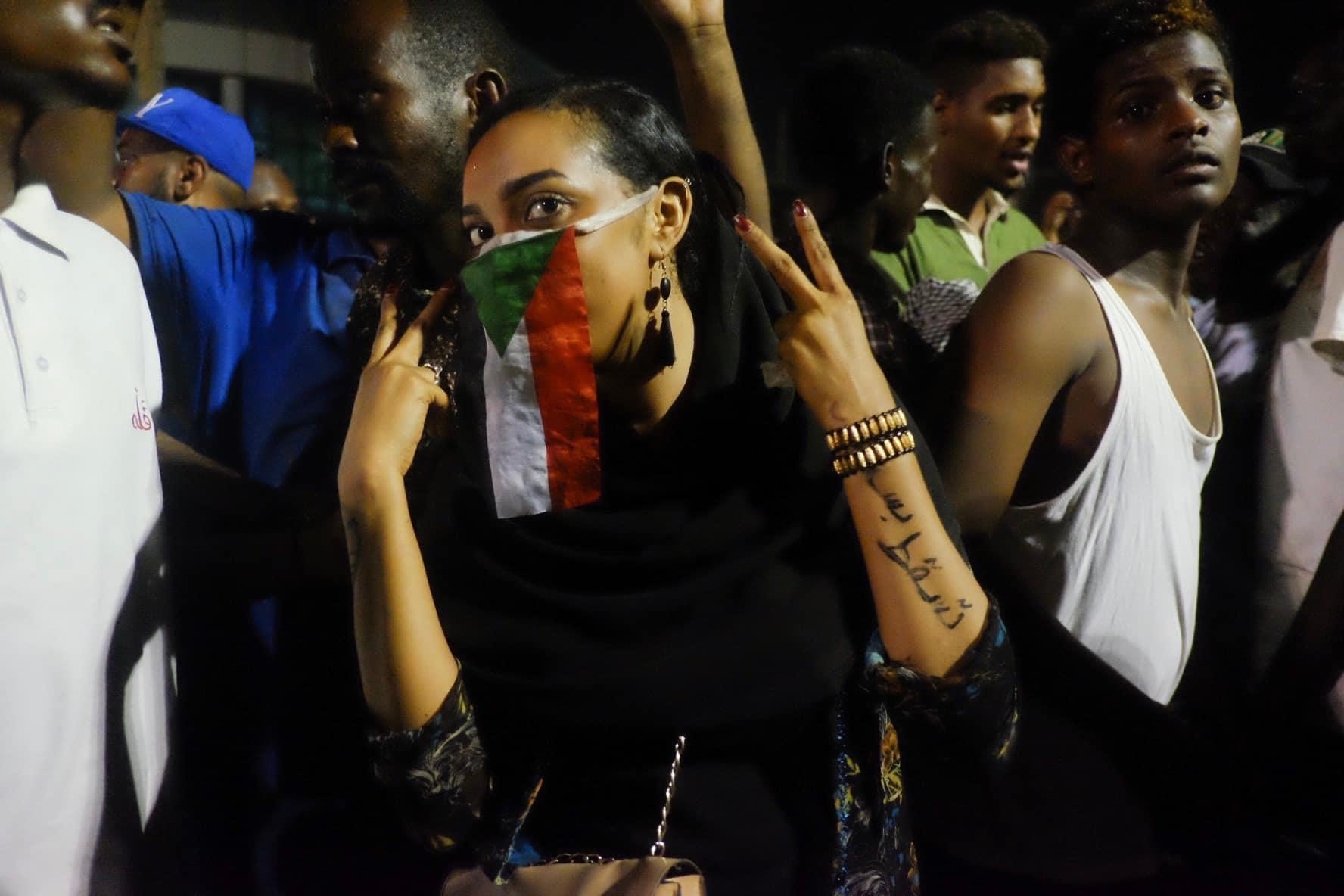
A woman flashes peace signs during the Sudanese revolution’s sit-in in Khartoum on April 8, 2019, with the slogan “Just Fall” written in Arabic on her arm. Photo: Ola A. Alsheikh/Wikimedia Commons (CC BY-SA 4.0).
“Doha, come sit with us. We need to talk to you.”
I was 15 years old, had just finished high school, and was getting ready to start university in Sudan. My mother knocked on my bedroom door and asked me to come into the living room. My parents were waiting for me.
“We need you to understand something important,” my father began. “When you go to university, don’t talk about politics.”
I remember asking the only question that made sense to me. “What is politics?”
My father paused for a moment before answering. “Politics is the art of what is possible,” he said. “It’s how people pursue what they believe can be achieved.”
I stared at him, trying to make sense of words that felt much too big for a 15-year-old. Before he could explain any further, my mother interrupted him.
“No,” she said quickly. “Politics is what old people talk about.”
She looked directly at me. “You shouldn’t talk about it. Bad things can happen if you do.”
That was the lesson I understood.
Politics was dangerous.
Looking back, I realize that my parents were not trying to teach me politics. They were trying to teach me how to survive.
The conversation was not unique to me. My older brother had already had it. So had my sister. When I arrived at university, I discovered that almost all of my friends had grown up with some version of the same warning.
We learned where not to stand on campus. We learned to walk past the “political corners” without slowing down. We learned that curiosity could be mistaken for affiliation, and that sometimes the safest opinion was no opinion at all.
I became very good at being what I thought was an apolitical girl.
Even when I began working in human rights and activism, I carefully separated my work from politics. I spoke about dignity, equality, and justice, while convincing myself that these belonged to a different conversation altogether.
Looking back now, I smile at the contradiction.
What are human rights in a country where people are taught not to have opinions?
The 2019 revolution unsettled the belief I held all my life about avoiding politics.
Suddenly, politics escaped our living room.
For the first time in my life, I witnessed people debating it in cafés, on buses, in university hallways, and in the streets. Conversations that had once been whispered became public. My political realization was clearly shaped: politics does not belong to politicians; it belongs to all of us, and we can shape it together.
The streets became classrooms. Neighborhoods became places of organizing. Around me, people argued, dreamed, volunteered, fed each other, protected each other, and imagined a country that felt possible.
For the first time, I felt as though I had permission to talk politics without immediately looking over my shoulder.
But permission is not the same as understanding.
People often say that understanding the past helps us understand the future. Yet Sudan’s history felt less like a straight line than a circle: military rule, uprisings, coups, moments of hope, and promises that always seemed to collapse back into the familiar.
But the revolution changed something deeper than the government. It changed what those outside of institutional power believed they were capable of. I had never thought of myself as a political actor, but suddenly questions of how my neighborhood was organized, protected, and cared for felt like questions I could participate in answering. We were not simply demanding that someone else build a different Sudan; we were beginning to practice it ourselves.
Later, I came across the “Revolutionary Charter for Establishing People’s Power.” What stayed with me was not simply the language of a political document, but the idea behind it: that the people who had filled the streets could also become the people who shaped what came next.
Looking back, I wonder if that was what frightened those in power most: not simply that people were demanding change, but that they had discovered their own power to organize without waiting for permission—to build networks, provide care, protect their neighborhoods, and imagine political alternatives from below.
And perhaps this is what makes popular movements so threatening to systems built on concentrated power.
You can suppress a protest.
You can arrest a leader.
You can overthrow a government.
But what happens when people have already discovered that they have power together?
Then came the coup of 2021.
But the coup did not erase what had happened in 2019. If anything, it deepened the determination of many people to resist. The streets filled again. The organizing continued. The language of resistance changed, but the belief that another Sudan was possible did not disappear.
And then came the war.
During the first weeks of the war in April 2023, time stopped making sense.
Our lives became organized around survival.
We waited for water that only came for a short time before dawn. My mother and I played Ludo on a board we had drawn by hand to make the endless hours pass. Whenever the electricity returned, everything else stopped. We rushed to charge our phones, download messages, and discover who had managed to leave Khartoum, who was still trapped, and who had disappeared from our screens.
Those moments became our connection to the outside world.
Somewhere between waiting for water, rolling dice across a handmade board, and searching for familiar names online, one question settled into my mind and refused to leave.
How did we get here?
At first, I thought I was asking how a war had started. But I was not an outsider looking in; I had spent years on the ground, organizing, listening, and navigating the realities of Sudan myself. Yet, so much of what was happening did not make sense. The more I searched for the missing pieces in the history I thought I knew, the more I realized I was asking different questions.
How could a militia become powerful enough to wage war against Sudan’s national army? Why is the story of this war being told as though one side represented the nation and the other simply threatened it? And why did we stop asking what both sides have done to the people they claim to represent?
Every article I opened answered one question and created another.
The story clearly had not begun in April 2023. It stretched back years.
My father once quoted a saying often attributed to Imam Al-Shafi’i:
“My opinion is correct with the possibility of being wrong, and the opinion of others is wrong with the possibility of being correct.”
He told me that the moment someone believes their opinion is the only truth, dictatorship begins.
Sudan knows dictatorships well. One of them was Omar al-Bashir, who seized power in a 1989 military coup. Under his rule, the Janjaweed militia was used to fight rebel groups in Darfur. Over time, those forces evolved into what would later become the Rapid Support Forces.
Yet even this history did not fully answer my question.
I expected the answers to be found inside Sudan. Instead, every path I followed seemed to lead somewhere else.
The deeper I read, the more often Europe appeared in a story I had always believed belonged only to Sudan.
I wasn’t looking for European migration policy. Yet somehow, it kept appearing in the story.
That was how I stumbled across something called the Khartoum Process, also known as the EU-Horn of Africa Migration Route Initiative, a political dialogue launched in 2014 between European and African states to cooperate on migration along the route between the Horn of Africa and Europe.
What followed was a growing European investment in managing migration in Sudan. Through programs such as Better Migration Management, European funding supported capacity-building, training, information-sharing, investigations into trafficking and smuggling, and efforts to strengthen border management. Sudan had become important not only because people were leaving it, but because people were passing through it.
And this is where the story became uncomfortable.
The people being asked to help Europe control its borders were not operating in some neutral security system. They were part of a state security apparatus with a long history of violence and repression. The RSF was itself deployed along Sudan’s borders to stop irregular migration and combat trafficking. European policymakers knew the risks. In 2016, members of the European Parliament were already questioning how EU migration cooperation could prevent equipment and training intended for border control from being diverted toward repression.
The EU has repeatedly insisted that it did not fund the RSF. That distinction matters, and I am not arguing that Europe created the RSF. But I began to ask a different question: what happens when the desire to keep migrants away from European borders turns a violent security system into an international partner?
What happens when governments that are willing to use violence against their own people are nevertheless treated as necessary partners because they can stop people from moving?
This became harder to ignore when I looked at Omar al-Bashir. The ICC had issued a warrant against him, including charges of genocide, yet European cooperation with Sudan continued. At what point did stopping migration become important enough to make cooperation with a regime accused of genocide acceptable?
I am not arguing that migration policy alone sustained Sudan’s security system. Rather, migration control is one example of how international actors continue to engage with, build the capacity of, and legitimize Sudan’s security institutions, helping create the conditions in which this war became possible. Sudan’s political and military elites bear their own responsibilities. But they did not operate in isolation from the international systems that helped make their power possible.
Power is rarely built through a single cheque, an agreement, or a foreign government. Sometimes it is built through years of political relationships that make certain actors more powerful, more legitimate, and more useful to the outside world.
I thought I was researching Sudan.
I didn’t realize I was beginning to uncover how decisions made far beyond Sudan had become part of the conditions that made this war possible.
Eventually, I crossed the border into Egypt.
The road out of Sudan was marked by checkpoints. At some, it was the RSF. At others, it was the military. The faces and uniforms changed, but the feeling did not.
I did not feel safe at either checkpoint.
It wasn’t because I believed the two forces were the same. They weren’t. The Sudanese Armed Forces are a national institution, and I know that there can be no future Sudan without a national army. But at that moment, I could not bring myself to choose between the two sides because, for me, choosing either side meant accepting a war that I did not believe should define Sudan’s future.
I didn’t want Sudan to be ruled by the RSF. I didn’t want Sudan to return to military rule either. I wanted something else.
I wanted the Sudan I had seen become possible in 2019: a Sudan where civilians could determine their own future, where people could organize themselves, resist military rule, and believe that the country belonged to them.
And then I crossed the border.
I believed I had reached safety. Instead, I found myself confronting a different kind of confinement.
Before the war, I never dreamed of leaving Sudan. Many people my age did. They spoke about scholarships, jobs abroad, and better opportunities elsewhere. I understood why. Sudan was never an easy place to build a future. But I never shared that dream.
I wanted to stay. I wanted to become rooted in that place.
Home, to me, was never a house. It was the one place where belonging required no explanation. I didn’t have to earn it. I didn’t have to prove I deserved to be there. I could fail, begin again, change my mind, and still know I belonged.
I didn’t realize then that belonging itself could become political.
Crossing the border wasn’t only the loss of a country. It was the loss of that effortless belonging.
I was no longer trapped by shelling and checkpoints, but by visas, residency requirements, shrinking opportunities for movement, and the knowledge that my future depended on decisions made in distant capitals.
For the first time, I understood that migration policies are not experienced as documents. They are experienced as the limits placed on an ordinary life.
At first, I didn’t have the language for what I was feeling.
I only knew that something had shifted.
A few years earlier, I had a flight connection through Egypt. I left the airport for a few hours, wandered around the city, bought a few things, and returned in time for my next flight. I entered the country in less than 10 minutes. No one asked how long I intended to stay. No one questioned why I was there.
After the war, the same border felt almost unrecognizable.
It took me a week of daily visits to obtain residency. Every morning I woke before dawn and joined hundreds of other Sudanese people already waiting outside the immigration office. We arrived around four in the morning and often stayed until late afternoon, only to be told to return the next day and begin again.
What struck me most was what we were waiting for. Not citizenship. Not permanent protection. Not even freedom of movement.
We were waiting for a document that would allow us to remain without fearing another forced displacement. A document that would allow us to keep a functioning phone line that would reconnect us with family scattered across different countries, for the chance to exist legally for a few more months.
Even after I received it, I never left the house without checking several times that my passport was in my bag.
What if I forgot it? What if I was stopped? What if one missing document was enough to uproot me all over again?
That was when I understood something I had never considered before: crossing a border does not always end displacement; sometimes it simply changes its shape.
For generations, Sudanese people moved between Sudan and Egypt with a familiarity that reflected the long history connecting the two countries. Suddenly, we were being spoken about through a different vocabulary: numbers, quotas, security, migration management.
Somewhere along the way, I stopped being a neighbor.
I became a migrant.
A refugee.
A potential burden.
The conversations around us increasingly revolved around pressure on jobs, pressure on housing, pressure on public services. I found myself wondering how quickly a person could become a problem simply by crossing a border they never wanted to cross in the first place.
I want to be careful here. This is not a story about Egypt rejecting Sudanese people. My experience in Egypt was also shaped by kindness, generosity, and people who welcomed us. Ordinary Egyptians were often navigating their own economic hardships while extending compassion to strangers.
The story is bigger than Egypt.
And that is where my personal experience began to lead me back to the question I had been asking in Khartoum.
How did we get here?
The more I tried to understand why displacement still felt like confinement, the more I found myself reading about migration policies again and the relationship between Europe and countries such as Egypt, Sudan, Libya, and Niger.
That was when I came across a term I had never heard before. Border externalization.
At its simplest, border externalization is the practice of moving migration control beyond a country’s own borders. Rather than preventing migration only at European frontiers, European governments increasingly invest in stopping migration much earlier, through partnerships with countries that people pass through long before they ever reach Europe.
The border, I realized, no longer begins at the Mediterranean. It begins in places like Khartoum. It continues through Cairo. It stretches across deserts, checkpoints, visa offices, and residency queues.
What surprised me most was not only that these policies shaped the journeys of people hoping to reach Europe, but also shaped the lives of people like me, who were not trying to reach Europe at all.
I had escaped one war only to discover that I was now living inside another political system—one that quietly determined where I could move, how long I could stay, and whether I could build a life again.
The more I learned, the more another concept emerged alongside border externalization: the securitization of migration.
Migration was increasingly discussed not as a human experience, but as a security problem.
Refugees became statistics.
Migrants became risks.
Movement became something to contain.
I found myself wondering what happens when people begin to see you first as a category and only later, if at all, as a person.
The irony was impossible to ignore.
The very policies designed to manage migration had become part of the story that uprooted so many of us in the first place.
Without ever intending to, I had gone searching for the politics of Sudan. Instead, I found myself studying the politics of borders.
For years, I believed that understanding Sudan required understanding Sudanese politics.
The war taught me otherwise.
To understand why I was trapped inside my home in Khartoum, I had to understand decisions made far beyond Sudan. To understand why I felt trapped again after crossing the border, I had to understand migration policies designed far beyond Egypt.
The deeper I looked, the more I realized that migration policy was only one thread.
Sudan’s war is often described as a civil war, or as a humanitarian crisis. I struggle with both descriptions. Calling it a civil war makes the conflict sound internal, as though Sudan’s future is being decided only by the two armed forces fighting on its soil. But this is also a proxy war: a war sustained by regional and international actors pursuing their own interests through Sudanese territory, resources, and armed actors. The war is being fought in Sudan, but its conditions do not exist only within Sudan.
Yet, the danger of describing Sudan only through its external actors can make Sudanese people disappear from the political story altogether. Because what is at stake is not simply which armed force wins, or which foreign power gains influence.
The people who filled the streets in 2019 were not fighting simply to replace one ruler with another. They were fighting to break a cycle: the cycle in which military power repeatedly interrupts civilian politics, takes control of the state, and decides the country’s future for its people.
That is why I struggle with the idea that this is simply a war between two generals. What about the Sudanese people who wanted neither? What about the Sudan they were trying to build?
A Sudan governed by civilians. A Sudan where sovereignty means more than the ability of armed institutions to control territory. A Sudan where people who had spent decades being told that politics belonged to generals discovered that politics could belong to them too.
The war is not only destroying lives. It is threatening the possibility of breaking the cycle.
When we call Sudan “the world’s largest humanitarian crisis,” the focus naturally shifts to aid, displacement, food insecurity, and emergency response. These realities demand attention. But humanitarian language can also flatten history. It can make war appear as though it erupted on its own, disconnected from the political choices, international partnerships, economic interests, and regional power struggles that helped shape it.
It can shift the question from why are we at war, and how do we stop it? to how do we continue responding to the consequences of war? And there is a danger in that distinction. Because if we only manage the humanitarian consequences, we can end up managing an endless war.
Wars do not simply happen; they are built. Sometimes they are built through weapons. Sometimes through money. Sometimes through diplomatic agreements signed years before the first shot is fired. Sometimes through migration policies that reward stability at any cost, even when that stability depends on empowering those willing to use violence.
That does not mean Sudanese people are passive victims of decisions made elsewhere. Sudan has its own political history, its own actors, and its own responsibilities. But refusing to look beyond Sudan means refusing to see the whole picture.
The more I searched for answers, the more countries entered the story. Each revealed another thread connecting Sudan to a much larger political landscape.
And I finally understood why the question I had asked while sitting in my dark house in Khartoum—“How did we get here?”—could never be answered by looking at Sudan alone.
I spent years believing that politics was something I could choose not to discuss. I now understand that it was never something I stood outside of. It shaped the country I called home, the war that forced me to leave it, and the borders I encountered afterwards.
Perhaps that is another part of what I had been searching for all along. Not only how Sudan arrived at war, but how the story of Sudan itself is told. What we choose to remember, what we choose to leave out, and whose voices we choose to hear are all political choices.
When I was 15, my mother told me that politics was what old people talked about. She was trying to protect me from the consequences of speaking.
But perhaps that is what I misunderstood.
Politics was never simply something people talked about. It was something that determined who could speak, who could belong, who could move, who could stay, and ultimately who could decide what Sudan would become.
I became political not because I chose politics, but because war made it impossible to remain outside of it.
There are no apolitical girls in war.
Only girls who eventually discover that politics has been shaping their lives all along.