Not all empires look the same
Although the UAE doesn’t occupy territory, it arms militias, controls ports, and launders violence through the language of development. Sudan is paying the price.
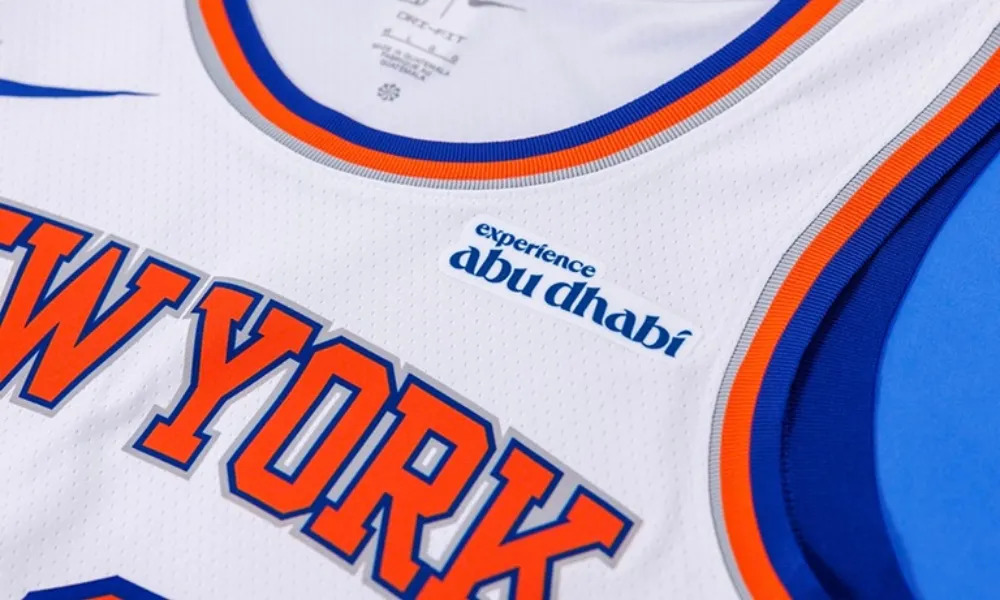
The New York Knicks unveiled the “Experience Abu Dhabi” tourism logo as a jersey patch sponsor in 2025. Source: New York Knicks.
Empire has never been only a matter of colonial occupation. The United States and Britain remain the most visible architects of widescale death and destruction, but the United Arab Emirates (UAE) represents a different, and in some ways more insidious, model: one that operates through the acquisition of capital, the arming of proxy forces, and the control of infrastructure rather than direct territorial rule.
The alliance between the West and the Gulf operates through military power, financial secrecy, and extractive investment. Its defining feature is the outsourcing of violence—laundered through the language of development, logistics, and humanitarian diplomacy, and hidden behind the architecture of luxury.
The UAE has recently been cast as the unfortunate victim of Iranian retaliation following the regional war started by Israel and the United States, with Donald Trump signaling that he is considering financial assistance to the UAE as a “good ally” that has taken an economic hit. The irony is pointed: The UAE has used its authoritarian apparatus to arrest anyone who publicly documents the extent of Iranian strikes on its territory—a Bellingcat investigation found that at least five people were detained simply for sharing phone recordings of missile strikes. But the victim narrative should not obscure the UAE’s role as a sub-imperial power that has enabled war and war crimes across the region, most consequentially in Sudan.
The UAE’s value to the United States is structural. It was the first Gulf state to normalize relations with Israel, is a major buyer of US weapons, and serves as a hub for intelligence, finance, and military logistics. It has built a network of bases and installations stretching from Yemen to Somalia, around the Red Sea and Gulf of Aden, constructed with US and Israeli involvement. This is the infrastructure of a regional power that seeks influence without accountability.
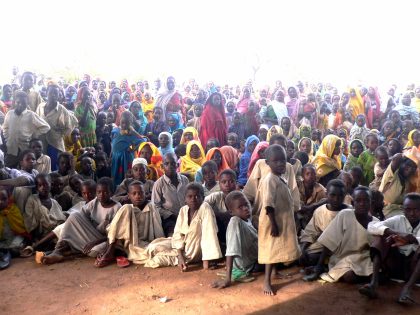
Sudan is the site of the world’s largest humanitarian crisis. A catastrophic civil war erupted in April 2023 from a violent power struggle between the Sudanese Armed Forces (SAF) and the Rapid Support Forces (RSF), devastating Khartoum, El Fasher, and dozens of other cities. Blood stains in El Fasher could be seen from space.
Since April 2023, roughly 15 million people have been uprooted, while millions more remain in need of life-saving assistance. Women face particular exposure to sexual violence and torture. More than 33.7 million people—out of a population of 50 million—now require urgent humanitarian aid. Acute food insecurity grips more than half the country, essential health services have collapsed, and disease outbreaks compound an already catastrophic situation. The death toll, though difficult to verify, was estimated at up to 400,000 by late last year.
The war in Sudan is one the UAE is directly funding. It does not resemble classical colonial occupation, and so it is rendered peripheral—yet its consequences are among the most catastrophic on earth.
Sudanese writer Husam Mahjoub offers the clearest analytical frame:
The UAE’s role in Sudan is not an anomaly. It is part of a coherent, well-financed, and regionally expansive project: a subimperialist agenda that combines economic extraction, authoritarian alliance-building, and counterrevolutionary politics under the cover of diplomatic sophistication and global partnerships. Sudan, tragically, is one of its central laboratories.
Mahjoub traces how the UAE has positioned itself as a counterrevolutionary force across the region, channeling support to the RSF—a militia implicated in mass atrocities—through weapons transfers and logistical backing. In April 2026, the Sentry revealed that RSF leader Mohamed Hamdan Dagalo (Hemedti) and his brothers have accumulated investments in 20 luxury properties worth US$24 million, all within the same gated estate in Dubai.
The UAE does not operate alone. Egypt and other regional powers work in alignment with the EU, Russia, and the United States, sustaining Sudan’s instability while extracting strategic and economic value: gold reserves, gum arabic, agricultural land, and access to Red Sea trade routes. The UAE has denied the allegations against it. The denials have not been accompanied by transparency, and meaningful accountability remains elusive.
Empire does not always announce itself with colonial decrees. Sometimes it arrives through ports. Over the past 15 years, the UAE has expanded its footprint across Africa through investments in port infrastructure, airports, and logistics networks—and the port is never a neutral site. Palestinian poet and scholar Rafeef Ziadah has written about the UAE’s intervention to control Yemeni ports and trade routes across the Indian Ocean and Red Sea, noting that the same port used for humanitarian aid is also used for military supply. The line between relief and warfare is deliberate blur, not accident.
Gold is the resource that makes the feedback loop legible. A report released in April 2026 by the Center for Environmental and Social Studies details how Sudan’s gold—extracted under violence and coercion—moves through informal networks across borders to Dubai. Supply chains allow materials to be misattributed, relabeled, or blended in ways that obscure their origins; the line between legally and illegally sourced gold dissolves in transit. Gold is exchanged for weapons and financial liquidity, and the war is sustained.
In January 2026, the Will for Peace naval mission brought a convoy of combat vessels from Russia, China, and the UAE to dock at Simon’s Town in South Africa, under the label of a “maritime exercise.” The deliberate blur Ziadah identifies—between humanitarian, military, and commercial logistics—was visible here in its most concentrated form. South Africa is not a bystander in these networks. Open Secrets has exposed Integrated Convoy Protection (ICP), a South African company, and its role in supplying the Emirati war machine, with shipments passing through Durban’s port to Jebel Ali in Dubai. This is what quiet violence looks like: It moves through ordinary infrastructure, hidden in the routine of global trade.
But Durban’s port has also been a site of refusal. In 2021, dockworkers declined to offload cargo from an Israeli ship in an act of solidarity with Palestinians, with labor movements joining in support. Ports are political—they are where wars are sustained, and where workers retain the power to interrupt them.
The UAE’s sub-imperial role is not an aberration. It is the logical expression of a global system in which strategic alignment takes precedence over human life—in Khartoum as in Gaza, in Sudan as in Yemen. Gulf states helped neutralize Palestinian liberation. Sudan is now being abandoned through the same mechanisms. The Western–Gulf alliance is not a relationship between equals pursuing shared values; it is a structure that produces and sustains mass death, and it needs to be named as such.
See Dubai for what it is: an artificial island built on slavery.