Rebranding French imperialism
Although the Africa Forward Summit in Kenya was framed as a partnership, it was actually France desperately looking for a new door into a continent that wants to throw it out.
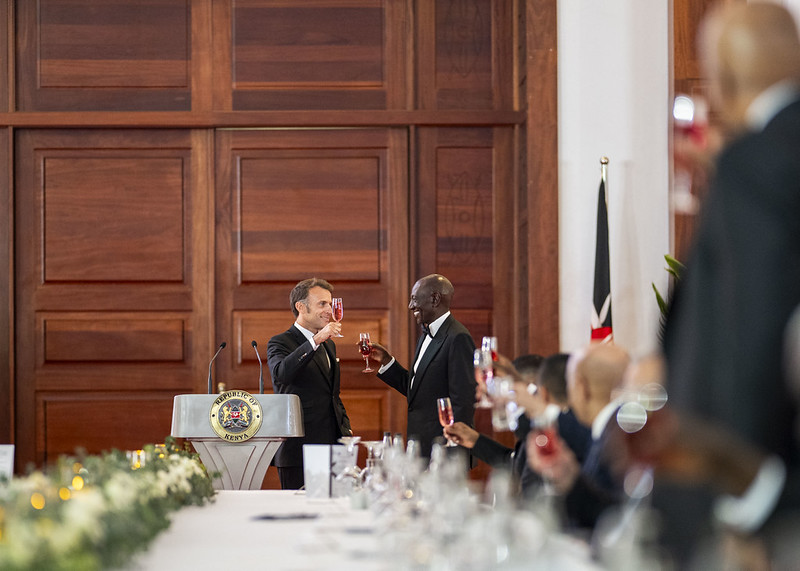
State Dinner hosted by President William Ruto of Kenya and First Lady Rachel Ruto during the Africa Forward Summit in Nairobi, 11 May 2026. Source: Paul Kagame/Flickr.
More than seven decades after the Fifth Pan-African Congress demanded the complete liberation of Africa from colonial domination, the continent still finds itself trapped in the structures of dependency. The resolutions of the historic 1945 Congress in Manchester were clear: African nations deserved full political and economic independence, the removal of foreign domination, and the right of the African people to determine their own future. Yet in 2026, many African leaders continue opening the gates of the continent to the same imperial powers that colonized, exploited, and brutalized our people.
The recently concluded Africa Forward Summit in Nairobi, co-hosted by Kenyan President William Ruto and French President Emmanuel Macron, became a symbol of this contradiction. Presented as a partnership of equals, the summit sought to rebrand France’s relationship with Africa at a time when Paris is rapidly losing influence across the continent.
The summit brought together over 30 African leaders and resulted in announcements of approximately €23 billion in investment pledges, targeting sectors such as energy, agriculture, and artificial intelligence. But beneath the language of co-investment, mutual respect, and win-win lies the enduring reality of imperialism.
France did not arrive in Nairobi merely out of friendship for Africa. The summit came at a moment when French influence has sharply declined in West Africa. Mali, Burkina Faso, and Niger have expelled French troops and challenged decades of French military and economic control. And France has been forced to withdraw military forces from several former colonies amid growing anti-French sentiment and popular uprisings.
This explains why the Nairobi summit was politically significant for France: it was the first major France-Africa summit hosted in an Anglophone African country. Kenya became the bridge through which France hopes to regain strategic influence in East and Central Africa, after facing resistance in the Sahel.
The question remains: why was President Ruto willing to host such a summit at this particular moment? The answer lies in the class character of the Kenyan state. The current administration has consistently aligned itself with Western powers, presenting Kenya as a reliable regional partner for foreign capital, military cooperation, and geopolitical interests. By hosting Macron, Ruto positioned Kenya as a strategic gateway for France’s renewed engagement with Africa while simultaneously strengthening his government’s standing among Western allies. Far from representing an independent African development agenda, the summit reflected the tendency of comprador elites to seek legitimacy and support from imperial centers of power, rather than from the citizens of their own countries.
Kenyan authorities framed the summit as an opportunity for economic growth and foreign investment. Yet the deeper question is: growth for whom, and under whose control?
Macron described the initiative as a partnership of equals. But equality cannot exist between economies structured in fundamentally unequal ways. The relationship between France and Africa has historically been shaped not by equality but by extraction. According to France’s Ministry for Europe and Foreign Affairs, over 1,000 French subsidiaries operate in Africa and over 140 in Kenya alone. Major corporations such as TotalEnergies, Orange, Carrefour, CMA CGM, and Bolloré maintain extensive commercial interests in energy, telecommunications, logistics, retail, and infrastructure. While this is presented as development and partnership, the profits extracted from African labor and resources overwhelmingly benefit foreign capital.
French influence in Africa has never been exercised solely through military and economic means. Cultural diplomacy has long formed part of France’s strategy for maintaining influence abroad. Through language institutions, educational exchanges, media partnerships, cultural centers, and development programs, France projects what is often described as “soft power.” Critics argue that such initiatives also serve broader political and economic objectives by cultivating favorable elites, shaping public discourse, and reinforcing France’s long-term strategic interests. The Africa Forward concert, Macron’s cooking with influencers, and other PR activities during his visit to Kenya all evidence this.
This is why Macron’s attempt to present himself as a “Pan-Africanist” during the summit was met with skepticism among activists and progressive forces. Pan-Africanism is not a branding exercise. It is a revolutionary struggle for African unity, sovereignty, and liberation from imperial domination.
Even the summit declaration itself reflected the language of dependency politics. Discussions focused heavily on debt restructuring, private investment, credit reform, and security cooperation—issues that often operate within financial systems dominated by institutions such as the IMF and the World Bank.
The security dimension of the summit also raised concern among activists. Kenya and France have strengthened military cooperation in recent years, with critics arguing that the recently signed military pact increasingly compromises national sovereignty. Social movements have drawn parallels between new defense arrangements and earlier military agreements involving British troops at the British Army Training Unit in Kenya (BATUK). Particularly controversial are the defense cooperation arrangements that grant significant legal protections to foreign military personnel operating in Kenya—limiting the ability of Kenyan institutions to hold foreign troops fully accountable under local law.
At the same time, France continues presenting itself as a “stabilizing force” in Africa, despite widespread criticism of its military role in the Sahel. Many people across West Africa increasingly associate foreign military interventions with instability rather than liberation.
These contradictions became more visible during protests organized by activists and members of social justice movements in Nairobi during the summit. Protesters denounced French imperialism, foreign domination, debt dependency, and military expansion. Reports from activists indicated that demonstrators were met with police violence, including tear gas, arrests, and arbitrary detention.
The summit therefore exposed two Africas existing side by side. One Africa sits inside conference halls discussing investment frameworks with multinational corporations and foreign powers. The other Africa exists in the streets, among unemployed youth, struggling workers, peasants, students, and communities facing rising costs of living.
Only a week after the summit, Kenya witnessed protests linked to the high cost of living and fuel prices. Across major towns and cities, sections of the population expressed frustration with worsening economic conditions. These demonstrations reflected deeper class contradictions inside Kenya’s capitalist economy.
Recent developments in the Alliance of Sahel States demonstrate that sections of Africa are once again questioning foreign military domination and asserting greater sovereignty. While contradictions and challenges remain within those states, their rejection of permanent foreign military influence has inspired anti-imperialist discussions across the continent.
Ultimately, the task before progressive African forces is not simply to criticize summits such as Africa Forward. The deeper challenge is building organized political alternatives rooted in workers, youth, peasants, women, and oppressed communities. Africa’s liberation will not emerge from elite conferences hosted in luxury halls or from dependency disguised as partnership. It will come through revolutionary political organization, Pan-African solidarity, and the collective struggle of African people against imperialism, capitalism, and comprador elites who profit from foreign domination.
The future of the continent cannot be determined in Paris, Washington, London, or the boardrooms of multinational corporations. It must be determined by the organized masses of Africa themselves. The task of this generation is clear: to learn from the failures of false independence, reject dependency, and continue the unfinished struggle for a united and sovereign continent.