Deported to Liberia, again
Two centuries after the American Colonization Society shipped free black Americans to Liberia, Washington is sending its unwanted there once more.
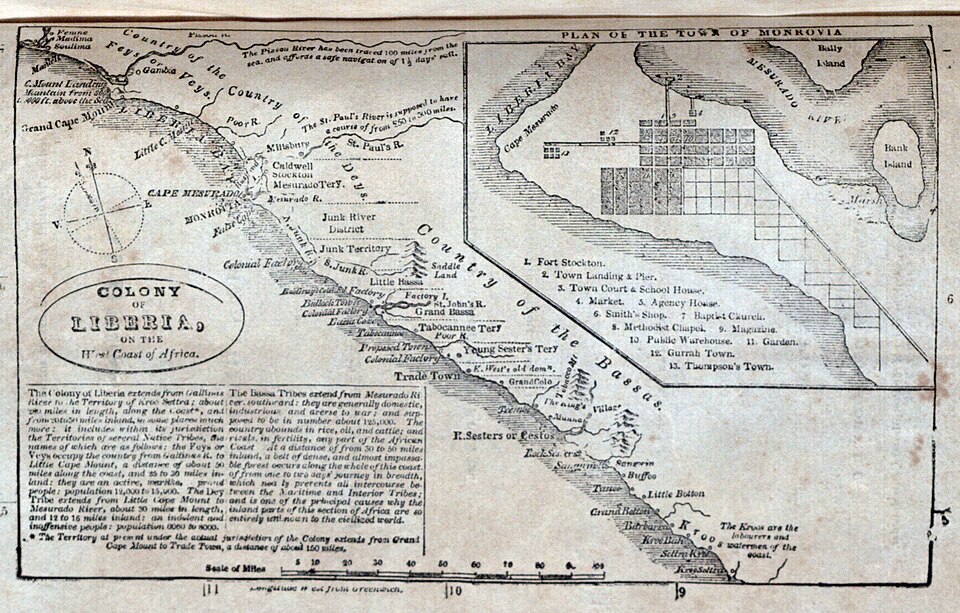
An 1836 map of the Colony of Liberia, established under the auspices of the American Colonization Society. Source: University of Texas at Arlington Libraries Special Collections/Wikimedia Commons (Public Domain).
In 1816, a group of white people in the US created the American Society for Colonizing the Free People of Color of the United States (later simply the American Colonization Society), aimed at resolving the “problem” of a growing population of free black people in the country. Both slave owners, fearing that large numbers of free black people would lead to slave uprisings, and some white abolitionists, who viewed their presence as either a security threat or a barrier to emancipation, joined hands in a plan to quite literally deport free black Americans and freed slaves to a settlement they hoped to create in the African motherland.
This is the origin story of the African state of Liberia, one where race, racism, and anti-black slavery meet yet another type of forced movement: deportation. And in a continuum with centuries past, the African continent, which had solved a problem of lack of (free) labor for white US elites and landowners, now solved yet another perceived problem for their descendants: a population of free black people they considered undesirable. As Jonathan Ort has shown, today’s deportation system revives that colonial blueprint.
A little more than 200 years later, an overwhelmingly white US executive power again uses Liberian territory as a deposit for its undesirables, with one difference: the constructed enemy deported from the white nation is another racialized figure, the immigrant. The US has historically applied a racialized migratory policy, restricting on racial and class grounds those welcomed into the nation while profiting from the cheap undocumented labor those restrictions produce. Many of these workers are non-white immigrants from Latin America, a pattern shaped by geographical proximity and by a long US imperial presence in the region. Continuous political and economic interventions have fueled conflicts, generalized violence, and socioeconomic chaos in Latin America while enriching the US, and those fleeing have formed a cheap workforce in the north as temporary laborers, undocumented workers, and asylum seekers. However, migrants have become the scapegoats for everything that challenges the US’s self-perception of “greatness.” And while the US has long detained and returned Latin Americans, the current government has not only entered a new era of interventions in the region but also further escalated forced returns.
Thus far, the second Trump administration (Trump 2.0) has signed largely secretive bilateral agreements for (forced) returns with at least 35 countries, overwhelmingly in the Global South. Migrants, including asylum seekers and people whom US judges have protected from return to their home countries, are the bargaining chips in these unequal agreements. Partner countries end up taking part in one of the cruelest return practices the US has used: removing people with almost no warning and little chance of defense to countries where they have no ties and may face inhuman treatment or torture, as UN human rights experts warned in September.
In a chilling roundabout way, Liberia once again becomes a place where unwanted deportees arrive on its shores, with little to no say in the matter, and with no medium-term plan for their protection and well-being, or that of local communities. On August 18, 2026, Liberia’s government announced that it would accept up to 1,200 third-country nationals, one of the largest agreements struck by Trump 2.0. Two days later, about 20 people landed at Roberts International Airport; 14 stayed, from Cameroon, Eritrea, Venezuela, Honduras, Colombia, Brazil, and Guatemala. Most had won US court protection against return to their home countries because they faced persecution or torture there, and some only learned their destination mid-flight. None of the Latin Americans interviewed wants to remain in Liberia. Housed in a hotel and fed by the International Organization for Migration, free to apply for asylum but unable to work, they have been separated from their families and long for a safe place with ties, a shared language, the right to work, and a community. Is Liberia that place? And what does their arrival mean for Liberians?
The imbalance of power between Liberia and the US is part of the answer. In June 2025, a State Department memo placed Liberia among 36 countries facing a possible US travel ban and suggested accepting deportees as a way out. Washington had already cut aid, and the health compact that replaced USAID provides US$124 million over five years, roughly 63 percent less than before. Since signing the deal in September 2025, Liberia has received US$5 million to manage third-country nationals and an extension of Liberians’ US visitor visas from 12 to 36 months.
Focusing only on US leverage obscures the choices of Liberia’s own government. Officials insist there is “no quid pro quo” and describe the arrangement as humanitarian. However, Liberian scholar Robtel Neajai Pailey argues that the executive bypassed the legislature, which the Constitution requires to ratify such agreements, and kept the terms from the public. This also raises the question of how the benefits and costs are distributed. Easier mobility and closer ties with Washington serve the state and Liberians who travel, while the immediate consequences fall on deportees separated from their families. If arrivals approach 1,200, accommodation, health care, and access to work will become questions for Liberian communities too.
Liberians have raised concerns about the agreement from the outset, especially its secrecy and the implications for local communities. Many first learned about it through the media. William Sando, president of the University of Liberia Student Union, told Al Jazeera that he first encountered the news on Facebook and questioned where the deportees would live and whether those who remained would be allowed to work. In Monrovia, food vendor Yarssah Jallah described the arrangement as “risky for us,” citing concerns about drug use and the lack of information about those being received. Clara Mallah of the Center for Transparency and Accountability in Liberia questioned why the US could not accommodate the deportees itself, while Senator Samuel Kogar asked whether the agreement had been presented to both Houses of the Legislature, describing it as “not a small issue.” All of this points to a lack of transparency, the bypassing of democratic procedures, the passivity with which Liberians are treated by their government, and how little warning they were given—warning that might have helped ease some common misconceptions and stereotypes about migration and migrants.
These concerns extend to Liberia’s capacity to accommodate the arrivals. Eddie Jarwolo of the civil society organization NAYMOTE Partners for Democratic Development criticized the lack of a publicly available plan explaining how the government would provide accommodation without further pressuring public services. Similarly, Representative Anthony Williams raised questions about housing, health care, and screening. At the same time, opposition politician Joshua Tom Turner warned that the arrival of large numbers of deportees could place additional pressure on employment and heighten social tensions without adequate public consultation and safeguards. These are reasonable concerns in a country already facing unemployment and reductions in US development assistance.
Although the government maintains that the US and an international partner will cover accommodation, food, and onward travel, questions remain about the duration of that support and the arrangements for those who eventually remain in Liberia. This is a particular concern given that these Latin American migrants may have specific needs due to language, cultural differences, and a lack of social support—a whole ocean of distance separates them from Liberians, which in turn shapes needs that Liberia may not be able to meet. There is also a risk that public frustration over an agreement reached without adequate consultation could be directed toward deportees who had no say in their transfer. For now, both Liberians and those sent to the country are left confronting the consequences of decisions over which they had little influence. In this game between one nation-state and another, Latin American deportees, on the one hand, and Liberians, on the other, stand at the margins of decision-making, in a process that structurally silences them and renders them invisible, while asking them to bear the direct consequences of those decisions.
Liberians know this uncertainty from their own experience. When refugee status ended for Liberians across West Africa in 2012, many who stayed in countries such as Nigeria were promised residence papers by the Economic Community of West African States that never fully arrived. Liberia itself ended refugee status for the Ivorians it hosted only in 2022, and the UN Refugee Agency, according to Third Country Deportation Watch, is not currently operating there. An offer of asylum without the institutions to deliver it risks repeating a past pattern of protection promised on paper, with nothing secure to follow.
The past is close at hand. Under an 1819 law, the US sent Africans rescued from illegal slave ships to Liberia, whatever their origin, and settlers built on land coercively obtained by a US naval officer from a local ruler, facing armed resistance from autochthonous communities for years. Christina Sharpe calls this living in the wake of slavery. Two centuries on, deportees from Latin America and Liberians asked to receive them live in that wake together, bridging past and present, the Americas and Africa, through the experiences of people whose lives are being shaped by decisions made elsewhere.