Autonomy in Barcelona
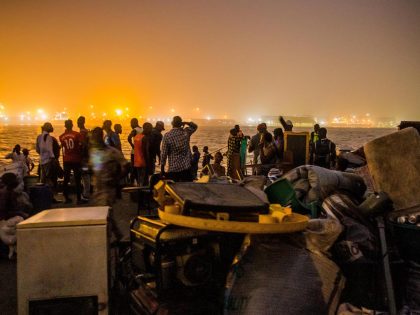
The story of the Mount Zion community, largely made up of West African men collecting scrap metal all over Barcelona.
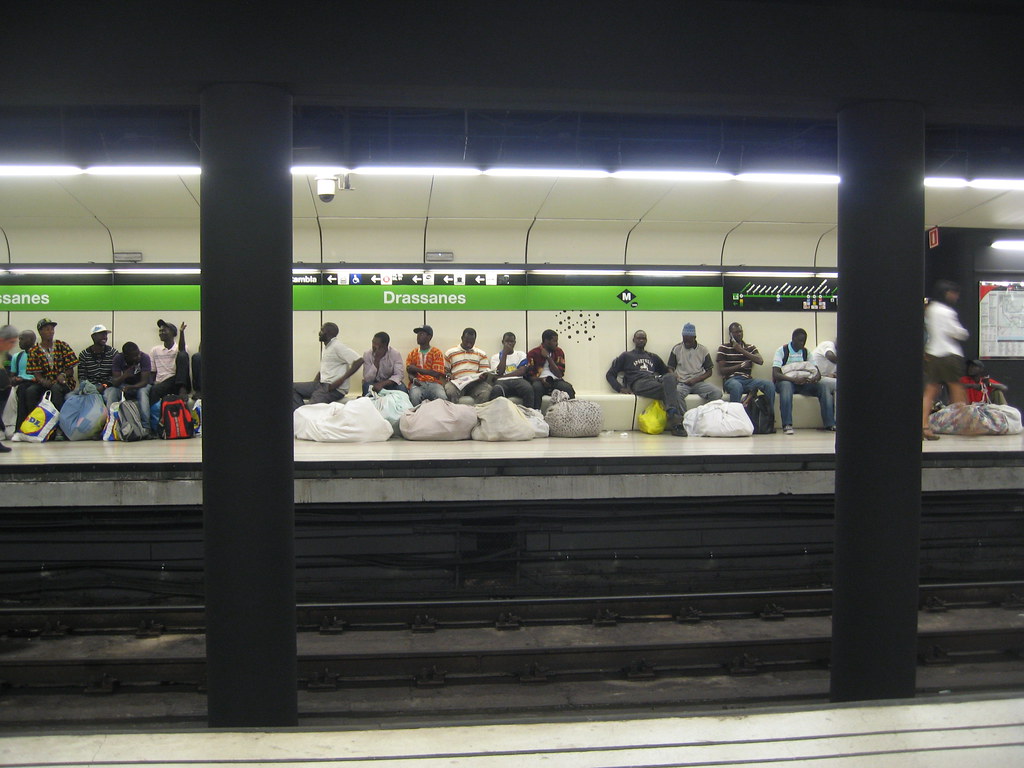
A group of informal traders in Barcelona, heading home on the metro. Image: Todd Martin, via
Between the 19th and early 20th century, Barcelona’s Poblenou neighborhood became the site of a fascinating transformation. Factories, processing plants and small stores blossomed as industrialization turned the swampy marshes on the banks of the Besòs River into a densely populated hub, centered on the textile industry. They also poisoned that river, and the living conditions suffered by the new inhabitants were highly toxic. Defenseless in the anomic void of structural exclusion, the workers who had migrated from Barcelona, Aragon and Valencia to find work in the previously unpopulated area had built their own shanty houses. Hygiene was a problem, and frequent epidemics of typhoid, cholera and smallpox produced an atrocious mortality rate. Their working conditions included unthinkably long hours, low wages, insufficient meals and exposure to harmful waste. Yet those same workers overcame these conditions through mutual aid and solidarity, using their autonomy to organize into cooperatives and associations, as well as under the flag of one of the most storied unions in the history of the labor movement: the anarcho-syndicalist Confederación Nacional del Trabajo (CNT).
“The situation of the migrants living in Poblenou is abominable,” says Mutuma Ruteere, the United Nations Special Rapporteur on contemporary forms of racism, racial discrimination, xenophobia and related intolerance. “The conditions there are inhumane and degrading. The hundreds of immigrants who live there have no access to the most basic services, such as heating, clean water or health care facilities. The conditions are clearly not suited for housing people.”
The most striking examples of mutual aid and solidarity are the actions being taken by the Mount Zion community itself. While it is no secret that an undocumented status (whether it is due to undocumented entry or having expired papers) can force people to rely on the riskier work that characterizes the informal or illegal economy for sustenance, the workers who live at Mount Zion have taken a different route. In addition to the work they do collecting scrap metal throughout the city, they have started a glass recycling project. And while many of the artists in the community use the objects they collect in their art, others are musicians in Barcelona’s vibrant dub, reggae, dancehall and African music scene. All of the work they do is organized horizontally, cooperatively, and they are currently taking steps to legalize their economic activity by forming an Integrated Cooperative. They have also expressed that they would be willing to rent the space at a reduced rate.
“There is a political blockade, a marginalization being carried out by the institutions,” says Sharif, one of the current inhabitants of Mount Zion, “The citizens support us, but the politicians want to turn us into delinquents.” Until now, while the city government currently run by the right-wing nationalist Convergència i Unió party (CiU) has resorted to a soft, appeasing rhetorical style to discuss the Mount Zion community, the actual responses by public institutions have been ambiguous at best, and hostile at worst. In a recent court hearing about the future of Mount Zion, fifty residents were forced to wait outside as the judge stated that, despite the “humanitarian crisis that an eviction would create”, she must rule in favor of the owner’s right to own private property.
Meanwhile the Endesa power company, in collaboration with the Catalan police, made their contribution to the process by cutting off the power to the building, in a clear effort to pressure the residents to abandon the only shelter available to them. Finally, the CiU government rejected Mount Zion’s original proposal, offering a job-training program and 40 day stays in local shelters instead.
Mount Zion is scheduled to be evicted on July 18th. It seems hard to believe that, having seen the positive steps taken by the community and their neighbors in Poblenou, the City of Barcelona will suddenly put 800 people out on the street. The Depression-level magnitude of the economic crisis affecting Southern Europe is proving too overwhelming for both public and private social protection services, and even the mini-Guantanamos that are Spain’s Immigrant Internment Centers are incapable of dealing with such a massive influx of people.
An eviction of this magnitude would not only be a massive violation of human rights and the suppression of a tremendously commendable exercise of worker autonomy and self-management; it would also constitute the political fabrication of a social time-bomb. By blocking the institutional path towards a fair solution, an entire community of people would be forced to rely on the noxious dynamics of the underground economy.
One would think it wise for the City of Barcelona to examine the way its history still resonates in places like Poblenou.
This guest post by Carlos Delclós is cross-posted with Roarmag, photography via Ground Press. Also, check out Carlos’ post on some of the music coming out of the Mt. Zion community at Dutty Artz, where AIAC’s Boima Tucker has a role.