When Bob Marley went to Africa
Bob Marley was deeply shaped by his relationship to Africa — through faith, music, and Pan-African politics — visiting Kenya, Ethiopia, and Gabon. This relationship was marked by contradictions.
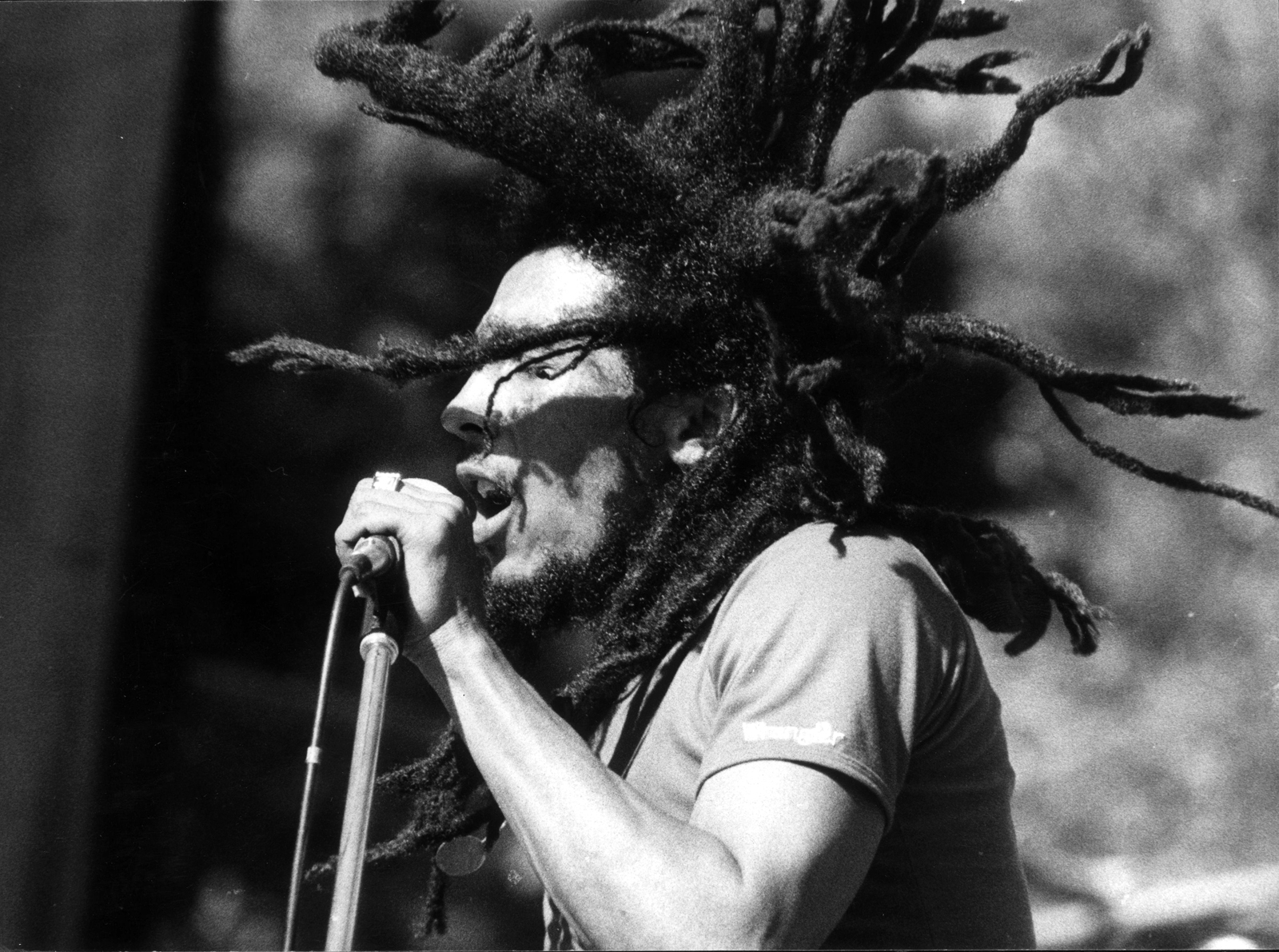
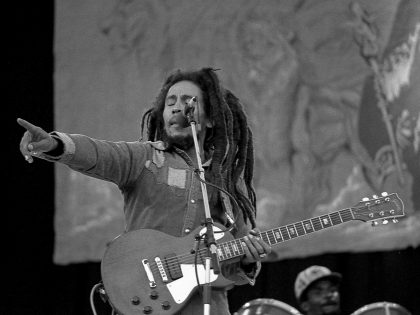
Bob Marley in an undated photograph.
The public persona and politics of Bob Marley—who was born on 6 February 1945—were deeply shaped by his relationship with Africa, both symbolically and materially. Kevin Macdonald’s film Marley explores that connection in considerable depth. In anticipation of Marley’s birthday, I watched the film again.
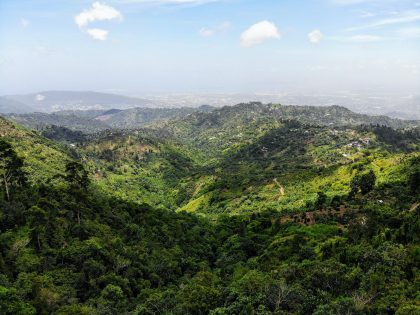
The film opens on the Ghanaian coast at the remains of a slave post. The camera then pans over the Atlantic before settling on the green hills of rural Jamaica—Marley’s birthplace, Nine Mile—from which it begins to trace his story. The effect is to cement a historical and affective link between the African continent and its New World diaspora.
In his youth, Marley was drawn to the teachings of Leonard Howell, who had been organizing Rastafarians in Jamaica since the 1930s. Macdonald’s interlocutors also claim that Mortimer Planno played a significant role in introducing Marley to Rastafari.
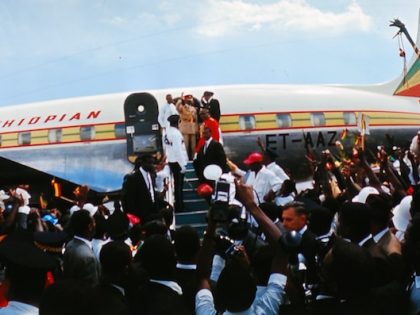
Rastafari, a millenarian movement, was inspired by antislavery resistance culture (the Maroons, for example) as well as Marcus Garvey’s early 20th-century advocacy for the repatriation of Jamaicans and all people of African descent to Africa. Its adherents revered Haile Selassie (Ras Tafari before he became Emperor of Ethiopia)—whose forces had resisted Italian occupation of Ethiopia—as a living deity. In April 1966, Selassie visited Jamaica, where ecstatic crowds greeted him at the airport, as the film shows. Marley would later record “Selassie Is the Chapel,” his version of “Crying in the Chapel,” a song associated with the white American singer Elvis Presley, as a tribute to Selassie. (In the early 1960s, Jamaican singers would often record their own versions of popular American songs.)
Marley, like many adherents of Rastafari, longed to visit the African continent—or even to live there. As his fame and means grew, and as invitations followed, he did travel to Africa. Macdonald suggests that Marley’s first such trip was to Gabon in January 1980. Later that same year, Marley performed at Zimbabwe’s independence celebrations, marking its transition from British colonial rule and white-minority governance to majority rule. The film treats both trips in some detail.
Strangely, however, the film is silent on Marley’s earlier 1978 visits to Kenya and Ethiopia—omissions that feel less incidental than telling. Even so, the trips Macdonald does cover point to some of the more contradictory impulses within Marley’s politics.
When Marley arrived in Gabon, the country was under the long-standing dictatorship of Omar Bongo. The latter’s regime, built on oil wealth, was widely known for corruption and repression of political opponents. Bongo came to power in 1967, and by the time Marley arrived, he had already been in power, uninterrupted, for thirteen years. Successive French presidents, through the informal system often referred to as Françafrique, helped sustain his rule. In return, Bongo safeguarded the interests of French multinationals, which dominated the economy and contributed to political financing in France. By the time Omar Bongo died in 2009, he had ruled for an astonishing 41 years.
Bob Marley, it seems, was romantically involved with Pascaline Bongo, the president’s daughter. They were dating at the time—though not exclusively, as Marley often maintained concurrent relationships. In fact, he was married to Rita Marley, one of his backup singers. When they first met, Marley reportedly scolded Padaline for chemically processing her hair, even calling her “ugly.” He nevertheless agreed to perform a birthday show for her father.
Macdonald’s interlocutors suggest Marley did not initially realize Bongo was a dictator—a claim that strains credibility—and only grasped the situation upon arrival, yet chose to perform anyway, reasoning that he had already traveled so far. The film, interestingly, devotes more attention to a sequence in which Marley and members of his band detain and interrogate their manager in a hotel room over alleged theft than it does to probing this apparent inconsistency in Marley’s politics.
In an interview with the Caribbean culture site LargeUp, at the time of the film’s release, Macdonald elaborated on the Gabon trip, emphasizing Pascaline Bongo’s importance in Marley’s final years and her role in facilitating his connection to Africa. MacDonald frames the episode as a “bizarre story,” contrasting Marley’s origins in Trenchtown with the opulence of the Gabonese presidential environment, while suggesting that Pascaline’s influence extended beyond a conventional romantic relationship.
Pascaline Bongo remains active in Gabonese politics.
Her brother, Ali Bongo Ondimba, appears in the film. He is shown receiving Marley at the presidential palace. In the 1970s, Ali fancied himself a singer and even recorded an album.
After his father’s death, Ali became president, underscoring how governance in Gabon has remained a family affair.
The film then turns to Marley’s decision to spend approximately $90,000 of his own money to fly his band to Zimbabwe’s independence celebrations. He had already been performing Zimbabwe, which he composed in honor of the country’s liberation. Archival footage shows Marley performing at Rufaro Stadium, intercut with scenes of the crowd.
Macdonald’s film affirms that Marley anticipated the authoritarian and corrupt political trajectory of Robert Mugabe’s government. During the concert, riot police teargassed crowds attempting to enter the already full stadium. Marley refused to leave, continuing to perform amid the gas. According to accounts, he turned to his band afterward and remarked: “Now we know who are the real revolutionaries.” On his song, “Zimbabwe,” Marley sang to the crowd: “Soon we’ll find out who is the real revolutionary.”
Though not covered in the film, we know that Mugabe reportedly preferred Cliff Richard to perform at the celebrations. Years later, Mugabe would publicly disparage Jamaican men, including Rastafarians, as “drunkards” perpetually under the influence of marijuana.
The film’s broader implication is that Marley was, at times, politically naïve—or at least poorly advised. Admirers and close associates might dispute that reading. Yet the film also shows that in 1970s Jamaica, Marley struggled to fully grasp the dynamics of garrison politics—arrangements between political parties and local enforcers designed to secure loyal voting blocs. Indeed, his departure from Jamaica followed a politically motivated assassination attempt at his home, in which he was shot.
As noted earlier, one particularly puzzling omission in Macdonald’s film is Marley’s 1978 visit to Kenya and Ethiopia—especially given Rastafari’s profound connection to Ethiopia. As accounts note, during his time there, Marley stayed in Shashamane, part of a land grant associated with Selassie for members of the African diaspora seeking repatriation. He also traveled to Addis Ababa, visiting sites tied to Selassie’s life and to Ethiopia’s long history. An odd omission by MacDonald, whose film seems obsessed with Marley’s mixed identity.