Eggs and omelettes
The existence of African billionaires are not positive evidence of “Africa rising,” but testament to the extreme inequality characterizing economic growth on the continent.
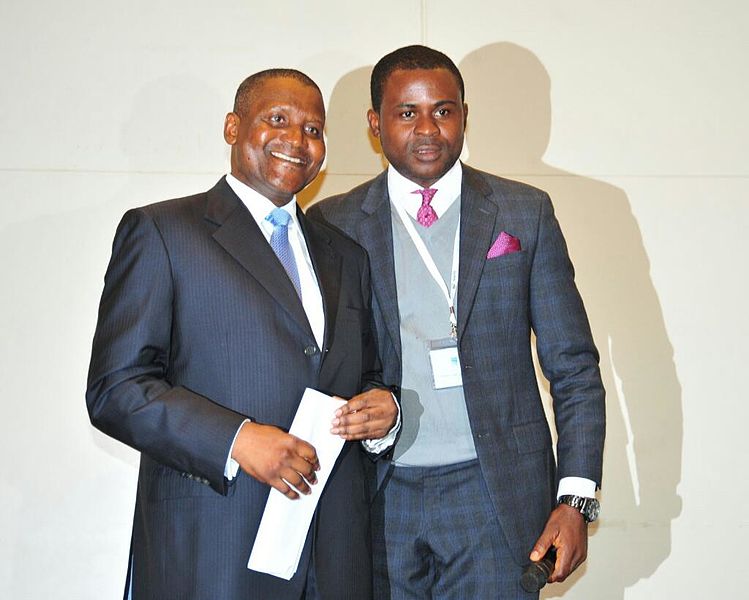
Aliko Dangote, left, the richest man in Africa. at a summit in Nigeria, 2015 (Image via
The American business magazine, Forbes Magazine, recently released its second annual list of “Africa’s 40 Richest” people. The feature appeared on the Forbes homepage alongside lists of “America’s Richest,” “India’s Richest,” “Thailand’s Richest,” and “China’s Richest.” For Forbes, it seems, Africa is indeed a country – it’s the only place where the richest are grouped by continent and not countries – and an increasingly wealthy one at that.
The Forbes list is just the latest example of the current dominant Western press narrative regarding Africa: the continent as “emerging economy.” Forbes does, however, avoid one problem that characterizes many other recent writings about African economic growth: it acknowledges the deeply unequal distribution of wealth on the continent. It does this not by citing Gini coefficients or talking about poverty but by explicitly celebrating the grotesque wealth of the few. Indeed, while other authors traffic in broad narratives of “Africa rising,” the compilers of the Forbes list are more interested in Africans rising.
Of course the success of the 38 men and 2 women included on the list, and the fact that “the moguls’ combined net worth . . . is up 12% over last year,” is taken as an implicit sign that Africa as a whole is improving. “Amid grim news about the global economy, Africa continues to shine,” begins the article introducing the list.
Every good capitalist economy, it seems, needs its oligarchs. Far be it for Forbes to question whether the money could be distributed differently, to probe how those on the list acquired their assets in the first place, or to look at those who got pushed down during the moguls’ climb to the top. Indeed, if one takes Forbes’ word for it, it seems that Africa’s billionaires are, without exception, awesome.
Topping the list, for instance, is Nigerian construction and telecom magnate Aliko Dangote, with a net worth of $12 billion in 2012. This is up from $10.1 billion in 2011 and good for 76th richest person in the world. Dangote, we are quickly told, is working with Bill Gates to fight polio.
Indeed, one might be forgiven for wondering if the entire purpose of the Forbes list (or Forbes more generally for that matter) is to humanize billionaires, allowing the rest of us to see them as people (rather than as walking embodiments of economic injustice). How else to explain the fact that Forbes finds space in its 70 word profile of Nicky Oppenheimer, Africa’s second wealthiest person, to tell us that he is an “avid cricketer”? Or the rather bizarre editorial selection of a picture of Africa’s third richest man, Johann Rupert, swinging a golf club to accompany his write-up?
Now, I should say that I did a good deal of digging around for dirt on everyone in the top ten of the Forbes list and didn’t come up with much. Whether this speaks to a heretofore undiscovered correlation between ethics and obscene amounts of wealth, or just to excellent corporate PR and Google policing, is hard to say. Oppenheimer and Rupert’s families did build their fortunes under apartheid, but both men and their fathers have made sure to highlight that they “spoke out” against the National Party’s racist regime. Construction magnate Naseef Sawiris of Egypt did amass his money under the Mubarak military dictatorship, but, according to TIME magazine (who else), Sawiris “has a reputation for personal integrity, being a strong nationalist with a liberal vision of Egypt’s future”; so much so that he is one of the few Egyptian oligarchs not to have his assets frozen in the wake of last year’s Revolution.
I won’t speculate on the means by which Africa’s billionaires acquired their wealth. I have no evidence that they are anything other than fine upstanding citizens, and to imply otherwise could be libelous. (Though I can’t help thinking of an old expression involving eggs and omelets.) I will, however, say that I find their mere existence to be not, as Forbes would have us believe, positive evidence of “Africa rising,” but testament to the extreme inequality that characterizes economic growth on the continent. This inequality needs to be spoken about and addressed through global structural changes, and glossing it over with a simplistic, celebratory narrative helps (almost) no one.