Africa’s manosphere
Influencers on the continent are marketing themselves as self-development coaches, advising men on everything from health and wellness to work opportunities, building wealth, relationships, and putting women in their place.
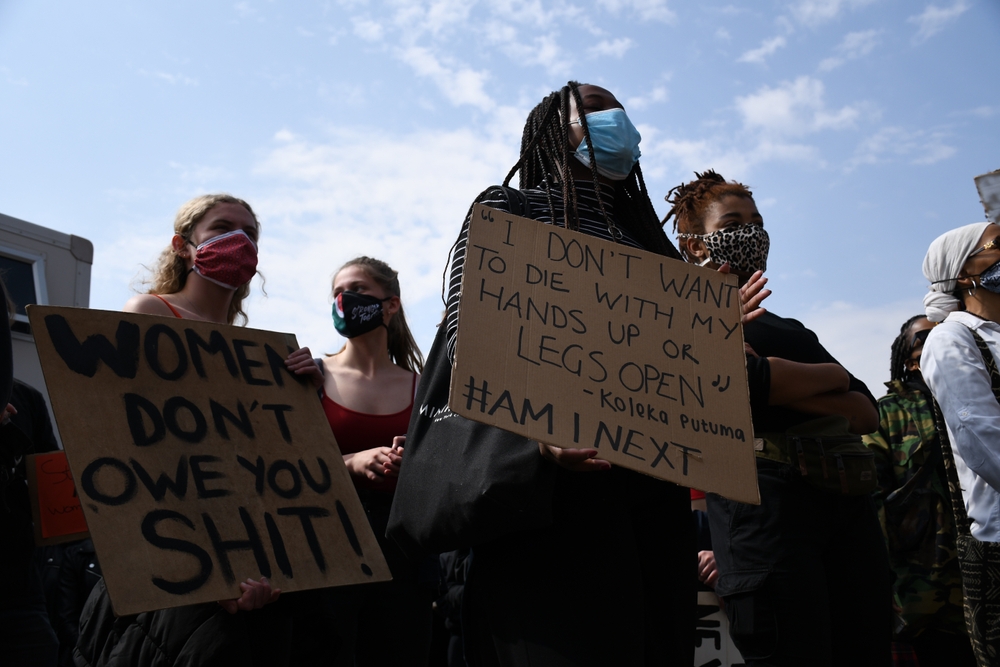
Demonstrators protest against gender-based violence outside the former Women’s Jail at Constitution Hill in Johannesburg, South Africa. Photo: Julia Jean/Shutterstock.
“He killed her because of a birthday cake.”
This is how researcher Dabney Evans began her presentation on femicide at the Sexual Violence Research Initiative Forum in Bangkok last month. The weapon involved in femicide is usually a familiar object: a rifle that a partner uses for hunting, a knife you have used many times to chop vegetables, or the hands you once held close to your heart.
The United Nations estimates that every day, about 137 women and girls lose their lives “at the hands of their partner or a close relative.” Africa has the highest number of femicide cases worldwide.
For years, feminist activists have warned about the manosphere. UN Women describes the manosphere as “an umbrella term for communities that promote harmful definitions of masculinity,” including podcasts, gamer communities, social media, and dating apps—the digital movements that are enabling femicide, supporting it, and teaching men how to be more strategic in their abuse. A recent Lancet paper by Sarah J. Hawkes and Kent Buse argues that the manosphere “is best understood and addressed as a public health problem.”
When people think of the manosphere, Andrew Tate comes to mind as perhaps the most recognized name, but in recent years we have seen the rise of Tate-style figures worldwide. In a Guardian article published earlier this year, African feminist scholar Awino Okech noted the rise of the manosphere in Africa and a growing conversation on the “red pill” theory, which is the belief “that men and boys were being left behind as a result of all of the investments that had been made around girls’ and women’s rights.”
The manosphere draws in young men by offering self-improvement advice, simple companionship in the face of rising male loneliness fueled by economic hardship, reassurance in the face of their anxiety about independent women, and a sense of masculinity in repressive states where citizenship is contested through state violence and economic opportunities are scarce.
But these offerings come with a catch. The Guardian article notes that the manosphere first teaches men to think of themselves as victims: of feminism, the state, the economy, or changing social norms. It tells them there is a way to take back their power through “domination and intimidation.”
This pattern is replicated in the African manosphere. Content creators and influencers market themselves as self-development coaches, advising men on everything from health and wellness to work opportunities, building wealth, relationships, and putting women in their place. In Kenya, Eric Amunga, known as Amerix, stands out. Calling himself a medical specialist and masculinity coach, he is prominent for his #MasculinitySaturday posts on X. In one recent post, he tells his followers that “a man’s salary pays artisans, plumbers, masons, technicians and mechanics. A woman’s salary buys an iPhone, earphones, bundles, airtime and subscriptions to online gossip. We are not equal.” His posts get thousands of comments and likes. He has 2.3 million followers on X, and he sells courses through his website.
In Nigeria, Àgbà John Doe leads a community called “The Agbafians Community,” which he claims can’t be killed by woke culture. On X, he runs a main account, a backup account, and a premium account, where followers pay to access his content.
The subscription model on X allows content creators to make money on the platform directly from their audiences, reflecting what Hawkes and Buse, in their research, refer to as the “commercial ecosystem” of the manosphere, where insecurities and perceived problems are monetized through different packages. In other words, the manosphere is an ideological ecosystem, but it also has a lucrative business model.
In Egypt, the rise of the manosphere has coincided with the normalization of misogynistic terms such as Nashez, which means “disobedient woman,” as several cases of femicide against university students have gained mainstream media attention. One widely covered case was the 2022 killing of 21-year-old Nayera Ashraf, a student at Mansoura University who was stabbed to death outside its gates by a classmate whose proposal she had rejected. Her killer was executed less than a year later, but femicide cases across homes and university campuses have only risen since then.
Recent research has exposed the links between the manosphere and violence. In Kenya, for example, femicide is rising rapidly. At the same time, women protesting femicide have been tear-gassed, and online there are fewer allies and more voices telling women to stop complaining and protect themselves.
A 2025 article in The Republic argues that the rise of incel culture on Nigeria’s social media is linked to the increasing rate of femicide in the country. The article links the growing manosphere and incel ideology to an increasing desire for control over women that can turn violent, and situates this within the established patterns of gender-based violence.
Such articles in African media and intellectual outlets are critical because they reiterate that the manosphere is not just a problem in the North, but a growing phenomenon on the continent.
However, it will always be difficult to assess the depth and size of the manosphere on the continent because there are many languages. For example, Naty Mon, an Ethiopian red pill content creator, presents in Amharic, which makes his content relevant to audiences in Ethiopia, whereas Amerix reaches English-speaking audiences in East Africa and beyond.
The most dangerous effect of the manosphere may be the way it normalizes violence against women. Dr. Moya Bailey coined the term “misogynoir,” which describes the “co-constitutive nature of racialized and sexist violence that subjugates Black women due to intersecting systems of oppression.” This is critical to understanding the prevalence of gender-based violence in Africa and in the African diaspora and the rise of creators such as Sudanese-American podcaster Myron Gaines, who uses his platform to spread misogyny, but most importantly to dehumanize Black women. Dehumanization doesn’t only lead to violence, but it also normalizes violence and chronic impunity.
The manosphere encompasses influencers and celebrities, some of whom require their wives and girlfriends to sign non-disclosure agreements. The manosphere warns high-earners that all women are gold-diggers and thus wealthy men must protect themselves and their money. These agreements are not only about protecting assets: they offer men an opportunity to subject women to abuse and violence and get away with it.
Femicide is already difficult to distinguish. In many cases, murder cases by intimate partners or family members continue to be categorized as “homicide” or even “honor killing,” which makes it exceptionally difficult for women’s rights groups to monitor and track the scale of the femicide epidemic. Femicide of sex workers is an example. Sex workers are regularly killed across Africa; in Kenya, activists have started adding sex workers to femicide lists, noting that one-third of femicide victims are sex workers.
As much as things are moving forward when it comes to documentation in Kenya, the manosphere has been instrumental in shifting the blame to victims of femicide and simultaneously criminalizing the feminist movement that is working to end the practice. Felix Kiprono, who built the Silencing Women database, which visually documents femicide in Kenya, noted that he was appalled “by the reaction to its findings, in particular on social media which is sometimes described in Kenya as a ‘manosphere.’”
Yet women and civil society continue to push back.
In South Africa, Gun Free South Africa, a local organization and a member of the International Action Network on Small Arms, initiated the #GunFreeValentine campaign after noting that femicide increases during that period, following several high-profile cases.
The forthcoming compendium by the Building Knowledge Bridges Community of Practice convened by Liberation Alliance Africa, which brought together African Indigenous knowledge holders, feminist researchers, organizers, and women’s rights activists, developed three briefs on responding to and preventing sexual violence. One of the briefs is on “Epistemic Sovereignty” and it invites people working to end sexual violence to adopt epistemic sovereignty in their analysis of sexual violence on the continent. The brief proposes a number of practices, one being community accountability as a relevant and timely approach to combating femicide and holding the African manosphere accountable.
Community accountability is often presented as an organic approach to empower the community to reclaim justice and sovereignty. This approach was first promoted by women of color in the US through organizations such as INCITE!. Legal scholars Hanan and Nussbaum write that the history of community accountability is rooted in approaches developed by prison abolitionists who sought to address “violence without state involvement through policing, prosecution, and prisons.” This came from the belief that the community needs to be accountable and the individual needs to be held responsible.
In Africa, different renditions of community accountability are inspired by Ubuntu. Ubuntu requires us to be accountable to each other and empowers the community to discipline the wrongdoer in their own ways. Feminists around the world have long used this holistic and sustainable approach to tackle sexual violence. Usikimye, a Kenya-based collective working to end gender-based violence, has recently developed a program called the Femicide Accountability and Community Empowerment Program. Usikimye views femicide as neither an individual act nor a personal tragedy for the survivors, but a result of deeply embedded values held by men, and that working through the official justice system will not create a safer community for girls and women. Any framework for community accountability must engage with the manosphere, whose discourse both contributes to violence against women and undermines the very social fabric needed for this accountability process.
Finally, it is not strange for a woman to die after buying cake, and it is not strange for women to be killed on their birthdays or on Valentine’s Day. It is common for women in Africa to be killed by their loved ones, including fathers and brothers. Femicide is an epidemic that we have to understand and address immediately. We need further research on the main players of the manosphere in different countries; we need to understand how algorithms bring people to such content, and we need to understand the dynamics of femicide across the continent. We also need to mobilize influencers and content creators to produce media that challenges the dangerous, misogynistic narratives of the manosphere and provides relevant information and support to young men who are struggling with economic hardship, loneliness, and state violence.