What Nollywood owes the ancestors
Masquerade custodians in Lagos keep saying no to Nollywood. Nollywood keeps returning to masquerades anyway.
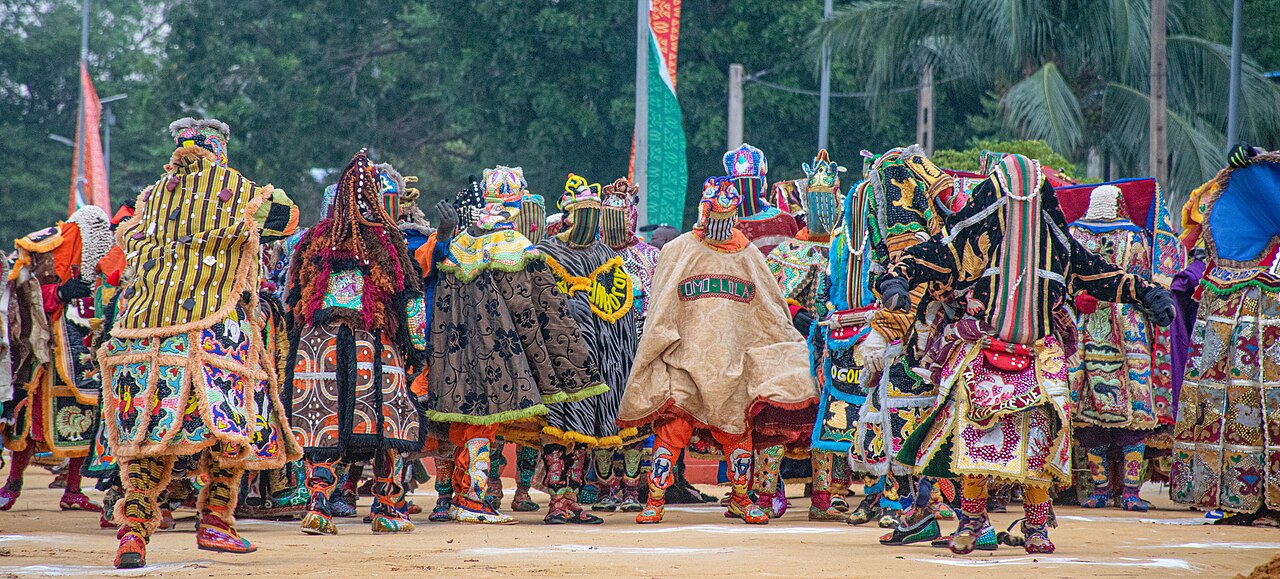
Egungun masqueraders perform at the Festival of Masks in Porto-Novo, Benin, August 3, 2025. Source: Romario Coffi/Wikimedia Commons (CC BY-SA 4.0).
In June 2025, in Lagos, I sat down with custodians of Yoruba masquerading traditions, and I asked each of them a version of the same question: “What do you think about masquerades appearing in Nigerian films?” Each time, the answer was a flat no.
I grew up in Lagos and have spent years studying Yoruba masquerading traditions, particularly Eyo and Igunnuko. With support from the Ebrahim Hussein Fellowship and the Aliko Songolo Award, I conducted formal interviews at the Bajulaye and Alagbeji palaces and at the Igunnuko shrines in Epetedo and Alaguntan to understand where this resistance comes from. More importantly, I sought to know what it means for Nollywood to keep returning to these figures despite the pushback.
Foundational cultural theorists of the 1930s and 1940s grappled with a similar question of what happens when a sacred or ritual object is copied, restaged, or transferred into a new medium. In 1944, Theodor Adorno and Max Horkheimer believed that mechanical reproduction drains ritual objects of their meaning, while Walter Benjamin had argued the opposite about a decade earlier. For Benjamin, reproduction could free art from ritual’s grip rather than hollow it out. The reality of this tension is a concept that my fieldwork explores.
To understand the resistance to masquerade remediation in film, you first have to understand what a masquerade is to its custodians. In Yoruba tradition, the egungun is not a costume design. It’s what a family member becomes after death, made visible. Ile, the family compound and infrastructure of domestic life, is what produces a person worth remembering. A properly raised person becomes, after death and burial within that same compound, an ancestor (alaale or babanla). The cloth used to bury them, ago or eku, is equal to the same cloth a masquerade wears.
Therefore, a masquerader is not an actor playing an ancestor; the masquerade is treated as an ancestral presence, returned. These masquerades are called ara orun (heaven dwellers), and their presence has two faces: the ancestral side is what is made public, danced and seen at a festival, while orisa is the sacred essence beneath it, hidden and guarded. None of this starts on the day a masquerade appears. It starts with the ile, a life, a death, a burial, a cloth. Once you skip that, what is left on a screen is the shape of a masquerade without the systems that make one real.
Interestingly, motion has always been the story of Yoruba masquerades. Scholars trace the tradition from the Nupe to the Oyo, who developed traditions like Ololu, still performed in Ibadan today. From Oyo it moved south, reshaped by Ijebu, home to the Agemo and Eyo masquerades. Historical accounts credit two Ijebu brothers, Malaki and Ejilu, with carrying Eyo onward to Eko, old Lagos, where it grew into the festival celebrated today. Therefore, studying masquerade in Lagos already means studying something remediated many times over, long before a camera entered the picture.
Following this trajectory, screen media is the newer remediation, and it works differently. Abba Makama’s The Lost Okoroshi (2019) turned a security guard into a purple ancestral spirit, putting a masquerade at the center of a very modern Lagos story. Jagun Jagun (2023), the Netflix epic produced by and starring Femi Adebayo, leaned hard on Yoruba spiritual and masquerade imagery and became one of the biggest Yoruba-language releases in years. Gangs of Lagos is another Nigerian film that significantly employs the image of a masquerade tradition. Masquerades also appear constantly in music videos, almost always as background texture, with no voice of their own.
The rare film attempts have drawn public criticism and lawsuits from masquerade societies and state authorities, as in the case of Gangs of Lagos. However, nothing comparable has happened to a music video. The traditional masquerade falls under the supervision of a secret cult called awo, which sets the pace and protects orisa, the sacred core of the tradition. A film crew doesn’t move at that pace, and it certainly doesn’t answer to that authority.
Furthermore, the filmmakers see it differently. In my interviews with them, both Adebayo and Makama were clear that they aren’t trying to reproduce a masquerade as it exists. They’re making something new, despite drawing on existing traditions. Makama has said plainly that he wants Nigerians, especially younger ones, to reconnect with traditions that colonial-era religion spent decades demonizing. However, that doesn’t necessarily mean consent from the people who consider these figures sacred.
Film isn’t the only place where masquerades reappear. I spent time at the John Randle Centre for Yoruba Culture and History, the National Museums in Onikan and Ibadan, and the Nike Art Gallery, all of which hold masquerade pieces. These vitrine spaces offer another kind of remediation, arguably a stranger one than film. It removes a masquerade from ile entirely and places it in a non-performative state. There is no dance, no voice, no direct exchange with the living, which is the entire point of a masquerade at a festival. No lawsuits follow a museum acquisition in Lagos. If the objection to film is about skipping the machinery that makes a masquerade real, a glass case skips all of it. In fact, it rarely draws any objection. This evidences the tension I raised earlier.
As I wrapped up the interviews, I realized it might be useful to revisit the classical debate among Frankfurt School scholars. I think Adorno and Horkheimer would read the custodians’ “no” as evidence that mechanical reproduction erodes what makes a masquerade real. Benjamin would push back, insisting that sacrificing authenticity at the altar of accessibility is fine. My take on this is simple. If masquerading traditions have never stood still, then the question is not whether they should be remediated. Perhaps the more important question is how screen remediation can demonstrate genuine care and respect for tradition while remaining committed to social function.