The shadow of the fatherland
Akinola Davies Jr’s feature-length debut traces how Nigeria’s military rule collapsed the boundary between political crisis and intimate life, leaving families to bear the cost of authoritarian power.
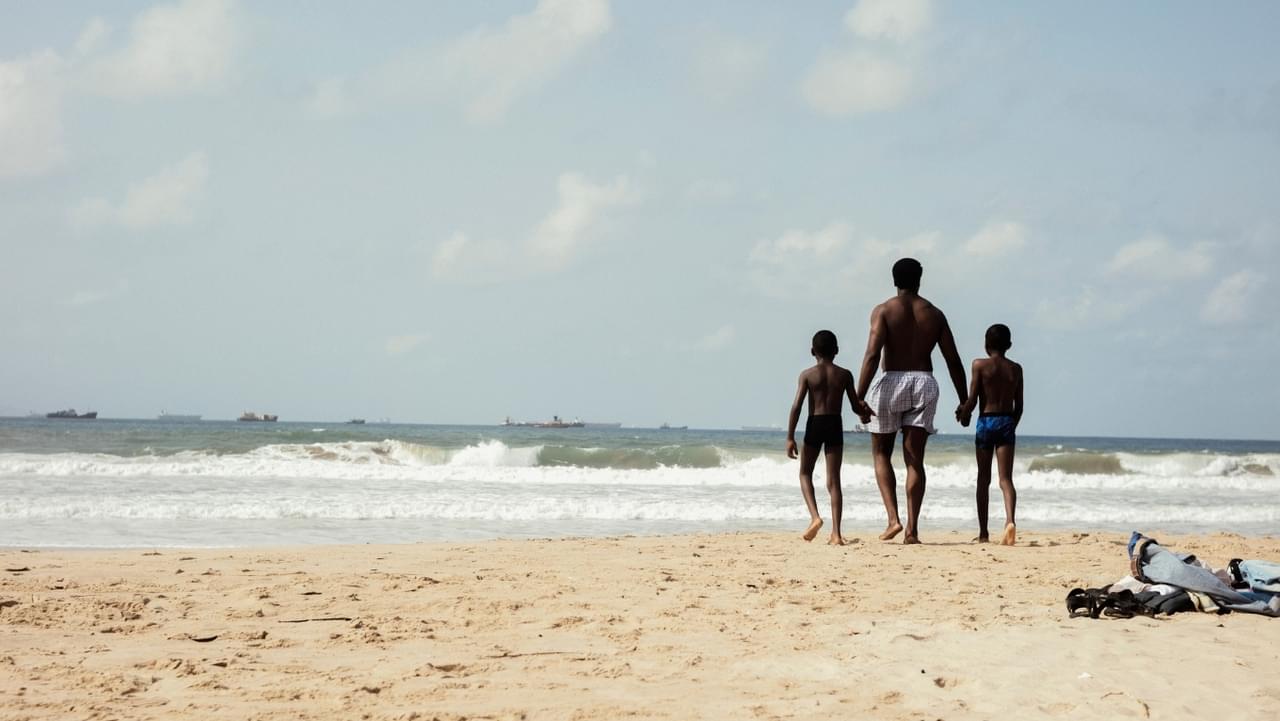
Folarin walks hand in hand with his two young sons along a Lagos beach in Akinola Davies Jr.’s My Father’s Shadow (2025). Image courtesy MUBI.
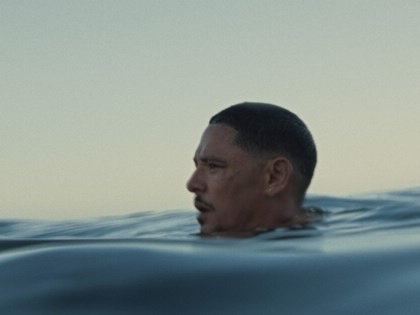
In the credits of My Father's Shadow, Akinola Davies Jr.’s devastating debut feature, one of the production companies listed is Fatherland Productions. Fatherland. The word sits there like a confession hiding in plain sight, a suggestion of the film’s deepest argument: In postcolonial Africa, the story of the father and the story of the nation have always been the same, and the strongman state didn't merely fail its citizens. It orphaned them.
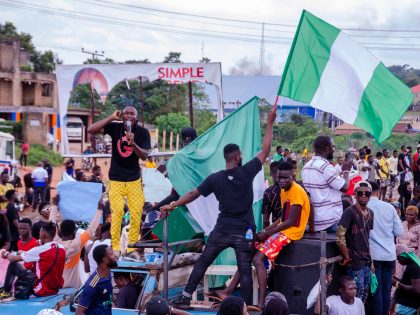
My Father’s Shadow is set on June 12, 1993, a date on which an entire national imagination swung shut. On that day, Nigerians went to the polls in the first democratic election since a military coup a decade earlier, and they elected Moshood Abiola in what political observers at the time widely regarded as the freest vote the country had ever seen. Abiola, a Yoruba Muslim, won across ethnic and religious lines, building an aspirational pan-Nigerian coalition. For a brief, vertiginous moment, the country cohered around a shared democratic future. Then General Ibrahim Babangida—who had ruled since seizing power in the 1985 palace coup and had already postponed the transition to civilian rule twice—simply annulled the results, invoking unspecified "irregularities" to void the most credible election the country had ever held. The future collapsed.
Davies chose this date because it is personal—he and his brother Wale, who co-wrote the screenplay, lost their father to an epileptic seizure when Akinola was 20 months old and Wale was four. By 1993, they were roughly the same ages as the film’s protagonists, two boys growing up fatherless in a country in crisis. The film, set against a political crisis the young could not fully understand, reimagines a day Davies and his brother never had with their father. June 12 is also the day on which a particular kind of African fatherhood became impossible.
The annulment didn't just end an election. It inaugurated the Abacha years, among the most brutal dictatorships in Nigerian history, and confirmed what millions of Nigerians already suspected: that the military state would sooner destroy the country than relinquish its grip. Men like Folarin, the father in the film, played with quiet ferocity by Sopé Dirisu, were caught in the wreckage. A factory worker who hasn't been paid in six months, a suspected political activist whose friend tells him the regime has killed four of their people, a man whose nosebleeds accumulate across the film like a ledger of debts the state has written on his body. Folarin is not merely a character. He is a condition.
My Father's Shadow is not just a film about one father and two sons. It is a film about what military rule cost African families at the level of the kitchen table, the bedtime story, and unanswered questions. Much of the critical apparatus around the film, particularly in the West, has foregrounded the personal elements while treating the political dimension as ancillary. The reviewers make comparisons to Barry Jenkins’ 2016 coming-of-age drama Moonlight, focus on the autofictional framing, and praise Jermaine Edwards's cinematography, but Davies has made a film in which the political is not backdrop. It is the thing itself. When the election is annulled, the father dies. This is not a coincidence. The film does not need to explicitly state this connection; it builds it into the structure of every scene, until the collapse of the election and the loss of father feel like the same event.
Consider what the film shows us. Folarin takes his sons to Lagos to collect his back pay—an economic errand that is itself a consequence of the military state's mismanagement. Along the way, the boys glimpse newspapers about a massacre at the fictional Bonny Camp, overhear adults debating whether military control is necessary, watch trucks full of soldiers pass by—"stupid people,” their father mutters. Politics is not merely context; it is the medium through which the family moves, the air it breathes, the danger that tightens around every scene until the checkpoint where a soldier claims to recognize Folarin and the film shatters into state violence. The confrontation is terrifying. Folarin’s nose bleeds heavily, his sons watch in silence, and they are eventually allowed to pass. But the damage is done. Not long after, in the film’s devastating final moment, Folarin is dead, and his sons are attending his funeral. Folarin's body—bleeding, laboring, gone—is the site where the political and the personal become indistinguishable. The strongman state didn't just kill democracy. It killed fathers. And it did so across the continent.
The early 1990s were the hinge decade for postcolonial Africa. The Cold War's end destabilized the superpower patronage that had propped up dictators from Kinshasa to Nairobi—less a withdrawal than a reconfiguration, one that created both democratic openings and desperate, violent last stands by regimes that had no intention of ceding power. Babangida's annulment sits alongside Mobutu's final looting of Zaire, Moi's rigged elections in Kenya, Eyadéma's constitutional manipulations in Togo, and Abacha's subsequent coup in Nigeria. Across the continent, a generation of strongmen—men who styled themselves as Fathers of the Nation, who demanded the filial obedience of entire populations—systematically destroyed the conditions under which actual fathers could exist. They created economies that forced men like Folarin to leave their families for months. They created security states in which political engagement could be fatal. And they created cultures of silence so totalizing that even fathers who survived could not speak to their children about what they had endured.
“If you're from an African household, our parents don’t talk very much,” Davies said after a screening at Angelika Film Center in New York in February. “It means a lot to try and humanize their experiences. Because a lot of what they went through, they didn't have outlets to talk about it.” Many have referenced this observation in profiles and reviews, but few have asked the obvious next question: Where did the silence come from? It was manufactured by regimes under which speech was dangerous, under which knowing too much about your father's political life could put you at risk, under which the safest thing a parent could do was tell their children nothing. In Nigeria, this had a material form. Under the military regimes that followed June 12, Abacha’s government dissolved political parties, shuttered newspapers, and jailed journalists. Dele Giwa, the founding editor of Newswatch and one of the country’s most prominent investigative journalists, had already been killed by a letter bomb widely attributed to state security forces in 1986. Families of the disappeared learned not to ask questions.
The regime that denied the Bonny Camp killings, the very headline the boys glimpse in the film, was teaching an entire population that what you saw with your own eyes had not happened. Folarin's stoicism in the film—the stern expressions, the terse deflections, the way he holds his sons at arm's length even as he clearly loves them—is too easily read as personal, a quality of the man rather than a condition of the state. It is a survival strategy forged in the furnace of the military state. Frantz Fanon described exactly this mechanism in The Wretched of the Earth: The colonized man, humiliated in the public sphere by a power he cannot confront, returns home and reproduces that constriction in the domestic sphere. The postcolonial strongman updated the pattern. He made silence not just a habit but a necessity.
The beach scene—the film’s emotional centre, the one most critics compare to Moonlight—is where this silence finally breaks. Sitting together on a shoreline littered with the rusting carcass of a shipwreck, Folarin tells his sons about how his older brother, who drowned as a child, was treated “as if he never existed.” This is the primal scene of African intergenerational trauma: the erasure of the dead, the refusal to grieve openly, the learned conviction that to survive is to forget. It is a pattern with deep roots in Nigerian life.
After the civil war of 1967–1970, which killed as many as three million people, the Gowon government adopted a policy of “no victor, no vanquished”—a reconciliation framework that in practice meant the war’s atrocities were never officially examined, its dead never publicly mourned, its survivors expected to simply move forward. An entire generation learned that grief was private at best, dangerous at worst. Folarin, who would have been a child during or just after the war, inherited that lesson. But then Folarin does the revolutionary thing: He speaks. He names his dead brother. He tells his sons, in a line that carries the weight of the entire film: “The memories that pain you when people go are the same memories that will comfort you later.” He is describing, without knowing it, what his own sons will one day need to do—not just with his memory, but with the memory of the nation that took him.
Because the Davies brothers are not just making a film about their father. They are making a film about a father they never had, from a country they were raised between, in a language—Yoruba—that Dirisu himself had to relearn because his parents’ social workers in Britain told them not to speak it to their children. That detail, buried in a Letterboxd interview, contains the film's entire thesis. The strongman state produces economic displacement. Displacement produces migration. Migration produces diaspora children forced to shed their languages, their accents, their connections to home. And yet the language was relearned. The father was reimagined. The production company was named Fatherland. Neither brother has publicly explained the choice of the name. They don’t need to. The word does its work silently, collapsing the distance between the man they lost and the country that shaped his loss—between the father and the land, between the personal and national grief.
This is the deepest thing My Father’s Shadow does: it reclaims the father from the fatherland. Not the father as symbol or national allegory, but the flawed, absent, bleeding, tender, and doomed man who was always more real than any patriarch the state could offer. And it insists that the act of remembering him, imperfectly, speculatively, through the haze of secondhand memory and diasporic longing, is itself a form of resistance against the state that tried to make him disappear.
“I will see you in my dreams,” says the younger son, Remi, in the film’s first and last line. It is a sentiment expressed to his father. But it is also, whether Davies intended it or not, a line spoken to a country—to the Nigeria that might have been, to the democracy that was annulled, to the generation of fathers who were silenced, scattered, or killed before they could tell their children who they were. The shadow in the film’s title is not one man’s shadow. It is the shadow cast by every fatherland that devoured its fathers, and it falls, still, on every child who inherited the silence without understanding its source.