Who started Nollywood?
Kenneth Nnebue made 27 Yoruba-language films before Living in Bondage. Why does Nigeria still only remember the one he made in Igbo?
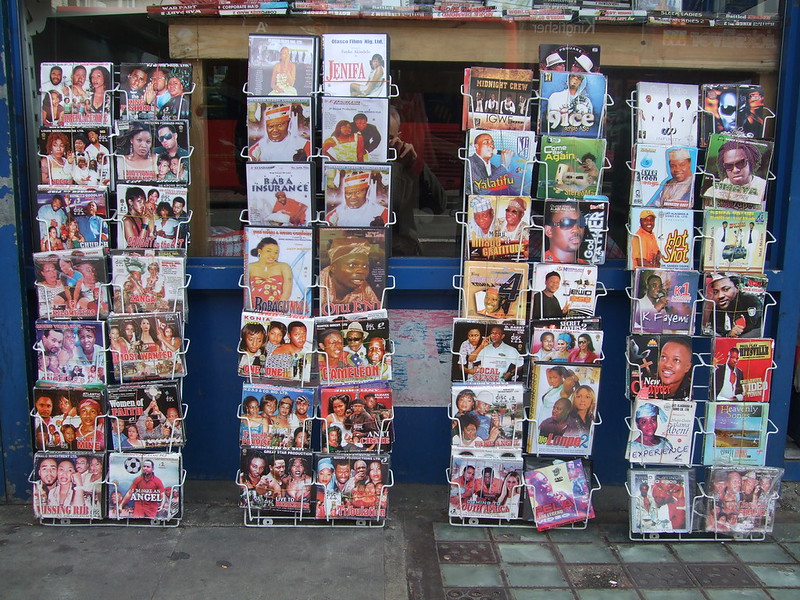
A display of Nollywood DVDs outside a shop in Dalston, London. Source: Michael Rank / Flickr.
Here is the short version of a story that has been told wrong for 30 years.
Kenneth Nnebue was born in Mgbidi, Imo State. He left school after sixth grade and apprenticed under his brother, a handbag maker, before entering trade himself in the Onitsha market. By the late 1980s, he was in Lagos, importing VHS tapes from Taiwan, distributing pirated foreign films, and trying to move product in a difficult economy. When the tapes stopped selling, he put an original story on them instead. That story—Living in Bondage (1992)—cost 150,000 naira, about $7,000 at the time. It sold over 100,000 copies in its first weeks through informal markets in Lagos, Enugu, and beyond. It launched a global industry.
What gets left out of most tellings: before Nnebue made Living in Bondage in Igbo, he had already produced at least 27 Yoruba-language films. An Igbo trader, operating in Lagos, making Yoruba content, who then made the Igbo film the world decided was the beginning of everything. The ethnic ownership of that origin—who gets to claim Nollywood, which tradition gets the credit, which city gets the heritage tourism—has been contested ever since. Not because the evidence is unclear, but because resolving it requires someone to say plainly what Nollywood actually is: an art form rooted in Yoruba theatrical tradition, or an industry born from an Igbo trader’s logistics problem. These are different things. The confusion between them is not innocent.
The Yoruba side of the argument is not a retroactive claim. The Yoruba Traveling Theater tradition, Alárìnjó, reaches back to the 19th century. Its modern form is usually traced to Hubert Ogunde, whose touring theater company toured Nigerian cities through the 1950s and 1960s, its work politically sharp enough that a regional premier banned it outright. That stage tradition migrated to celluloid film through the 1970s and 1980s, and by 1985 Moses Olaiya’s Mosebolatan was one of the country’s first genuine blockbusters. Critically, Yoruba filmmakers moved onto VHS format in 1988, four years before Living in Bondage. If the question is who touched the video format first, it wasn’t Nnebue.
So why does his name carry all the credit? Because Living in Bondage wasn’t first, but it was the first to look like it knew what it was doing, packaged with a glossy, full-color cover styled after pirated Hollywood tapes, presented as a professional product instead of a stopgap. The story helped too—a man who joins an occult society and sacrifices his wife for wealth, only to be haunted by what he’s done—landed hard in a country deep in structural adjustment-era desperation, when stories of ritual money were part of the cultural air people breathed. And despite being shot entirely in Igbo with no subtitles for a full year, the film crossed ethnic lines anyway—co-producer Okey Ogunjiofor would later say simply that people who didn’t understand the language still understood the story, because the pictures carried it.
What Nnebue actually contributed, then, wasn’t the invention of video filmmaking—Yoruba practitioners had that four years earlier. He contributed a “template,” an industrial model of direct-to-video production that the entire industry would replicate for the next two decades. Every straight-to-video Nollywood film that followed, regardless of language, was built on the business logic Nnebue stumbled into while solving an unglamorous warehouse problem.
Laid side by side, these two histories aren’t actually contradictory; they’re answering two different questions. It’s the single phrase “who started Nollywood” that collapses them into one, forcing a false contradiction. The Yoruba lineage answers where the art form came from. The Nnebue story answers where the industry came from. Ogunde’s company built the grammar. Nnebue’s warehouse problem built the factory.
I’m writing this from Enugu, one of the cities where Living in Bondage first sold by the hundreds in market stalls. Here, Nollywood’s Igbo roots aren’t distant history but lived memory, passed down the way a family recipe is. That memory is real. So is Ogunde’s banned theater company. Neither one needs to lose for the other to be true.
But Nigeria rarely lets cultural origin stay this generous. Who started Nollywood is never just a historical question here—it’s tied to tourism revenue, festival programming, whose language gets state funding, whose grandchildren get to say “we built this.” Thirty years on, the debate hasn’t been resolved because resolving it was never really the point. Someone benefits from the ambiguity every time it stays open, and someone loses something every time it closes.
That, more than the biography of one trader from Mgbidi, is the story worth telling.