Eyes open in Addis
In Addis Ababa, the war in Tigray once arrived only in fragments. What happens when the dark we made for ourselves no longer holds?
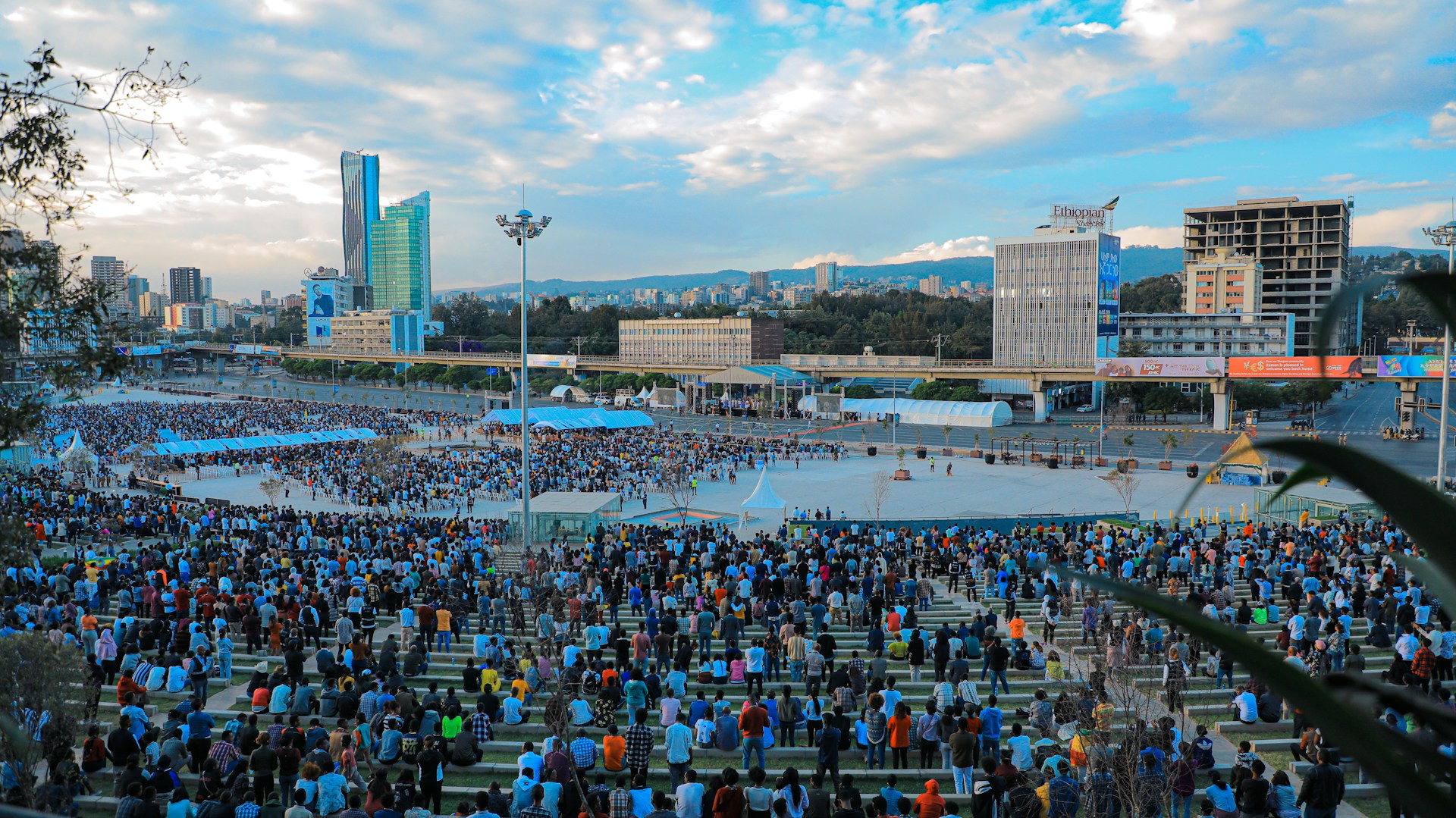
A large public gathering at Meskel Square in Addis Ababa, Ethiopia. Source: Gift Habeshaw/Unsplash.
If I squeeze my eyes shut and cover them with my hands, perhaps all of this will disappear. My father used to tell me something similar when, at an age perhaps already too old for it, I would whisper to him: “I’m afraid of the dark.”
“Richo,” he would say, “why in the world would you be scared of the dark? The dark is something we can make and unmake. See?” He would then cover my eyes with his big, calloused hands. “I made the dark for you.” And so I would fall asleep, covering my eyes with my hands and making my own dark.
So many years have passed since then—years in which I have learned not only how to make my own dark, but how to fill my eyes with the brightest colors: the green of my fields, the yellow suns of the Antilles, and the red of those tomato sauces shared over plates of pasta with the people I love.
With time I have also learned, and wanted more and more and more, to see and live those same colors lined up in a row: green-yellow-red. And again: green-yellow-red, the flag of my country of origin, Ethiopia. Sometimes for a few months at a time, during summers spent in the capital; sometimes buried in tedious readings, retracing its legendary history; other times—for longer, for months—trying to learn its script, so curved, as I did when I lived in Addis Ababa from September 2022 into 2023.
That time, in 2022, when I spent several months in the capital, is perhaps one of the times I most distinctly remember feeling like a child again: trying to memorize the fidel, the Ethiopic script, from the blackboard, slowly reading one letter after another, and then hoping that somehow a sentence that made sense in Amharic would come out of my mouth.
Perhaps it was also one of those times when, unconsciously becoming a little like a child again—learning how to read and write in a new language, discovering everything from scratch—I decided to do what my father had told me years before and cover my eyes with my hands.
By the time I arrived in Addis Ababa, the war in Tigray—mainly, but not solely, pitting Tigrayan forces led by the Tigray People’s Liberation Front (TPLF) against the Ethiopian federal government—had been going on for almost two years. Just two months later, in November, the two sides signed the so-called Pretoria Agreement, committing to a permanent cessation of hostilities. And yet, even in the capital, at least to me, the war and the tensions it had brought to the surface continued to come in fragments.
I remember, in order:
When the war came knocking at the edges of the city. That January of 2023 I was walking through the streets of Asko, right at the edge of the capital, wearing a traditional Wollo dress from the Amhara region.
All dressed up with my cousins, we hummed songs to celebrate Timket, the Ethiopian Orthodox festival marking the baptism of Jesus in the River Jordan, and were laughing our heads off about who had been hit by the most lemons—during Timket, young men traditionally toss lemons or limes toward girls they are interested in, as a sort of courtship—when some police officers on the street told us to keep it down. “And then,” they added, “you should be ashamed of wearing those clothes. We are celebrating Timket, not one particular ethnic group.” Ouch.
It took me, in fact, a little while—and an explanation from my cousins—to understand what I had initially taken as an insult to my sense of style. The traditional Amhara dress, it turned out, was not read simply as a dress but almost as a political statement in support of Amhara identity amid tensions around ethnicity—who was who, who was supposedly better than whom—that had been growing for years and that the war in Tigray had only exacerbated.
Funnily enough, this happened just as Amhara forces, which had fought alongside Ethiopian federal troops during the war, were reportedly beginning to withdraw from parts of Tigray, seemingly in line with the provisions of the Pretoria Agreement. Yet on the streets of Addis, some of the tensions left by the war were proving harder to leave behind.
Something similar happened, for similar reasons, when I was denied access to my own home. Every March, Addis Ababa dresses itself in green-yellow-red to commemorate the majestic victory at the Battle of Adwa in 1896, when Ethiopian troops, led by Emperor Menelik II and Empress Taytu Betul, defeated the invading Italian army. Yet that year, even a victory remembered as pan-Ethiopian seemed to fracture along ethnic lines. Menelik, celebrated by many as a symbol of Ethiopian independence, was also remembered by others for the violence and dispossession that accompanied his empire’s expansion into territories inhabited by different ethnic communities in what is now Ethiopia.
By then, displaying images of Emperor Menelik and Empress Taytu, or even the plain Ethiopian flag without its central emblem, had become politically contentious, as these symbols were increasingly associated with competing visions of Ethiopian identity. Printing presses and shops selling them were reportedly forced to shut down.
And by Adwa Bridge, where I lived, the roads had been blocked amid the tensions around the celebrations, and so, for hours and hours, my flatmate and I tried to make our way home but were not allowed through, left outside waiting until it was dark and then darker.
And finally, the countless times when, beyond the celebrations, the war found its way into people’s mouths, as they told me how they tried, and tried again, to reach their loved ones in the North, where phone lines had been cut off for much of the war.
Yet, as unreal as all of this felt to me, I realize now how little it changed in my everyday life. As with the thousand other incredible injustices of the world, I carried on with my life, while kilometers away from me, within the very same borders, thousands of people were being hit, dispossessed, and killed (among other things).
Four years have passed since then and now history repeats itself: I find myself, again, in Addis Ababa. Across the country, fighting has erupted again between federal and Tigrayan forces, with former enemies joining forces against the government under a new coalition calling itself the Alliance for Survival. But this time I am better trained: I can now read with ease all the news I have to compile for work in Amharic: Turmoil in Tigray; More than 700 patients crowd hospitals in the northwest of the country; War in Ethiopia intensifies; and so on.
I have been thinking nonstop, day and night, for weeks now. Among the many angry yet simple realizations that seem to come only at night is the thought that, in the years since the signing of the Pretoria Agreement, we had perhaps allowed ourselves to close our eyes, mistaking the absence of full-scale war for peace. Yet beneath the surface, so much was still boiling: disputes over territories that remained contested, disagreements over disarmament, mistrust, and ethnic divisions—the very ones that had made their way even into the streets of Addis. Only this time—oh, this time—if I squeeze my eyes shut and cover them with my hands, none of this will disappear. What is happening in the country forces me to keep my eyes open, as something that once seemed so far away makes its way into the capital, now more forcefully: evening checkpoints for residents, rumors traveling faster and faster, or explosions—still unconfirmed—heard near the military headquarters.
And so news reports and newspapers—myself among them, now—proclaim a war at the gates. But whose gates? Those of an Addis, where perhaps it had already been knocking: in the clothes we were told to be ashamed of wearing, in the roads that kept us from our homes, in the mouths of those trying, and trying again, to reach their loved ones in the North.
These days I keep wondering how much of what we are living through is really “sudden.” The dark is something we can make and unmake, my father used to say. He was right. We, myself included, have made the dark for ourselves: While conflict staggered between Tigray, Amhara, and the contested territories, displacing millions of people; while recent attempts at mediation collided with mistrust and accusations of partiality; while signed agreements seemed to give us just enough hope to look away.
Only this time, as the explosions grow louder, we are forced here, in Addis, in Ethiopia, to try to keep our eyes open while elsewhere the world can keep sleeping.