Who can make peace hold?
Ethiopia has already shown that an agreement can stop a war and that an army can retake a capital. Whether peace lasts will be decided by the less spectacular work of making promises enforceable.
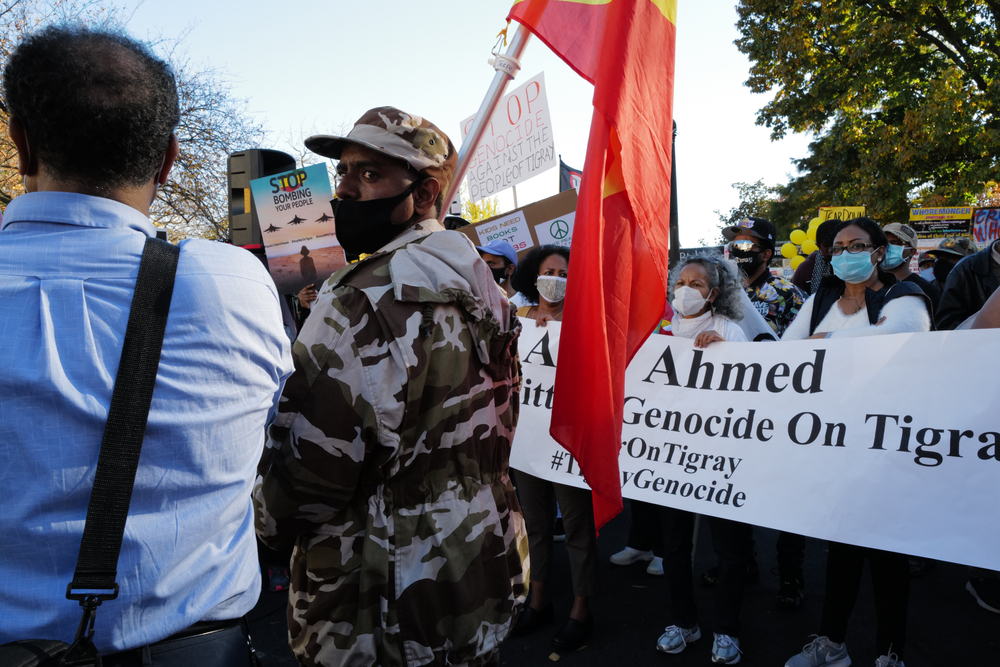
Demonstrators protest the outbreak of war in Ethiopia’s Tigray region at Black Lives Matter Plaza in Washington, DC, November 9, 2020. Photo: Phil Pasquini/Shutterstock.
On October 4, Ethiopian government forces and their Tigrayan allies entered Mekelle after fighters loyal to the Tigray People’s Liberation Front (TPLF) withdrew from the city. Twelve days later, Prime Minister Abiy Ahmed announced a new caretaker administration, promising to restore public services, help displaced families return, and prepare elections. From Addis Ababa, this appeared to mark the beginning of a political reset. But the situation in Tigray was far less settled. Armed factions continued to contest authority, hundreds of thousands of people remained displaced, and the territorial disputes that had helped fuel the last war were unresolved. Mekelle had changed hands. Whether Ethiopia had moved any closer to peace was another question.
The five-member caretaker administration has six months to begin rebuilding Tigray’s public institutions, and its officials will operate under federal oversight. Yet the military retreat that preceded its appointment did not end armed resistance. Some former combatants have sought to return to civilian life; other commanders have vowed to keep fighting. The TPLF has also joined an opposition alliance with Amhara and Oromo armed groups, even as Ethiopia’s relations with its former wartime ally Eritrea have deteriorated into a border crisis. This is the government’s dilemma: It must restore everyday order while the alliances, territorial claims, and chains of command that determine that order remain contested.
To understand the danger, it helps to recall how Ethiopia reached this point. For nearly three decades, the TPLF was the most influential party in a ruling coalition that governed a formally federal state through an unusually centralized political system. Abiy’s rise in 2018 disrupted that arrangement. His rapprochement with Eritrean President Isaias Afwerki ended two decades of hostility, but the growing confrontation between Addis Ababa and Tigray culminated in war in November 2020. Eritrean troops and Amhara forces joined the federal campaign against the TPLF. Their common enemy concealed sharply different visions of the peace that would follow.
The African Union–brokered Pretoria agreement of November 2022 ended the main phase of the fighting. It was not an empty ceasefire. The federal government and the TPLF pledged to protect civilians, restore services, allow humanitarian access and establish a transitional administration; disarmament and political dialogue were also envisaged. A subsequent agreement in Nairobi linked the surrender of Tigrayan heavy weapons to the withdrawal of foreign and nonfederal forces. That sequencing mattered: One side could scarcely be expected to disarm confidently while forces it feared remained in place.
The agreement’s weakness lay less in what it promised than in who could deliver. Eritrea was not a signatory. Amhara armed groups that had helped prosecute the war did not necessarily answer to federal negotiators. The TPLF, meanwhile, could sign for Tigray without ensuring that its own leadership and fighters would remain united. Pretoria brought a terrible war to a halt, but it could not freeze the balance of power among those expected to implement it. Peace required not only consent at the negotiating table but authority over armed men, budgets and territory.
Western Tigray illustrates why these distinctions are more than diplomatic technicalities. The area, claimed by Amhara actors as Welkait, changed hands during the war. Human Rights Watch and Amnesty International documented mass expulsions and abuses against Tigrayan civilians. In April 2026, Human Rights Watch reported that Tigrayan residents continued to face restrictions on identity documents, movement, work and access to land. For displaced families, territorial settlement means the possibility of returning home. For authorities entrenched since the war, it may entail surrendering offices, property, and economic advantage. A boundary left unresolved does not stand still when those controlling it can determine who is allowed to live there.
Disarmament poses a similarly concrete problem. A United Nations–supported reintegration program began in 2024, and former fighters have continued to register. But registration is not reintegration. A man who hands over his weapon without secure work, protection or confidence in the local authorities may be available to the next recruiter. Nor is reintegration solely a Tigrayan question: After Addis Ababa moved in 2023 to integrate regional special forces, resistance among armed Amhara networks helped feed the Fano insurgency. Security reform can be necessary and destabilizing at the same time when communities distrust the institutions meant to protect them.
The postwar political order inside Tigray also fractured. The interim administration led by Getachew Reda became embroiled in a struggle with TPLF leaders loyal to Debretsion Gebremichael. In 2026, the faction associated with Debretsion reasserted control over regional institutions. Federal pressure, failed mediation and renewed military mobilization followed. A government recognized by Addis Ababa might obtain funds but lack acceptance among armed Tigrayan factions; a faction commanding fighters might claim popular legitimacy without the means to keep hospitals open. Neither capacity could simply substitute for the other.
Then came an alliance few would have imagined during the last war. On September 20, seven opposition organizations announced the Ethiopian Peoples’ Forces Alliance for Survival. Its members included the TPLF, the Amhara Fano National Movement, and the Oromo Liberation Army, alongside groups from other regions. Tigrayan and Amhara combatants who had fought on opposite sides were now declaring a shared aim: removing Abiy’s government. It was a measure of the political realignments since Pretoria, not evidence that Ethiopia’s conflicts had become easier to resolve.
The coalition’s contradictions remain formidable. Tigrayan movements and Fano fighters have incompatible territorial claims in Western Tigray; other partners have distinct grievances and chains of command. Opposition to Abiy may sustain battlefield coordination without establishing a common program for governing Ethiopia. The distinction became unmistakable when the TPLF-led offensive launched on September 23 was followed by a rapid federal counteroffensive. By October 4, TPLF forces had left Mekelle. Their withdrawal did not mean the end of resistance: On October 23, as a caretaker official urged fighters to disarm, a rebel commander vowed to fight on.
The new caretaker government therefore inherits something more difficult than a military victory. It must rebuild services and attract civilian cooperation while seeking the disarmament of opponents who still contest its authority. Elections in six months may offer a route back to accountable regional government, but an electoral calendar cannot confer legitimacy on its own. The conditions of voting—who may return, organize, speak, travel, and campaign without intimidation—will determine whether the exercise can resolve a dispute or merely certify the outcome of the latest battle.
The crisis is also no longer confined to Ethiopia. Abiy and Isaias, celebrated as peacemakers in 2018, became military partners against the TPLF two years later. That alliance subsequently collapsed. The survival of the TPLF after Pretoria contributed to Eritrea’s misgivings, but the dispute has an independent source: Ethiopia’s renewed insistence on Red Sea access. A commercial arrangement to use a port is fundamentally different from a claim to sovereign coastline. Asmara sees the latter as a potential threat to its territorial integrity; Addis Ababa says it seeks a peaceful solution.
In early October, Ethiopia expelled Eritrean diplomats and the neighbors severed diplomatic relations. Ethiopia then accused Eritrea of invading its territory and backing insurgents; Eritrea rejected the allegations and accused Ethiopia of threatening its sovereignty. On October 13, Reuters reported that Ethiopian troops had reached Zalambessa, close to the Eritrean border, after disputed reports of Eritrean troop movements. Independent confirmation of every cross-border claim remains difficult. What is clear is that the political rupture has brought two heavily armed states into dangerous proximity, while war continues in neighboring Sudan.
The human stakes are easy to lose amid these reversals of alliance. Reuters reported in October that roughly 750,000 people were still internally displaced in Tigray as of February. For them, an agreement is credible when it permits safe return and restores the ordinary rights that make return meaningful: documents, homes, livelihoods, clinics and protection from arbitrary detention. For those who stayed, it is credible when schools reopen and armed men no longer decide who can cross a road.
Four tests should matter more than the caretaker government’s six-month deadline. The first is civilian protection: Can people reach aid and public services regardless of suspected political affiliation? The second is durable demobilization: Do former combatants receive real opportunities to earn a living, rather than a one-time instruction to surrender? The third is territorial fairness: Can displaced residents pursue return, restitution and legal remedy under independently monitored procedures, particularly in Western Tigray? The fourth is political authorization: Can Tigrayans participate meaningfully in decisions about their future, including security arrangements and elections, without being required to endorse either the TPLF or Addis Ababa?
None of these tests excuses violence by armed opponents or denies the federal state a responsibility to keep order. They ask whether force can become something different from another temporary distribution of power. Ethiopia has already shown that an agreement can stop a war and that an army can retake a capital. Whether peace lasts will be decided by the less spectacular work of making promises enforceable—and giving those who live under them reason to believe they will be kept.