Sovereign rot
From Eko Atlantic to the Niger Delta, elite enclaves have become the defining spatial expression of Nigeria’s political order.
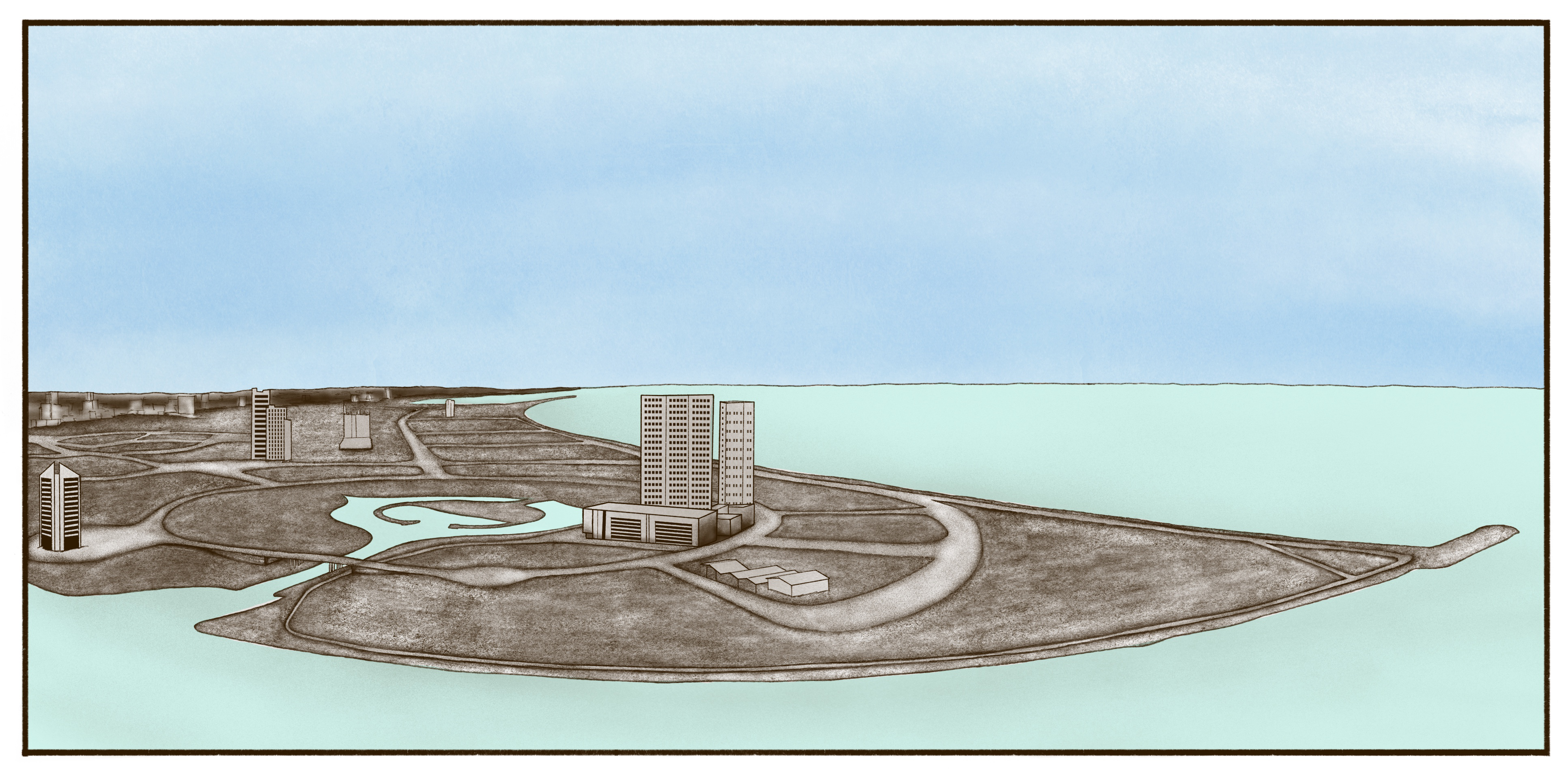
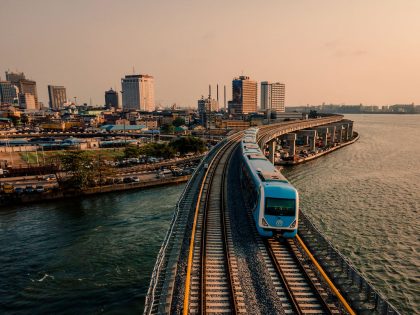
Illustration of Eko Atlantic City, Lagos. All illustrations © 2026 Ninu Sonuga.
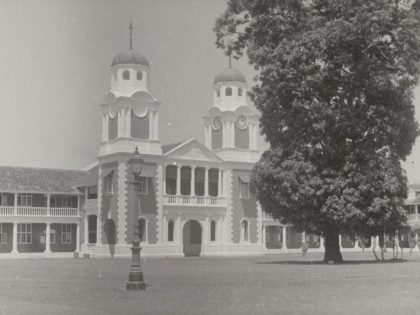
In the heart of Ikoyi, Lagos, a fifteen-story concrete ghost haunts the skyline. The Old Federal Secretariat was once a nerve center of Nigerian power, functioning as the heart of Nigeria’s civil service. Since the federal capital was moved to Abuja in 1991, this complex has been left to rot. In a city defined by fervent construction and the relentless pursuit of newness, its stillness, frozen in time, is a provocation.
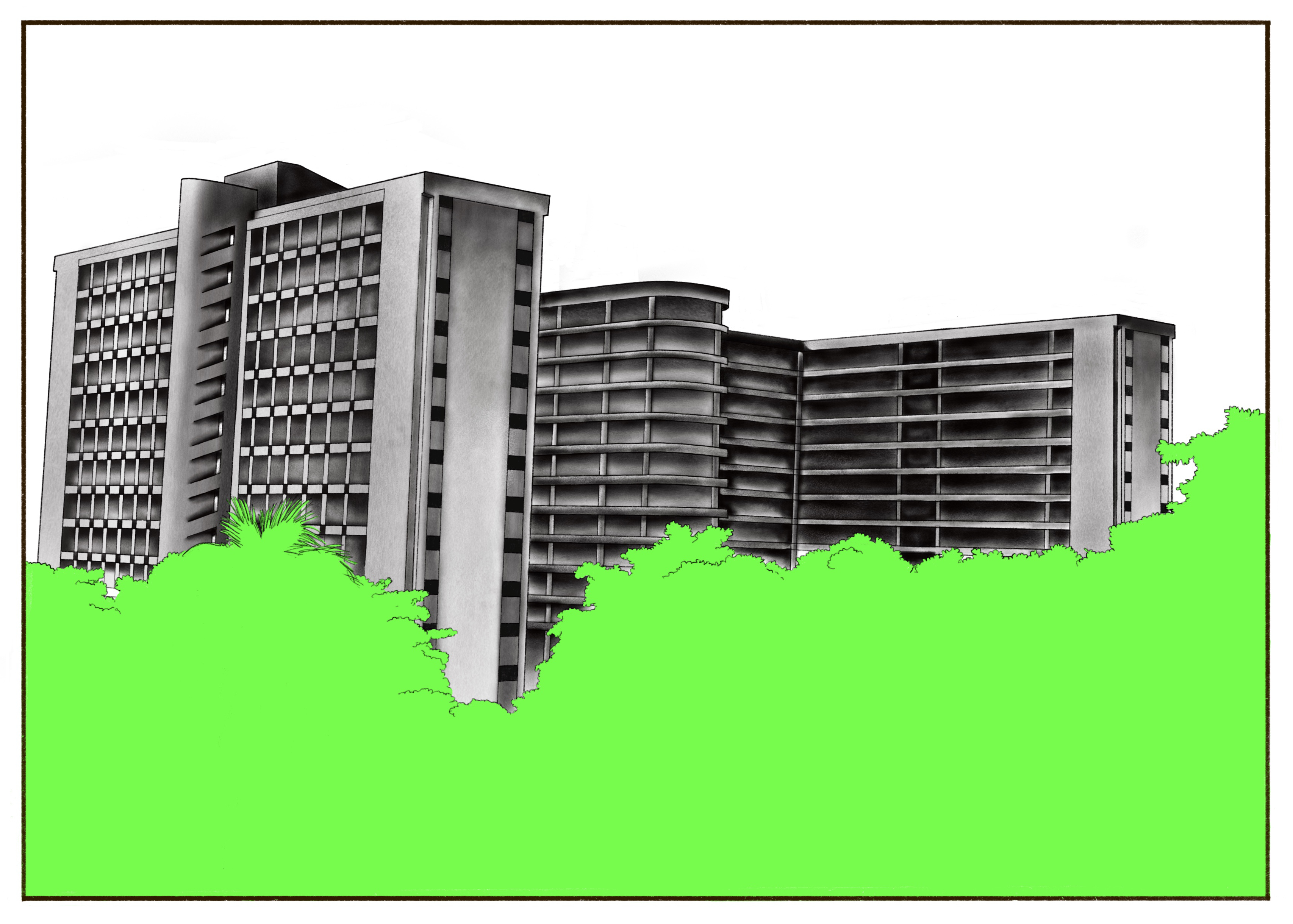
Nigeria’s independence in 1960 arrived with serious ambition. Gifted by the British to mark the young nation’s sovereignty, the 25-story Independence Building served as the Republic’s first federal secretariat, anchoring the administrative machinery of the new state. As the civil service swelled during the oil boom years, the government erected the Ikoyi Secretariat in 1976. This new structure was designed to monumentalize the nation’s soaring aspirations—an architectural declaration that a young republic had outgrown its colonial infancy and entered a new era of industrial sophistication.
The Independence Building was eventually appropriated by the military and renamed Defence House. Today, it stands as a shadow of its former glory. Following a devastating fire in 1993, the military command abandoned the charred remains, relocating to the new capital of Abuja. Left behind in Lagos, the old tower’s narrow apertures now watch over the public square below like hollow eyes, stripped of its utility and its national significance.
Down the road, this architecture of abandonment reaches its literal peak at NECOM House. Built as the tallest skyscraper in the country, this telecommunications tower was conceived to be the crown jewel of the Lagos financial district; today, it suffers the same slow rot that plagues the civic landscape. This pattern of neglect repeats across the city center. Lagos is now a museum of deferred promises, littered with monumental structures left underused, suspended in time, or surrendered to decay.
The vacuum left by the government’s silent withdrawal from these sites has inevitably invited squatting and illicit activity. When the state refuses to occupy and maintain its landmarks while failing to provide housing, resources, and safety, it creates the conditions it then criminalizes. What appears as squalor is state neglect made visible. These buildings become shelter for those the state has rendered invisible. In a twist of irony, these administrative monuments have been involuntarily democratized.
While state-owned monoliths sit idle for decades, the government exhibits a violent agility elsewhere, bulldozing lives and properties in informal settlements with little to no prior notice.
Makoko, a historic community of roughly 100,000 residents, is one of Lagos’s most storied waterfront settlements. Established on the lagoon by the Egun fishing people, it has evolved over generations into a complex urban ecosystem built entirely on stilts. In December 2025, armed demolition teams backed by state authorities entered this settlement under the pretext of enforcing a safety corridor beneath a high-tension power line. Demolitions started two days before Christmas.
Over 3,000 homes, schools, and clinics were bulldozed and burned, displacing about 10,000 people. Protesters and civil society organizations have alleged that the demolitions resulted in deaths, including infants and elderly residents.

The official justification followed a familiar script: environmental concerns, urban renewal, the language of progress. But beneath the bureaucratic vocabulary, what it produced was displacement, lives dissolved into the water. In this context, the long-term abandonment of these spaces reads as an intentional pattern of uneven urgency. The government grants itself unlimited leniency regarding its own monumental dereliction, while displaying a ruthless impatience for the expedient improvisations of the people it has abandoned.
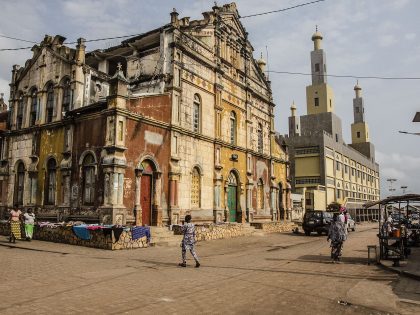
Deracination has shaped Lagos’s socio-economic fabric for generations, and the map of the city can serve as a historical record of state-led displacement. Take Obalende, whose name translates to “the [British] king chased us here”—an etymology the historian K. Dike traced, in a 1997 Guardian essay, to the colonial army’s expansion into the area. Today, it is a bustling hub bordering Lagos Island, but its origins trace back to the colonial era, when the British crown displaced the local population in favor of expanding an army base. This is a foundational precedent of spatial injustice that outlived the empire. Instead of dismantling this colonial architecture of exclusion, the modern Nigerian state has embraced and optimized it, expressing its sovereign authority through the violence of forcible land clearance rather than the duty of housing its most vulnerable communities.
The message to the average Lagosian is clear: Space is scarce when it belongs to the poor, expendable when it belongs to the state, and available to those with enough clout to bend the city to their will. When there is corporate capital to secure or elite enclaves to engineer, the state magically rediscovers its capacity for urban planning. Ultimately, the rotting high-rises of the Marina and the demolished stilt-houses of Makoko are symptoms of the same institutional disease. They represent a state that has fundamentally abdicated its social contract, leaving behind a city that is simultaneously starved for public life and choked by avarice.
For those tasked with shaping the built environment, this landscape of sovereign rot poses a sharp ethical challenge. We are trained to obsess over the new, chasing the next “smart city.” But what does it mean to design for the future in a city where the most basic act of care—maintenance—has been undervalued by those meant to uphold it the most?
To answer this is to confront a notoriously wicked problem, an entangled crisis in which the professional domains of the architect, the policymaker, and the developer are all implicated. In Braiding Sweetgrass, Robin Wall Kimmerer notes a sobering truth: “As the land becomes impoverished, so too does the scope of [our] vision.” Lagos, and indeed much of Nigeria, suffers acutely from this exact starvation of perspective. On paper, the mechanics of urban revitalization are not rocket science. However, the unchecked greed permitted to fester across the country has corroded the foundations of every civic institution and shriveled the imagination of our city-makers.
When presented with decades of water-adapted vernacular literacy in Makoko, or the complex maritime history of Tarkwa Bay, the developer’s only legible response is demolition—flattening centuries of ecological resilience to install a yacht club or a generic “luxury” tower. This impoverished vision can only copy; it cannot synthesize. It views indigenous knowledge as a blight to be cleared and abandoned structures as dead weight, all while funding exclusive archipelagos reclaimed from the sea. Eko Atlantic stands as the ultimate expression of this hubris: a private enclave engineered for the few, rising from the ocean while the waterfront communities of the many are erased to make room for the supply chain of exclusivity.
By chasing the illusion of the “blank slate,” the architect becomes the aesthetic enforcement arm of this system, providing the glossy renders that legitimize spatial violence long before the bulldozers arrive. The policymaker completes the triangle. It is the state that issues the demolition orders, absorbs the legal challenges, and quietly steps aside for the developer. The FBT Coral Estate agreement, in which the Lagos State Government negotiated a 25 percent stake in the “luxury” development designed to replace Makoko, exemplifies this arrangement explicitly. Everything is transactional.
By trading the social contract for a real estate ledger, the state has rendered its own history meaningless and its people invisible. Lagos continues to rise, but it rises against itself.
The abandoned Secretariat and the state-sanctioned displacement are evidence of a system functioning exactly as those who benefit from it intend. “Smart city” rhetoric and urban renewal frameworks create the assumption of a state that has lost its way, merely requiring the right policy intervention to find its footing again. But a government that can mobilize armed demolition teams against impoverished communities two days before Christmas, while its own civic infrastructure crumbles unremarked across the city, has not lost its way. It has chosen one.