Too big to regulate
Dangote’s refinery ended Nigeria’s dependence on imported fuel and became Africa’s most important energy asset overnight when Iran shut the Strait of Hormuz. But it also became the country’s most powerful monopoly.
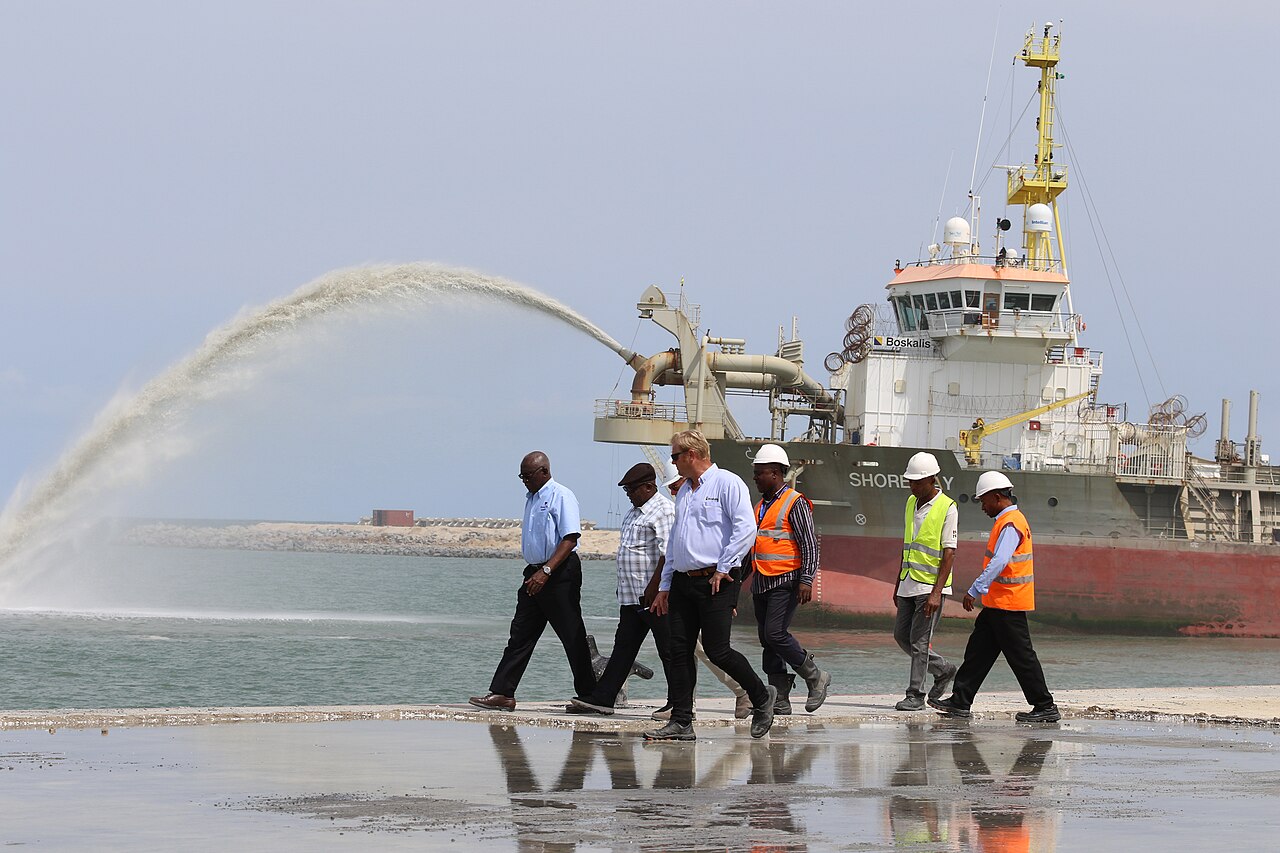
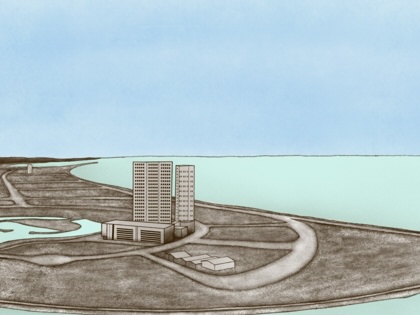
A dredging vessel reshapes the shoreline during construction at the Dangote refinery site in Lekki, Lagos State, Nigeria, March 2020. Source: GodwinPaya/Wikimedia Commons.
In September 2024, Nigeria achieved something it had been promised for decades: the Dangote Petroleum Refinery began producing petrol on Nigerian soil. At 650,000 barrels per day, the largest single-train refinery on earth, it was a genuine industrial landmark.
Yet, by early 2026, Nigerian consumers were paying petrol prices roughly 12 percent above what competitive imports would have cost, according to a shelved World Bank report.
It is well argued by scholars that Nigerian merchant capital did not emerge organically from agricultural surpluses or small manufacturing. It was shaped, from the colonial era onward, by three distinctive features: import-substitution policies that protected specific domestic interests; an oil economy that concentrated state revenues in few hands; and a “political settlement,” in the words of economist and professor Mushtaq Khan, that tied business access to political proximity rather than competitive performance.
The Dantata family were among the trading families of northern Nigeria, enriched under colonial commodity boards that set paltry prices paid to farmers for export crops, with the boards accumulating surpluses that sometimes exceeded 100 percent of expected earnings. Licensed Buying Agents extracted their own share between the farmgate and export terminal. Farmers received the smallest portion of the value their labor produced. Aliko Dangote, Dantata’s great-grandson, is the chairman of Dangote Industries Ltd.
Nigeria’s “backward integration policy,” launched in 2002 to develop domestic manufacturing through tariff protection and tax incentives, was sound in principle. In practice, the political settlement governing it systematically concentrated its benefits in conglomerates with pre-existing political access. Nigeria’s industrial policy became a form of legislated primitive accumulation where the state manufactured the conditions for monopoly capital to form, and connected families captured those conditions first.
Nigeria’s cement capacity grew from roughly 2 million to nearly 48 million metric tonnes per annum between 2002 and 2019. Dangote invested in massive-scale kilns that outcompeted rivals, developed coal-mining operations to cut fuel costs, negotiated machinery discounts from Chinese contractors, and maintained a cost-to-revenue ratio of 30 to 40 percent against Lafarge Nigeria’s 70 to 80 percent. By Schumpeterian standards, this was a genuine competitive success.
But between 2011 and 2016, Dangote Cement’s profits more than tripled, whereas average wages per employee, over the same period, fell in real terms. The effective corporate tax rate on Nigerian cement operations was approximately 2 percent in 2016, against a statutory 30 percent. This was achieved by continuously rolling “pioneer status” tax holidays across new production lines as previous exemption windows expired. Between 2010 and 2017, Dangote Cement earned NGN 1.7 trillion in profits and paid NGN 90 billion in taxes: a realized rate of roughly 5 percent.
The “paradox of costs” holds that while rising wages reduce individual firm margins, they increase aggregate demand and, ultimately, total profit rates across the economy. A monopolist that suppresses wages and minimizes its fiscal contribution may maximize its own returns while shrinking both the purchasing power its sales depend on and the state resources needed to sustain it. When commodity prices fell in 2014, and Nigerian consumer spending contracted sharply, DIL’s food-processing businesses showed signs of this structural overcapacity: markets created by policy, but without the wage growth to sustain them.
Still, Dangote Refinery represents a qualitative leap in strategic importance. Its capacity reportedly exceeds Nigeria’s entire domestic fuel demand. Practically, it now supplies about 62 percent of Nigeria’s petrol, becoming the main supplier after import licenses were restricted. The monopoly emerged as failed state refineries and excluded modular operators left a technically superior but politically difficult private monopoly replacing a corrupt state one.
The “crude-for-naira” arrangement inaugurated in October 2024 is the analytical crux of the “fair deal” question. Despite its name, the scheme is not a simple currency substitution. It is not merely barter. NNPC supplies crude to Dangote in naira; Dangote, in return, sells the refined equivalent of the received product to Nigerian market(ers) in naira. Though the government says crude is priced at international rates, concerns remain over preferential access to domestic crude, reduced competition, and whether adequate supervision ensures Dangote fulfills his side of the bargain.
NNPC’s failure to supply Dangote’s requested 13 to 15 cargo-loads per month, delivering only approximately five, was not primarily a production problem. A PUNCH report documented that NNPC pledged a combined 213,000 barrels per day to service four major forward-sale loan facilities: Eagle Export Funding (21,000 bpd), Project Yield (67,000 bpd), Project Leopard (35,000 bpd), and Project Gazelle (90,000 bpd). Against Nigeria’s 2025 production of 530.41 million barrels, averaging roughly 1.45 million bpd, the 213,000 bpd committed to creditors represents approximately 14.7 percent of total output locked away for debt service until at least 2029.
With NNPC still unable to meet the daily demands of the refinery, the crude-for-naira announcement remains partly political theatre: a sovereignty narrative overlaying a structural reality in which Nigerian crude is substantially pre-mortgaged to global financial capital. The CBN’s Balance of Payments report confirmed Dangote spent $3.74 billion importing crude in 2025 to bridge the shortfall, dollar spending that directly contradicted the FX-conservation rationale of the policy.
The World Bank said suspended import licenses “reduced competition, allowing prices to exceed import-parity levels.” The regulator most publicly associated with maintaining competitive supply, former Nigerian Midstream and Downstream Petroleum Regulatory Authority (NMDPRA) head Farouk Ahmed, was accused by Dangote of corruption, investigated by lawmakers, and subsequently resigned after a meeting with President Tinubu. The World Bank report naming the monopoly problem was pulled from public access within 48 hours. This sequence describes, in plain terms, regulatory capture through indispensability. When a private entity controls the domestic fuel supply of Africa’s most populous nation, governments cannot afford to let it fail, cannot apply normal competitive discipline, and cannot publicly acknowledge its pricing power without political consequences.
In September 2025, more than 800 workers were dismissed for attempting to organize a union, the president of PENGASSAN told Daily Post. They were later reinstated on a “conditional pardon” that insiders said prohibited unionization, a constitutional right under Nigerian law. The refinery employs more than 10,000 foreign nationals, primarily from India, in technical roles. The Lekki Free Trade Zone designation under which the refinery operates provides “more flexible employment structures,” a legal euphemism for reduced oversight of labor rights.
At the community level, youth advocates from the host community of Ibeju-Lekki describe “underemployment, not employment.” Community gestures also included distributing bread, which youth leaders called insulting.
This replicates the Dangote Cement pattern precisely. The wage share in cement operations never exceeded 10 percent of revenue between 2010 and 2017. The truck drivers’ “Entrepreneurship Scheme,” where drivers nominally “earned” their truck after completing a mileage target, was revealed in worker interviews to be piece-rate labor disguised as ownership, according to a paper published in 2021. Contract workers were paid half the rate of permanent staff for double the work, then terminated before contracts matured.
The extraction of relative surplus value through the ideological form of entrepreneurship is a global pattern of contemporary capital accumulation. What is specific to Nigeria is the political protection that allows it to operate without accountability.
When Iran closed the Strait of Hormuz in February 2026, disrupting roughly 20 percent of global oil supply, African nations turned to Dangote. South Africa, Ghana, and Kenya entered negotiations for emergency fuel contracts. The refinery that had been starved of domestic crude and entangled in labor disputes suddenly became the most strategically significant energy asset on the continent.
The crisis did not create the Dangote monopoly problem. It made it undeniable, and structurally irresolvable in the short term. A global crude price above $100 per barrel raises the cost of every barrel Dangote imports. Without competitive import licenses or a state-led effort to revive government refineries, there is no mechanism to prevent that cost from passing fully to Nigerian consumers. Workers whose real wages the empirical record shows to be stagnant absorb the inflationary consequence. The government, committed publicly to denying that any subsidy exists, cannot impose a price cap. And Dangote’s strategic importance to the region has grown so large that challenging its position becomes geopolitically costly at precisely the moment it is most economically necessary.
This is how monopoly capitalism consolidates through the accumulation of indispensabilities: the refinery becomes the only domestic supplier, the region becomes dependent on its exports, and the state becomes structurally dependent on its fiscal contribution. Each dependency forecloses a regulatory option.
A critical response would not imply that Dangote is personally exceptional in his venality. Capital does what capital does. What it demands is a set of structural interventions that current policy systematically avoids.
The first is genuine taxation of concentrated profits: the 2025 Tax Reform Act’s 15 percent minimum effective tax rate for large companies is a step, but enforcing it against entities with Dangote’s political reach is the actual test, and an excess-profit levy on refinery margins above a defined benchmark would recover for the public a portion of the monopoly rent extracted from captive consumers. The second is mandatory collective bargaining: union recognition in strategic industries, including in Free Trade Zones, is simultaneously a labor rights question and a macroeconomic development question, since suppressing the wage share suppresses the domestic demand that makes industrialization sustainable. The third is competitive refining—transparent allocation of domestic crude to multiple eligible refiners, not one. The fourth is redistribution toward agriculture and the informal sector: 88 percent of Nigerian farmers are smallholders, and 72 percent live in extreme poverty, and no industrial policy is sustainable without the domestic demand base that agricultural investment alone can build. The fifth is transparent public contracts: the full terms of the crude-for-naira deal, including pricing formulas, currency conversion rates, and volumes, should be public documents, since the pattern of reports being shelved, regulators being dismissed, and parliamentary investigations going nowhere is a failure of institutional accountability that enables monopoly power to operate without scrutiny.
Nigeria’s development contradictions will not be resolved by one man’s industrial vision, however genuinely impressive. The road to something better exists. Whether it will be taken is, in the end, a political question about who Nigerian institutions actually serve, and whether enough people with enough power have any interest in changing the answer.