There is no vernacular
The architecture of southeastern Nigeria unsettles the neat binary between “indigenous” and “foreign.”
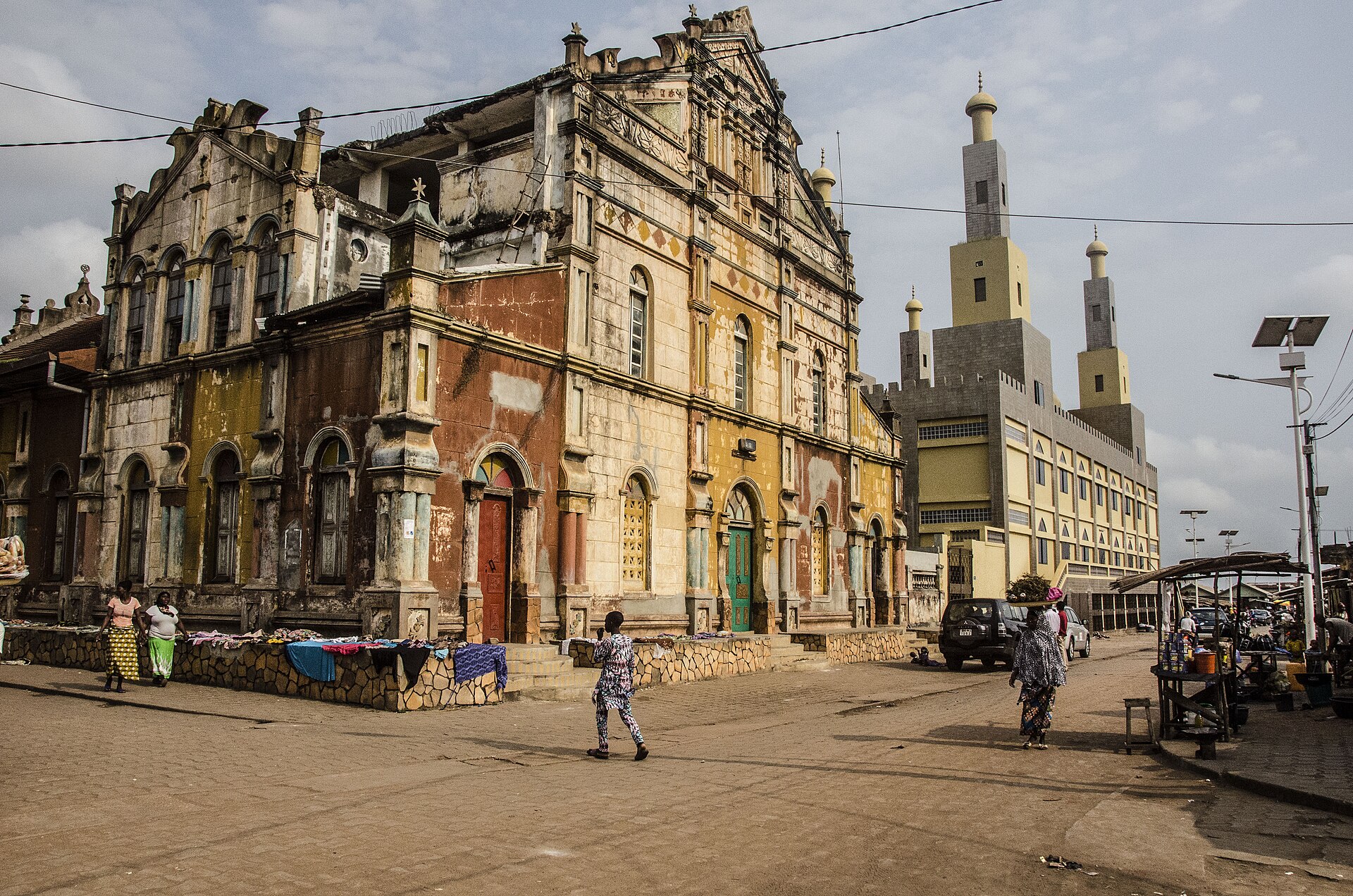
Grande Mosquée de Porto-Novo, inspired by Afro-Brazilian architecture and completed in 1935, Porto-Novo, Benin. Photo by
“We shape our buildings; thereafter they shape us”—or so said Winston Churchill, if the attribution scribbled out on the whiteboard in the first year of my undergraduate degree in architecture is to be believed. Regardless of its author, the quote attempts to pass along some sort of common-sense universal truth intended to communicate the simultaneous influence between spaces and their inhabitants. This would not be an inappropriate summary of Joseph Michael Godlewski’s new book The Architecture of the Bight of Biafra: Spatial Entanglements—but it would be an inadequate one. On the surface, the book proposes to discuss the evolution of the architecture of a region, the Bight of Biafra—located on the southeastern coast of Nigeria—through history. Underneath that, it reframes and recasts classic architectural themes, interrogating the political and social implications and meanings of the most introductory terminologies. Relying on archival evidence, oral accounts, fieldwork visits, and visual representation, the book takes particular spaces characteristic to this region as a thread that meanders through time and narration whilst defying chronological restrictions. It also employs key structures and buildings in the region as case studies and precedents through which to uncover the political lives of the people who lived within them.
The book’s core argument dallies with the theme of anti-categorization. We are shown, over and over, quite brilliantly and clearly, that things are not as neatly packaged as anecdotal history might suggest. Entanglement—a concept that negates the usual dichotomous ways of thinking that restrict and undergird safe rationalities—is a persistent idea in the book. We are pushed to reconsider and unlearn binaries as we are exposed to complicated histories which should not change but strengthen our resolve in our struggle for better worlds. In particular, the book repeatedly challenges the distinction between what is vernacular and what is foreign and how vernacular becomes foreign and vice versa. It exposes the myth of linearity, showing how technologies that appear cloaked in the attire of their time replicate themselves in newer eras with new names. Alas, nothing is new under the sun.
Impermanent architectures, in addition to being particular to regions where the earth isn’t always stable, also grow out of regions where culture is in flux. Concurrent transactions of influence and material goods are reflected in and enforced by the architectonics of such regions. Purposes ranging from resolution to deliberation and even detention, are housed in a hybrid informality that is distinct and experimental. In opposition to visible and central structures like castles and forts, the flexibility of Biafran infrastructures and the fragmentation of the political landscape prove elusive and only give space for a slow permeation. Even in the colonial period, there is a mutual dependence between different categories and overlap in spaces where segregation is intended. We are reminded repeatedly of the potency of cultural exchange through which foreign objects become centerpieces of indigeneity and evolve into potent and common expressions of tradition over time.
To practicalize these reflections, the book’s narrative is woven around five key elements of the Bight’s culture and architecture. The walled compound, the masquerade, the offshore, the enclave and the zone act as flexible models of relationships and expressions of the evolution of the region.
The walled compound, known in Efik as ésìtokure (compound), ésìt ùruà (trade compound), or ufòk (house), functioned as a center of daily life, trade, and worship. They formed the basic living units of community–or what one British colonial officer described as an internalized space surrounded by huts organizing a kinship based social hierarchy. They often broke apart, fused with one another or moved altogether. As lightweight convenient structures which did not need permanent materials, their temporality allowed for a high degree of flexibility. Such a perspective challenges an oversimplification of African compounds as stable harmonic social units, a veneration that refuses to engage the violence that often occurred in this space in postcolonial literature.
The book’s discussion of the masquerade introduces us to the Ékpè, an invisible otherworldly spirit residing in the forests of Old Calabar that manifested in the physical plane through a costumed masquerader. The Ékpè society, a secret association (still running), whose members alone could see Ékpè, played an important part in the eighteenth century as a regulating mechanism of the increasing slave trade in Old Calabar. The Ékpè society gradually grew to supersede the authority of compounds and established spatial control at a time when trade and European contact exploded. Performing debt collection, inter-compound conflict resolution, and mediation between African elites and offshore foreign slavers, the Ékpè grew into an integral institution. The Ékpè also acted as a conduit through which the spiritual controlled the transformation of the space between compounds into a zone of interface between the Ékpè and the uninitiated. Also, through the Ékpè, Old Calabar merchant elites were active participants in the creation of a dynamic urban commercial link. It was able to challenge the power of European merchants and was the main reason Old Calabar was able to maintain control of their land and resist colonization well into the nineteenth century. Eko lodges are the main structures discussed here.
In discussing the offshore, we peek into a fluid space connecting trading houses, the hinterlands and the other side of the Atlantic. Floating barracoons, prefabricated imported British houses and canoes are the tangible representations of the negotiations of identity and the invention of meaning. Through foreign items that adorn or mar the imported houses of local rulers (depending on who you ask), ties to the metropole are crafted in delicate and lasting ways. Slave trade is abolished, trading hulks bob on the Calabar River, traders’ wooden houses peer above walled compounds, collected objects sit dusty in imported houses, Presbyterian missionaries are invited to establish European footholds, and the charged space of the Ékpè society is marshaled under fewer titular and territorial kings. Power goes from being more collectively distributed among members to individual rulers holding a larger sway. King Eyamba V’s Iron Palace, which is integrated into a traditional compound complex, lies in the temporal center between old English wooden houses and brick buildings that come later on.
The book then turns to enclaves: culturally distinct pockets of space that serve as sites of asylum, refuge, and protest. Schoolhouses built by missionaries, the mission house, and plantation spaces act as sanctuaries and thorns in the flesh of local power. They represent and signify the slow tide of colonial might. As palm oil trade grows and soap manufacture blossoms, mooring hulks on the Calabar River become factory facilities owned by European trading firms. Members of the Ékpè society are recast as native agents of the colonial administration. Though iron houses give way to local brick production and uneven development and urbanization, colonial development is often situated within compound spaces, vernacular building techniques are used and older traditional towns are not interfered with. Segregation, justified from health and sanitation fears, fail in practice and boundaries are negotiated and redrawn as the colonizer depends on the colonized. Key buildings include the Duke Town Presbyterian Church, the Hope Waddell Training Institute, and St. Margaret’s Hospital.
In our present day, the syncretic Nigerian Pentecostalism that dominates Calabar depends on the underlying metaphysical fabric—of spirits and witches that inhabit children who are thrown out of their homes, abused and branded. Soldiers wield whips and send Ékpè out of the masquerader back into the forest that is cleared for a resort. Across the nation, impermanent architectures have evolved and multiplied due to economic instability and the resulting lack of security that lives side by side with the rationality that enables residents of Cross River to envision their little piece of the earth as a potential Dubai. Accents and modern tastes are stockpiled almost desperately in cerebral iron palaces of poverty. Indigenous brick manufacture and the evolution of the compound point to the resilience of some version of a vernacular architecture. Despite the seemingly eternal mutual dependence between imagined indigenous and foreign categories, the clamor for separation grows fiercer by the moment.
I did find that the different roles played by native and foreign actors (forgive my categorization) in the book’s narrative unfolded as expected, especially when the movement and force of capital acting through humans is taken seriously. It was not surprising that the clamor for profit and economic stability might provoke the basest and most selfish instincts and override ethnic and racial solidarities. It is even enlightening when we are shown through the narrations of captured kings, liminal societies, and transient pawns that even actions that seemed anticolonial and anti-imperial were also tinged with blatant self-interest and self-preservation. My worry, though, may lie with the effect that the knowledge of the porosity of those historical categories on the attention paid to the categorization that goes on in the present with reference to antiblackness and social death. It is also interesting how prominent “free trade zones” are, when definitions are stretched.
Although African architecture has long received limited attention, outside the dominance of round thatched huts, there is a lot to learn from the flexible resilience of the architecture of the Bight of Biafra. There is space for a lot of growth once we get past nationalistic postcolonial interpretations of our spatial and urban history. This body of work gives us a chance to do exactly that.