What does a museum mean here?
A dispatch from Benin City tells the unfinished story of the Museum of West African Art.
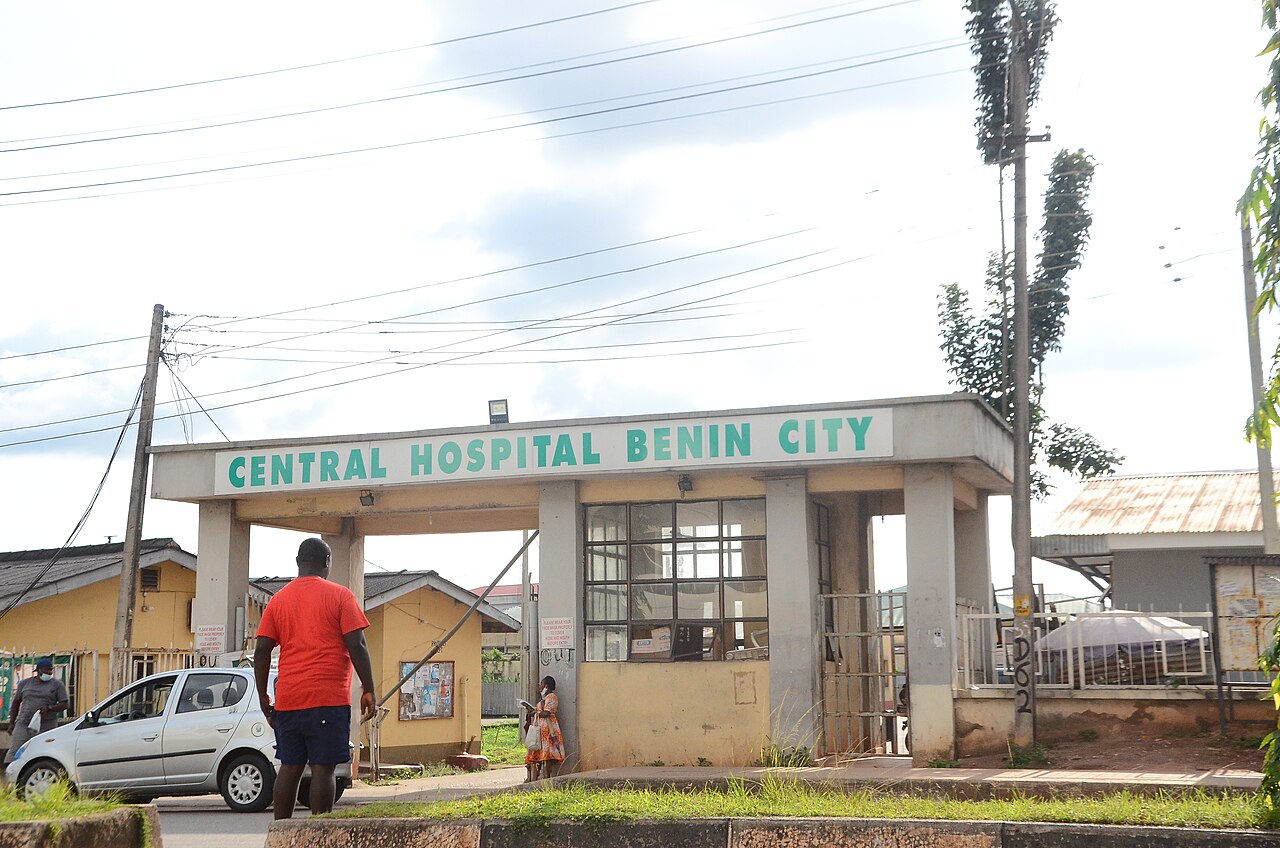
Central Hospital, Benin City, 2021. Image via Wikimedia Commons CC BY-SA 4.0.
Benin City’s old Central Hospital is gone now. Where the gynecology wing once stood, there is sand, debris, and the upright ribs of reinforcement rods—the anatomy of a building that has not yet decided what it wants to become. It takes effort to imagine what once lived here: women laboring, bones being set, families waiting in the courtyard for news. For more than a century, it served the majority of Edo State’s residents.
“There were very fond memories,” a Benin-born source, whose grandparents worked in the hospital, told me. “For it to be leveled for a museum is . . . difficult.” The Central Hospital once spanned seven hectares, but more than half of it was handed to the Museum of West African Art (MOWAA) in 2022. Even the remaining land proved vulnerable. In early October, Deputy Governor Dennis Idahosa warned the museum against encroaching on the neighboring Specialist Hospital. “This is not a witch-hunt,” he said, but “MOWAA must stick to the law.”
The hospital’s disappearance surfaced in almost every conversation I had in early November, when I was in Nigeria for what was supposed to be MOWAA’s opening. It became the quiet fulcrum on which the museum’s promise—and its contradictions—balanced. Artist and writer Jamilah Abu-Bakare, born in Benin City, gave language to this feeling. A hospital, she told me, is a site of repair. So what does it mean for a city’s most visible gesture of cultural revival to begin with the destruction of a place built for healing? “As someone born in Benin City but working in the art world, I realized I could have easily arrived on the wrong side of this,” she said.
One day before my scheduled flight to Benin City for a private preview of MOWAA, I was in Lagos with my suitcase half-zipped. As I was finalizing my plans for the trip, my phone lit up with messages from friends—some affiliated with the museum, others international art-world visitors—who were already in Benin City.
“Stay where you are.”
“They’re not letting us leave.”
“Don’t come yet.”
Videos followed: men at the gates confronting foreign guests, police moving in, doors locked. No one sounded afraid. Instead, I heard frustration, and the unmistakable clarity of something long overdue cracking open.
Within minutes, WhatsApp groups erupted—curators, artists, Edo community members, diaspora Nigerians, journalists, neighbors—all trying to make sense of the rupture in real time.
“This interruption was necessary.”
“This is years in the making.”
“Finally.”
Scrolling through voice notes and screenshots, I realized I was witnessing not the breakdown of a museum, but the collapse of the narrative that had been built around it.
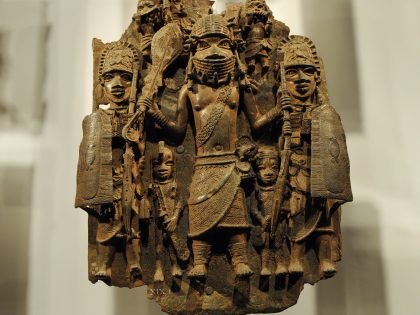
Long before anyone imagined a museum rising from the ruins of a hospital, there were the Benin Bronzes—cast by hereditary guilds, tended in palace courtyards, invoked in ritual, inscribed with a cosmology in which memory was not metaphor but material. Their story begins long before their theft, yet this pillage hangs over everything. In 1897, British troops razed Benin, exiled Oba Ovonramwen Nogbaisi, and emptied shrines into crates bound for London. What was left became trophies. What remained was a wound.
European museums did not arrive at restitution on their own. Activist pressure, the slow moral exhaustion of empire, and the 2018 Sarr-Savoy report—commissioned by President Macron and authored by Senegalese philosopher Felwine Sarr and French art historian Bénédicte Savoy—forced the conversation open. Their partnership, a subtle indictment of Europe’s reliance on African intellectual labor to interpret African loss, helped turn restitution into a new moral currency. For Western institutions, it offered the promise of ethical renewal; for Nigeria, a symbolic path toward redress. In that climate, the idea of a new “home” for the Bronzes took shape.
Enter Phillip Ihenacho, a British Nigerian businessman with a background in finance and nature conservation. He had no roots in Benin’s cultural ecosystem, but he had a longstanding relationship with then Governor Godwin Obaseki. In a 2020 BBC interview, Ihenacho remarked, almost casually, “If Godwin is not re-elected, it would be very difficult indeed to continue with a project like this.” It was a revealing admission: The focus of Inhenacho’s engagement with Benin City was political stability, not cultural legitimacy.
Many Edo natives I spoke with in the weeks that follow described this—allowing someone outside Benin’s lineage to become the face of a museum built atop Benin’s deepest historical wound—as the project’s original fracture. “Imagine the Louvre had no French staff,” one native told me. “That’s what this feels like.”
With Ihenacho driving the project and Obaseki smoothing the political terrain, the museum’s identity began to drift. The Benin Royal Museum was envisioned as a Palace project: a restitution site rooted in the Oba’s custodial authority and the return of royal objects. When it became EMOWAA, the scope widened. The 2020 press release presented the initiative not simply as a royal museum but as a regional arts and research institution—one that acknowledged the Palace while also positioning itself as part of a broader, more modern cultural infrastructure. It marked the first shift away from a singular restitution mandate toward a more elastic, donor-friendly mission.
Even then, contradictions were visible. In 2021, Oba Ewuare II publicly accused the Obaseki administration of diverting donor funds, averting the museum’s original plan, and undermining the Palace’s custodial role. Obaseki’s involvement carried its own historical charge. His ancestor, Chief Agho Obaseki, rose to prominence in the political vacuum left by the 1897 invasion, becoming leader of the Benin Native Council—and later Iyase—against the wishes of the new Oba. Whether he collaborated with the British or simply survived them is still debated, but the symbolism in Benin is unmistakable: an Oba was exiled and an Obaseki rose.
By 2024, EMOWAA had quietly rebranded as MOWAA. After President Buhari’s 2023 federal decree placing all restituted Bronzes under the Oba’s custodianship, the museum dropped “Edo” and widened its mandate from a local heritage project to a pan–West African, research-driven institution. The “Royal” vanished; “Edo” softened. Soon the institution was describing itself as “independent,” “non-governmental,” “non-royal.” Donors welcomed this. Western media repeated it. More than $25 million in international support followed.
I knew the project from another vantage point: In my previous role at the Mellon Foundation, I supported our Black Atlantic portfolio, and MOWAA was among the initiatives we funded—a $3 million grant meant to anchor a broader network of heritage, research, and repatriation work. To funders, MOWAA looked like a sleek new model for restitution: professional, cosmopolitan, legible to global art institutions. It promised to shift the conversation from symbolic return to structural transformation.
But MOWAA was not emerging into a vacuum. Benin City already held national and royal museums; long-standing guild systems; shrines; and archives of memory that live in families, compounds, and communities. The Palace’s position has remained consistent for generations: The Bronzes belong under the custodianship of the Oba, as affirmed by the federal decree. The conflict, then, was never simply about museum-building—it was about custodianship, sovereignty, and whose narrative would be allowed to stand.
The people of Benin watched the drift take shape. They saw the Palace recede as Obaseki’s influence expanded. They saw Ihenacho speak as though he could arbitrate heritage for a kingdom not his own. They saw the museum’s origin story bend toward a version designed for international legitimacy.
So when Western outlets framed the protests on November 9 as anger that the museum “was not called the Benin Royal Museum,” they flattened a century of dispossession into a branding dispute. They missed the political, spiritual, and historical stakes of a city whose memory had already been looted once before.
The story that took shape in my conversations with artists, organizers, educators, and voices across the global art world—in Benin and beyond—bore little resemblance to MOWAA’s official narrative. “Benin people see the global art world as colonizers,” one Edo native told me. He wasn’t angry, just tired. “It’s ridiculous that people whose ancestors stole from your people are now telling you what you can and can’t do with your own heritage.” Then he added, almost in a whisper: “For Benin people, this is religious. Like taking a holy relic. The cross. The Kaaba. Something from the Vatican.”
Here, restitution is not a metaphor. It is a spiritual breach, which is why MOWAA’s public statement on November 8, the afternoon after the protests, landed so poorly. It framed demonstrators as acting under “misconceptions,” cast the museum as a rational arbiter caught between political factions, and treated “independence” as a neutral fact rather than a political choice. The statement also erased the very shifts that fractured trust and flattened a five-year accumulation of tension into a brief “interruption.” And because it was written for donors, foreign press, and global partners, it reinforced the criticism many Edo people have voiced for years: that MOWAA speaks upward, not inward. That it reports to the world before it answers to the ground beneath it.
Edo State’s new governor, Monday Okpebholo, made his position clear early. On November 7, during the Oba of Benin’s historic visit to Government House—the monarch’s first in years—he publicly declared that the museum should be restored to its original Palace-anchored mandate. It was a direct refutation of MOWAA’s independence narrative. On November 10, a few days after the protests, his aides issued an even sharper statement, criticizing the project’s “lack of transparency,” noting that the governor had not even been informed that a foreign delegation was in the state for the preview, and questioning how the initiative had drifted from the Palace “without clarity or consultation.”
What few outside Edo realized was that Governor Okpebholo had intervened before the protests. On October 21, he partially revoked MOWAA’s certificate of occupancy after state officials determined the project had expanded beyond the four hectares originally allocated from the former Central Hospital site. The remaining land belongs to the Edo Specialist Hospital and had long been reserved for public healthcare expansion. The governor’s office stressed that the order did not shut down the museum; it simply reissued a certificate covering only the land MOWAA was legally entitled to, reducing the footprint it had been using.
News of the land revocation began circulating widely on social media after the November 8 protests. Partners like the German Embassy were blindsided, as were many of us invitees who turned to WhatsApp as a public forum to piece together what was rapidly unfolding.
But the shock did not stem from the decision itself. It came from its sudden visibility. Locally, tensions had been accumulating for weeks: The deputy governor’s earlier boundary warning, the Palace’s growing unease, and, according to Edo community members, the Oba’s request that the government rein in MOWAA’s overreach. Both the Palace and the state maintain that MOWAA’s international partners were never briefed on these fractures.
For Edo residents, the directive felt less like a shock than a correction. “They knew,” one artist from Benin told me. “They went ahead anyway.” What spread after the protests was not the order itself but its exposure, misread online as a total revocation rather than the boundary enforcement that had already been in motion.
On November 8, just days before MOWAA’s scheduled opening, Angels & Muse launched the Black Muse Art Festival—a community-rooted celebration of Benin’s creative lineage. Several people who had flown in early for MOWAA told me they ended up staying for the festival instead, drawn by an atmosphere that felt unmistakably local: woodcarvers and brass casters drifting through the grounds, university students passing between classes, families settling onto benches as performances unfolded.
The festival took place in a new 3,500-square-meter sculpture park—a collaboration between local artisans and Nigerian architect James Inedu-George, built on land long envisioned by artist Victor Ehikhamenor as an artistic commons. Over the months leading up to the opening, artisans, shopkeepers, students, and neighbors wandered in and out as the space took shape. Culture here wasn’t something constructed for international guests; it was lived into being by the people who carried it.
“Benin has never been new to art-making,” Roli O’tsemaye, the festival’s program director, told me in conversation days after the festival ended. “Bronze casting, brass work, woodwork—these histories have existed for centuries.” What worries O’tsemaye is how institutions enter these spaces with predetermined frameworks, disconnected from the intergenerational ecosystems that had sustained the city’s cultural life.
“Class mediates almost every form of cultural participation,” O’tsemaye said. Cultural expansion, she stressed, means little without material contributions—jobs, education—that allow Benin people to imagine futures. For many in Benin, culture is not something being built. It is something that never stopped.
Still, the story of MOWAA is one not just of rupture but of real work. During his residency at MOWAA, poet and playwright Inua Ellams wrote seven poems supported by staff he described as “young, energetic, locally focused but globally minded.” To him, the museum felt like a Sankofa gesture: moving forward while looking back.
To read MOWAA solely through failure is to miss the people who poured themselves into its promise. Among them is curator Aindrea Emelife, whose Nigeria Imaginary: Homecoming remains one of the most ambitious curatorial projects to emerge from Nigeria. Her curatorial vision treats restitution not as nostalgia but as speculation. It shifts the frame from recovering objects to cultivating the cultural, institutional, and imaginative conditions under which new futures can take root.
There’s also Ore Disu, the newly appointed director of the MOWAA Institute, who understands restitution as the work of building infrastructure—research programs, archives, community partnerships—rather than simply receiving returned objects. Under her leadership, the Institute had begun sketching what a more rooted future could look like. Multidisciplinary artist Timilehin Oludare, who was invited to lead a community workshop during the planned opening, told me that MOWAA offered “a new avenue for artists in Nigeria and across Africa,” and he spoke with real admiration for Disu’s leadership.
Earlier in the week in Lagos, at a panel on restitution, I asked Disu a question about MOWAA’s future: In an age when the brightest and most fragile objects are compelled to move—one by necessity, the other by history—what kinds of cultural economies make return livable rather than symbolic? It is a tension MOWAA will have to meet directly. Disu didn’t offer a neat solution. She acknowledged it as one of the core tensions shaping her work and emphasized that “livability” must be sustained and animated locally—through indigenous agency, local stewardship, and institutions that can hold memory beyond the spectacle of return.
This is the unspoken pressure African institutions face: With so few of them, each becomes a symbol. Every misstep threatens to confirm the same colonial logic that justified the original theft—the claim that Africans “cannot manage” their own heritage. Hannah O’Leary, a senior advisor at Sotheby’s who has spent two decades working with modern African art, put it plainly: “Because there are so few large museums on the continent, each one becomes a beacon. When one faces issues, people abroad generalize: This is what African museums are like. It’s unfair—China has thousands, and no one cares if a few fail.”
The consequences of MOWAA’s perceived failure came quickly. On November 15, President Bola Tinubu convened a federal committee to “safeguard national cultural heritage” and soon after the Edo State Assembly opened a probe into MOWAA’s funding. What was once framed as a cultural renaissance is now a matter of state review. Cape Town’s Zeitz MOCAA endured this scrutiny too. Lauded as Africa’s first major contemporary museum when it opened in 2017, it was engulfed in scandal a year later and forced to shoulder expectations no single institution could bear. Only under Cameroonian curator Koyo Kouoh leadership a couple of years later did it begin to regain its footing. This is the impossible history MOWAA inherited.
In the weeks after the postponed opening, one question lingers: For whom would the museum open, if it opens at all? For donors protecting investments? For the Palace or the state? For artisans whose hands shaped Benin’s memory long before museums existed? Or for young people imagining futures in a country that keeps telling them to wait?