Whose museum is it anyway?
The dispute over Benin City’s museum project shows that returning stolen art does not settle the question of ownership.
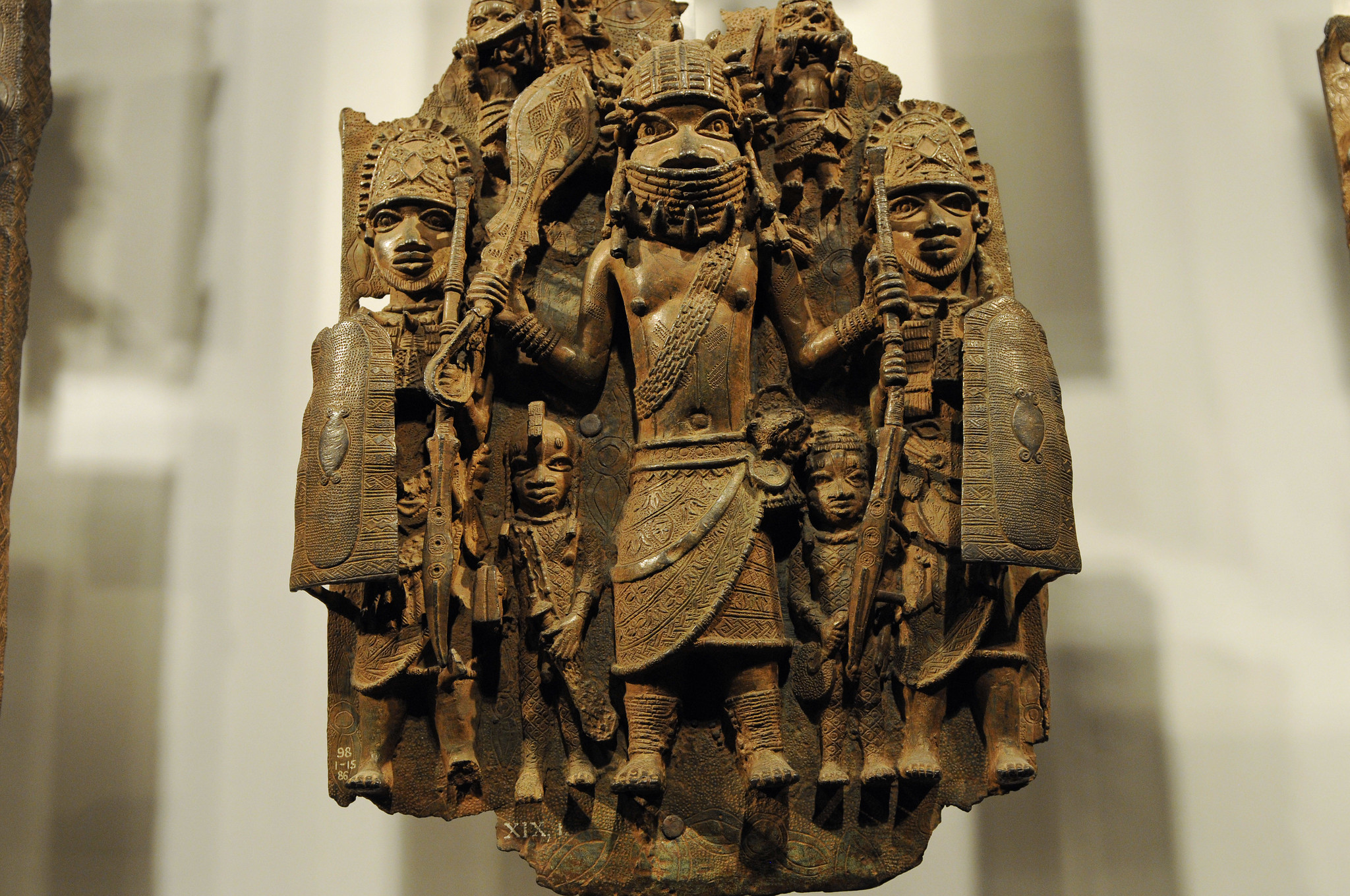
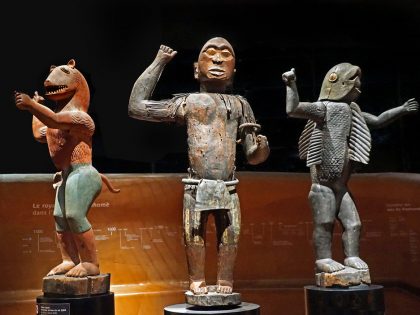
Benin bronze at the British Museum. Image credit Son of Groucho via Flickr CC BY 2.0.
Amidst the deluge of statements and counter-statements that have accompanied the recent controversy surrounding the Museum of West African Art (MOWAA) in Benin City, Edo State, Nigeria, only two facts seem to be clear: firstly, having a structure called MOWAA wasn’t part of the original plan, and secondly, no one is content with how we got here.
At different points, it was something different: a home for the repatriated Benin Bronzes, a $25 million architectural statement to restore cultural pride to the region and a museum for the Royal Court of Benin. That an exclusive preview scheduled in November for selected guests of MOWAA was disrupted by “thugs,” that the Edo State governor reportedly revoked its land rights, and a presidential committee was convened to manage the fallout, have only further obscured the fate of this ambitious project.
The irony is difficult to miss: after decades of campaigns arguing that Africans are the rightful custodians of their own artifacts, a triumphant conclusion to a part of this movement has stuttered because Nigerians cannot agree on who those custodians should be. This is infrastructure politics dressed as heritage discourse, revealing fault lines in Nigeria’s cultural politics that the “return stolen art” narrative has conveniently obscured.
The Oba of Benin occupies a unique position among Nigeria’s hereditary monarchies. His throne has a single royal family, which means he doesn’t require state government approval for succession—a structural autonomy that most monarchs in Nigeria’s federated democracy lack. This makes his relationship with the Edo State government fundamentally different, and it makes the MOWAA controversy fundamentally unresolvable through the usual political horse-trading.
Disentangling the Gordian knot that has now emerged requires that we backtrack at least to 2018. That year, at the meeting of the Benin Dialogue Group, which included the state government, the royal court, federal agencies, and major European museums, an agreement was reached to establish the Benin Royal Museum to house the repatriated Benin Bronzes. Plans for the Royal Museum appeared to gain momentum in the years that followed. In 2019, news broke that “starchitect” David Adjaye had been commissioned to design the museum. By 2020, apparently spurred on by the momentum of the Black Lives Matter protests, a timeline for the return of Benin Bronzes and a new name for the museum—now to be called the Edo Museum of West African Art (EMOWAA)—were announced. According to the 2020 announcement, the EMOWAA initiative would now be led by a Nigerian non-profit, Legacy Restoration Trust, and include an archaeological excavation of any remains of the historical Benin City found below the site of the new museum.
Here’s where the story gets complicated. In July 2021, the Oba of Benin issued a scathing statement, denouncing EMOWAA and the Legacy Restoration Trust as an “artificial group” created to “divert” the Benin Bronzes. As the statement further clarified, the initial plans to create a Benin Royal Museum within the vicinity of the Oba’s Palace had continued in parallel and, from the Oba’s perspective, the Royal Museum—and none other—remained the rightful home for the repatriated artefacts. Predictably, the Oba’s statement was followed by a flurry of responses—ranging from repeated protests against EMOWAA by enraged royalists to hand-wringing statements by officials in Western museums, all emphasizing a growing sense of uncertainty about the fate of the artefacts.
The tide appeared to turn decisively in the Oba’s favor in 2023, when the Federal government, led by President Buhari of the All Progressives Congress (APC), ruled that the Oba was the rightful owner and custodian of the bronzes, given that they were looted from the royal palace in 1897. This led to questions in Western capitals about the utility of restitution practices that would go to “a single owner,” when the aim was for everyone to have access to them.
It appeared, by this point that the EMOWAA management and the state government, led by the opposition People’s Democratic Party (PDP) governor, on one hand, and the APC-led Federal government and the Oba’s palace, on the other hand, were pursuing two different museum structures; EMOWAA, soon renamed MOWAA in an attempt to separate its ambitions from Edo, and, inherently, the Benin Bronzes repatriation—and the Benin Royal Museum, which became the palace’s project to host the bronzes. In time, the royal court would accuse MOWAA of confusing donors about its true ambitions, while MOWAA would state that it “consistently affirmed that it has no claims to these artefacts.”
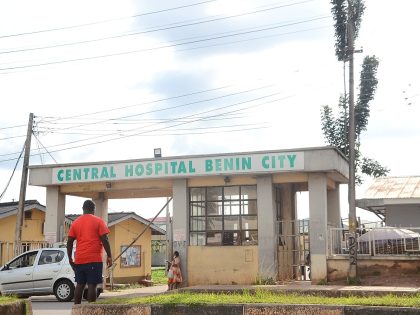
Ironically, Benin City already has a national museum, but the future of the city’s museum landscape quickly became a contest between two competing forces. The state governor wanted a museum in private hands to safeguard against the bureaucratic rot and political volatility that plague Nigerian public institutions. His actions, cited as betrayal of the kingdom, have been compared with those of his grandfather, who the British named as the kingdom’s prime minister after the Oba was deposed, a tested colonial strategy of replacing stubborn rulers with pliant administrators. The project also suffered from the perception that, driven and run by non-indigenes, it catastrophically underestimated the importance of local buy-in. But Governor Obaseki pressed ahead anyway, controversially demolishing a well-known hospital in the city centre to make way for the museum.
When elections were held to choose his successor, citizens rejected his preferred candidate, not least due to the perception that the palace’s blessing belonged to the rival APC candidate. The rival in question, now the governor of Edo state, has revoked MOWAA’s land rights and reportedly plans to restore the site to the hospital.
In the wake of the recent protests, some foreign and domestic reportage has been critical, framing the demonstrators as “thugs” and the wider opposition as informed by backward locals standing in the way of progress—precisely the problematic narrative that has helped justify keeping African artefacts in European museums for decades. But what if the locals are right?
The case for MOWAA has leaned heavily on its appeal to foreign visitors—the promise of tourism revenue, international partnership standards, world-class conservation facilities. This frames cultural appreciation as something performed for external validation. But Benin’s bronze-making tradition hasn’t been frozen in museum vitrines waiting for repatriation. It continues on Igun Street, where craftsmen have historically and still ply their trade, where the culture is living rather than preserved. Does the absence of a $25 million architectural statement actually deprive anyone of the opportunity to engage with Benin’s artistic heritage?
It’s also a question about what we mean when we talk about cultural preservation, especially since cultural production hasn’t stopped. This distinction is especially applied between art and craft, where the former is seen as one more “divorced from its social realm,” and the latter is seen as being better applied socially. This sentiment, especially where the bronzes are applied, speaks to how these pieces are valued and why their home communities might value their production and use value more than seeing them behind glass. That might look less impressive, but it is arguably more aligned with how most communities actually relate to their cultural production.
There’s a deeper tension here about development priorities. The demolished hospital was a piece of infrastructure that served immediate, tangible needs in a city where healthcare access remains limited. A museum, however culturally significant, registers differently when citizens are weighing heritage preservation against functional public services.
Nigeria is replete with museums in almost every state, palaces that double as residences and cultural repositories, festivals and artistic traditions that could fill any itinerary. What limits the potential of these establishments is a combination of insecurity and the reality that cultural appreciation requires a baseline of economic stability and disposable income that many Nigerians lack. To the extent that it presents an exception, Lagos’s cultural economy thrives not because it has better museums, but because it serves an audience with more disposable income. From the point of view of adherents to modernization theory, cultural appreciation, at least of the sort confined to air-conditioned spaces, is perceived as contingent on other prior developmental achievements. This perception further reinforces a myopic view that cultural and social service-oriented infrastructure are at odds, despite the intrinsic and distinct value they both serve in developing society.
A balanced assessment of cultural politics in Nigeria must also inquire: are traditional rulers still best placed to serve as custodians of history? This arises especially given the transformation (even “invention” in some cases) of the supposed traditional institutions in their contact with the colonial state, the (d)evolution of their role in modern-day governance, and the limited or coercive history of their actual hands-on role in the creation of such historical artifacts, from the perspective of social history. Taking the Benin Bronzes as an example, some argue that ownership rights should be conferred on diasporic descendants of the transatlantic slave trade, given both the Benin Kingdom’s historical role as a slaving empire and the recent evidence suggesting that manillas exchanged for enslaved Africans were the source of the brass from which the Bronzes were cast. For others, such as Mahmood Mamdani and Lungisile Ntsebeza, the unelected role of chiefs in a political democracy creates an unnecessary contradiction.
Edo’s case is unique because of a powerful monarch with a direct claim to ownership (or “custodianship”?) of the artifacts in question. This also means that a response to this situation might not be universally applicable. As such, we are likely to be left with a solution that will no doubt be questioned in different contexts. If nothing else, this highlights the necessity of a more critical engagement with the distinction between state, traditional leaders, and cultural producers.
The diplomatic pressure, foreign investment, and international partnerships mean MOWAA is unlikely to be shuttered entirely. But it can—and likely will—become a political football, proving an expensive experiment for its current stakeholders. Sadly for external constituents, its proximity to Lagos by flight cannot discount the reality that its most significant stakeholders, as patrons, promoters, and professionals, will always be Edo people. And some Edo people, for both political and practical reasons, seem unconvinced.
The volatility of Nigerian politics and the failure to manage government relations across party lines are navigable problems. The underlying tension—between palace and politics, tradition and bureaucracy, arts and crafts, heritage as living practice and heritage as a preserved object—is structural. Both the palace and the government derive their legitimacy from the populace, which means Edo people truly own the responsibility of preserving their culture. But a museum that serves foreign visitors while locals remain ambivalent, one that externalizes validation through European partnerships while dismantling local healthcare, isn’t cultural preservation. It’s cultural theater. And the audience is walking out.