Who's afraid of Michael Jackson?
The new Michael Jackson biopic turns a politically conscious Black artist into a raceless fantasy figure, erasing the civil rights struggles, global solidarities, and histories that shaped him.
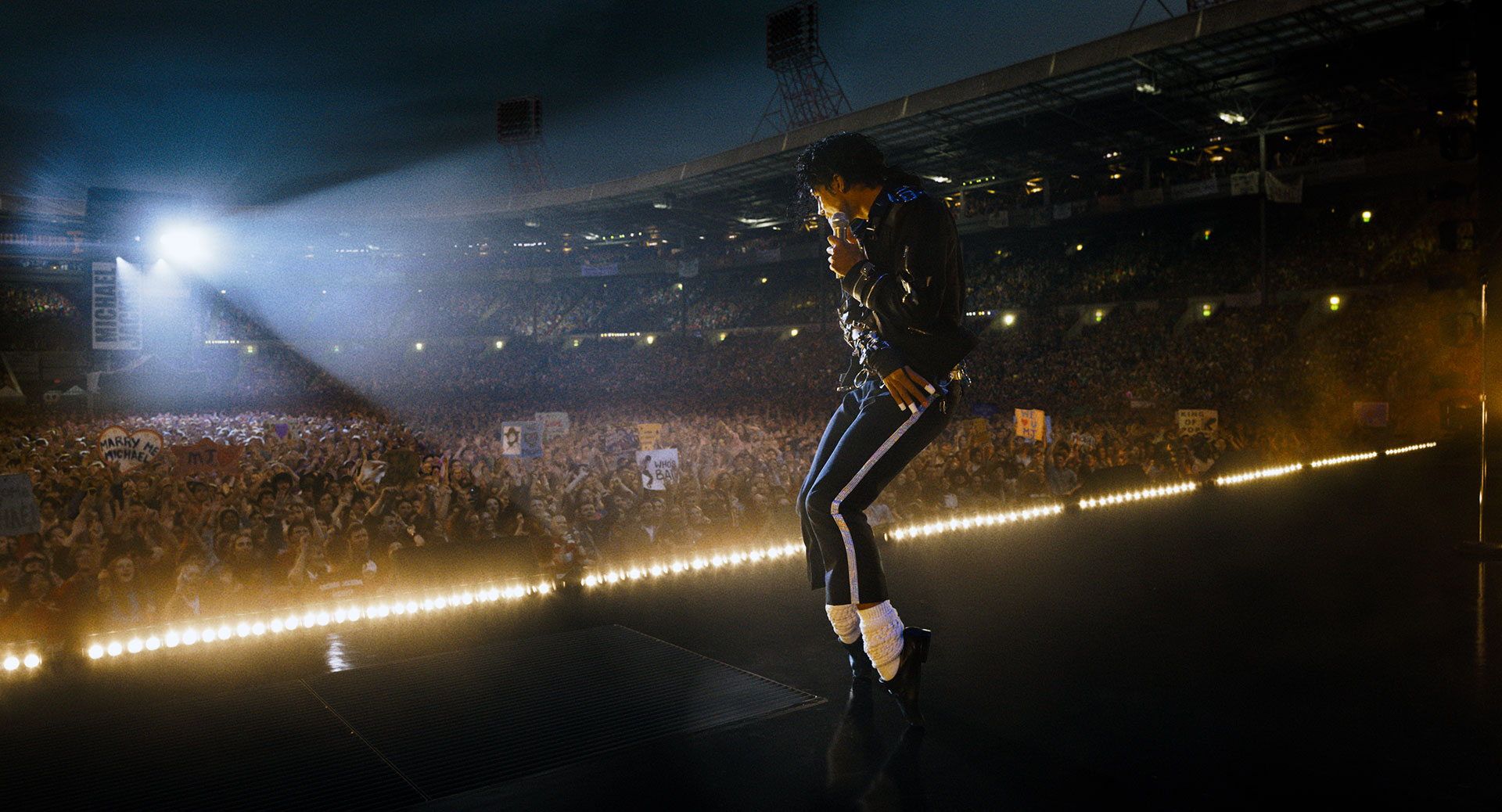
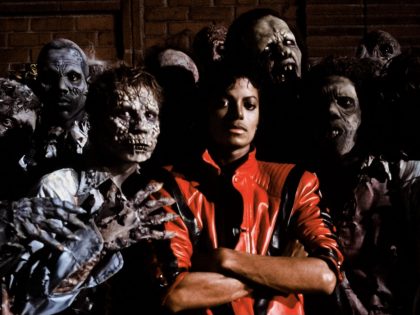
Promotional still from Michael (2026). Courtesy Lionsgate.
The East German secret police kept a file on Michael Jackson. He performed near the Berlin Wall in June 1988, and the preparations for his arrival were elaborate. A memo dated May 4, 1988, recorded negotiations between East German officials and the West German concert promoter—names redacted—regarding stage height and speaker placement, specifically to minimize what could be heard or seen from Unter den Linden on the eastern side of the Gate. There was also a contingency plan: The concert would be broadcast from an East Berlin stadium with a two-minute delay, giving authorities a window to swap in archival footage if Jackson said anything political that might incite fans to riot. One report warned that young people were “prepared to go to any lengths” to hear the concert from near the Brandenburg Gate (near the Wall) and that the confrontations were meant to probe how far the security apparatus could be pushed. Coca-Cola sponsored the concert and was more than willing to meet the East German government’s demands.
It is unclear whether Jackson knew about these negotiations, but approximately 5,000 people gathered on the eastern side of the wall, hoping to hear the concert. Historian and Berlin-based translator Dr. Alan Nothnagle describes the confrontation:
We noticed “inconspicuous” men in civilian clothes, slouching on street corners in groups of three, eyeing the passers-by. The reason was no secret: somehow, everyone knew that Michael Jackson was giving a concert in front of the Reichstag that evening, just a few hundred meters from where we were standing. Hundreds, soon thousands of young people congregated to hear the music. The Stasi agents also multiplied . . . We never heard a note of music that night, but soon voices arose in the crowd calling “The Wall must go!” and “Gorbachev! Gorbachev!” Now the plainclothes Stasi men came alive. They hurled the young people to the ground, shouting, “What did you say? What did you say?” and hauled them off by the collar into side streets where police vans were waiting to bundle them off to Stasi headquarters.
The Guardian stated the violent crackdown was prompted because “the Stasi considered Jackson, like most western pop stars, to be a subversive influence on its youth.” They weren’t the only ones paying attention. And that’s the point of departure for this essay: the gap between who Michael Jackson was and who the various institutional actors in his life—the estate, the press, the critical establishment—have required him to be.
Antoine Fuqua’s estate-approved biopic Michael opened to $217 million globally, setting records in 82 territories, and has continued to dominate globally, reaching $710 million and still climbing. It broke opening records in Brazil for a major studio biopic, earned a 9.6 rating on China’s Maoyan, and drew audiences in Peru, the Netherlands, and Italy in numbers that surpassed every musical biopic before it. Critics gave it 39 percent. Audiences gave it 97 percent. The Guardian dismissed fans as people who want to live in a fantasy. The critical consensus settled around familiar complaints: cowardly, cursed, a plastic jukebox picture.
The question isn’t whether the film is honest, because it isn’t. The more interesting question is what the estate, the critics, and the broader cultural apparatus are so consistently invested in not showing us?
The film opens with real force. “Wanna Be Startin’ Somethin’” builds under the Lionsgate logo, loud and insistent. The camera starts at the feet: silver belt loops, the “Bad”-era silhouette. Then it cuts to Gary, Indiana, and a small boy who cannot meet his father’s eyes. At its core, Michael tells a familiar Hollywood story: poor Black kids from Indiana, raised by a brutal father and possessed of a musical gift so singular it seems almost unreal, who build something the industry machine cannot contain.
There is nothing wrong with that story. It is true and moving, and Fuqua directs it with skill. Jaafar Jackson’s physical performance is extraordinary—the precision of the moonwalk, the forward lean, the way he holds a note as if testing how much tension it can carry before it breaks. The music lands every time.
For fans and non-fans alike, for anyone who wants spectacle, nostalgia, and the collective pleasure of hearing these songs in a theater full of people who know every word, the film works. But it is also the only story the estate is willing to authorize, and that is not a neutral decision.
It is the same logic Berry Gordy used to build Motown: Leave your politics at the door, and make Black music legible and palatable to white America. When Marvin Gaye recorded “What’s Going On” in 1970–71—an album about Vietnam, police violence, and the conditions of Black life—Gordy initially refused to release it. He called it the worst thing he’d ever heard. He was wrong, of course, but the instinct is worth sitting with: The first response to a Black artist making explicitly political work was suppression. The estate that produced this film is making the same choice, at a greater remove and with better production values.
The result is a biopic that tells you everything about Michael Jackson’s ascent and almost nothing about the man who made it. The film returns to his illustrated copy of Peter Pan so often that it becomes a thesis. After his death, a 1911 first edition was supposed to be auctioned from his estate—a real artifact of his reading life. What the film never shows are the books Jackson himself referenced throughout his life: works on civil rights, on Martin Luther King Jr., on Malcolm X. He described studying them seriously, as someone who understood exactly what it meant to be a Black man with his kind of reach. A Michael Jackson who reads Malcolm X is a Michael Jackson with politics, and a Michael Jackson with politics requires his audience to confront histories that remain unresolved. The estate knows this, and this film is the solution.
After a pyrotechnics malfunction during the filming of a 1984 Pepsi commercial, which set Jackson’s hair alight and put him in the hospital, the film gives him a spiritual epiphany: His purpose is to heal the world. It’s a moving scene. It’s also the estate’s thesis statement—not a Black man navigating a racist industry, but a universal figure, raceless, politics-free, and globally marketable.
That choice has consequences. The film covers 1966 to 1988, the estate’s chosen time frame, and within those 22 years, there is a documented political record it had full access to and chose to exclude.
The Jacksons were not entirely manageable, even within the Motown machine. Jackson wrote about it himself in Moonwalk. When a reporter asked the brothers about the Black Power Movement, a Motown representative answered for them: They did not think about that, he said, because they were a commercial product. Jackson recalled: “It sounded weird, but we winked and gave the power salute when we left.” A small act of refusal. The machine said these young men had no politics, but they tried to signal otherwise.
In 1969, the Jackson 5 returned to Gary for a concert and were photographed with Mayor Richard Hatcher, giving the Black Power salute. Michael was eleven years old, his fist raised. That photograph exists. It is not in the film.
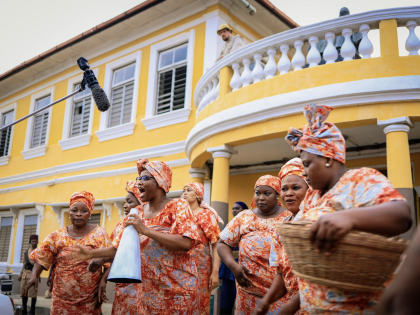
In 1974, at 16, he stood at Gorée Island in Senegal—the departure point for enslaved Africans taken to the Americas—and wept. He received an award from the Organization for African Unity and said, standing on African soil for the first time, “This is where I come from.” That moment is documented, and once again, it is not in the film. Instead, the film shows Michael speaking to his pet rat about animals on the Serengeti. This is the film’s Africa: a nature documentary filtered through the imagination of a lonely child. Not the Africa he stood on, which was the Africa that moved him to tears.
The MTV confrontation is the film’s most revealing sequence. In the early 1980s, MTV largely excluded Black artists and focused on white rock acts, which meant it initially refused to air Michael Jackson’s “Billie Jean” video despite his commercial success. When CBS—Jackson’s label—threatened to pull its roster unless the network played Black artists, Jackson said: “I won’t be shoved to the back of the bus by anyone,” invoking Rosa Parks. At that moment, he explicitly named the structure: MTV had built its brand on the exclusion of Black music, a resegregation of popular culture at the very moment “Thriller” was reshaping the industry.
The film gives you the statement. Then, CBS president Walter Yetnikoff picks up the phone, and it becomes a contract negotiation. This is the epitome of the film’s method: Take the political and make it personal, take the systemic and make it individual, take a civil rights confrontation and repackage it as a business deal.
In 1984, during the Victory Tour, the Jacksons co-chaired the NAACP’s national voter registration drive, with booths outside stadiums. In 1985, he purchased the ATV music catalog for $47.5 million, including the Lennon-McCartney catalog, and became an economic force the industry had not anticipated. That same year, he recorded “We Are the World,” raising $63 million for famine relief in Africa. The film omits all of it. What it shows instead is a boy watching other children play through a window. A boy reading Peter Pan. A boy who becomes a man whose purpose is to spread love and joy.
That image requires a specific erasure, and it is not the one the critics are focused on. The film was supposed to begin in 1993, with the arrival of police at Neverland Ranch. But something else happened in 1993. In September, on a return flight from Tel Aviv—where he had performed two concerts days after the signing of the ill-fated Oslo Accords—Jackson took a sheet of British Airways Concorde stationery and wrote a song titled “Palestine, Don’t Cry.” The lyrics, “Bomb shells are flying. . . . see the children crying,” were later offered at auction. During that visit, he had spent time with both Jewish and Arab children in hospitals, and a United Press International report from the time describes Palestinian children in keffiyehs at his concert.
His only concert in an Arabic-speaking country, Tunis in October 1996, sits largely outside his official legacy. After his acquittal in 2005, he did not go to London or Los Angeles, but to Bahrain, then Dubai. A man who had just survived the most public trial of his life chose the Middle East as a place of recovery. On MBC, the pan‑Arab satellite network, responding to a child’s question about Arabs, he answered with warmth and clarity. Western media paid little attention.
When people respond to this record with “Let him rest in peace” or “He wasn’t political,” they are demonstrating exactly what the film accomplishes. They watch two hours of his life and come away believing he had no politics, which is the intended outcome. The same depoliticizing editorial logic that turns Gary, Indiana, into a backdrop and the NAACP voter drive into an omission also obscures his Middle Eastern solidarities.
The estate is not alone in this. The critics angry at this film want the allegations on screen—the original third act that dramatized the 1993 abuse case and was then scrapped when producers discovered that a settlement barred any depiction of the accuser. The studio spent $10 to $15 million and 22 days on reshoots to build a new ending around that legal constraint. What many now describe as cowardice is, in part, prosaic litigation. Nonetheless, in their focus on what the film omits about the allegations, they have little to say about what it omits about Jackson’s politics, his civil rights engagements, or his international solidarities—they identify one erasure and miss the other, because they are not looking for it.
The comparison with Elvis makes the asymmetry clear. A white artist with a documented relationship with a 14-year-old is rewarded with eight Academy Award nominations. A Black artist whose alleged crimes remain legally contested and who was acquitted at trial is met with moral condemnation. That disparity is not explained by artistic merit. It has a racial dimension that the critical establishment has never been asked to explain.
To understand why, you need a history that the critics are equally reluctant to name. In 1967, the FBI issued an explicit directive under COINTELPRO to prevent “the rise of a messiah who could unify and electrify” and to discredit leaders before their politics could take hold. Malcolm X was surveilled and assassinated—Jackson was six. Martin Luther King Jr. was declared “the most dangerous Negro in the future of this nation,” subjected to wiretapping and sexual smears, sent anonymous letters urging suicide, then killed—Jackson was nine. Fred Hampton was shot in his bed, 35 miles from Gary—Jackson was 11. The mechanism was consistent: Destroy the person before the politics can spread.
The FBI did not need to open a political file on Michael Jackson. By the time it reached him, the mechanism COINTELPRO perfected had been absorbed into the infrastructure of American media. You no longer needed a government program. You needed a tabloid, a prosecutor with a vendetta, and a critical establishment willing to reduce a man’s entire legacy to the most sensational question about his life.
The American critical establishment cannot explain the global box office numbers for Michael without acknowledging something it has long resisted—that his music carried political meaning, that his reach unsettled established hierarchies, and that the version of him the film refuses to show was real.
In Brazil, where Jackson filmed “They Don’t Care About Us” in a Rio favela, the film broke box office records. The Hindustan Times gave it four stars. These audiences did not need a critic to interpret what they were seeing. They recognized something the official narrative works hard to obscure, and the music had already done the interpretive work.
“They Don’t Care About Us” was sung at an ICE detention protest in Broadview, Illinois, in 2025. “Earth Song” continues to circulate at climate demonstrations across Europe. His music moves through public space with political weight that neither the estate nor the critics can fully contain, which is not how fairy tales function. It is how political work persists.
Members of Jackson’s own family have distanced themselves from the film. His daughter has called it dishonest. His sister declined to participate. Even within the production, tensions surfaced—Jermaine Jackson, an executive producer whose son stars in the film, reportedly framed its reception in terms of momentum rather than accuracy. A wave, he called it, not a verdict.
The film ends with his face, finally visible. The screen cuts to black: His story continues.
It does. In 1988, they wanted to delay the broadcast in case he said something they could not control. The same instinct runs through this film, through its critics, and through the estate that produced it—the persistent fear that the full version of Michael Jackson might say something that cannot be taken back.
The estate buries him under Peter Pan. The critics bury him under the allegations. The film does both simultaneously, wrapping the erasure in music so extraordinary you barely notice what isn’t there.