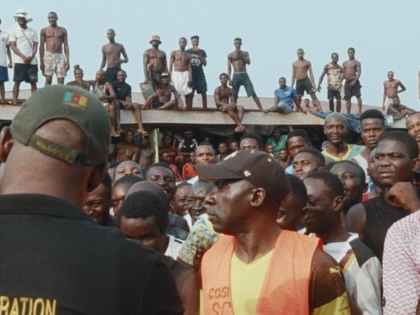
Walking through the ruins of French Cameroon
A new documentary revisits how Mongo Beti used literature and political writing to confront the suppressed history of French colonial violence in Cameroon.
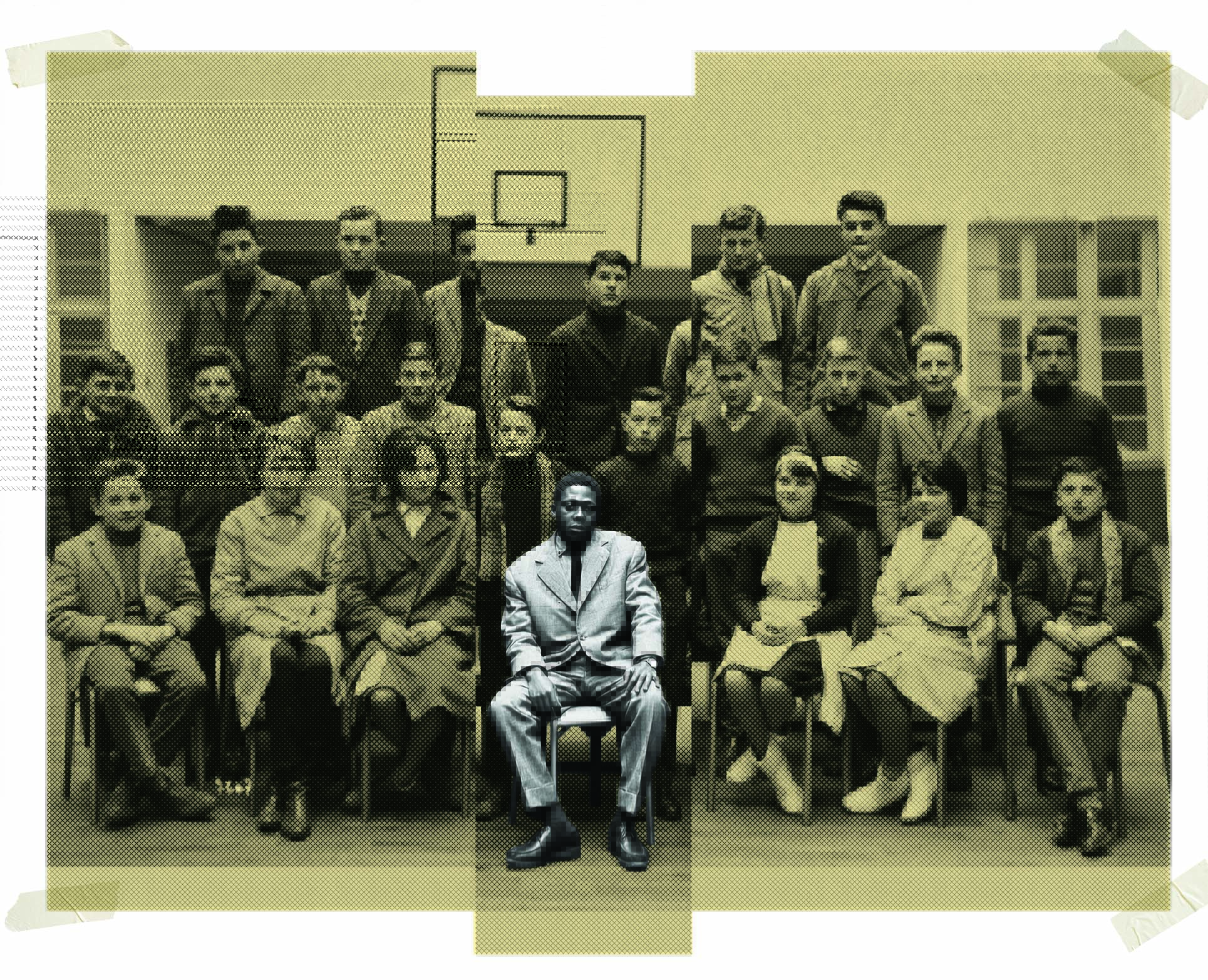
Class photo of Alexandre Biyidi Awala (Mongo Beti) with his students at the Lamballe high school (France) in 1961. Illustration: Jean Philippe Mathieu.
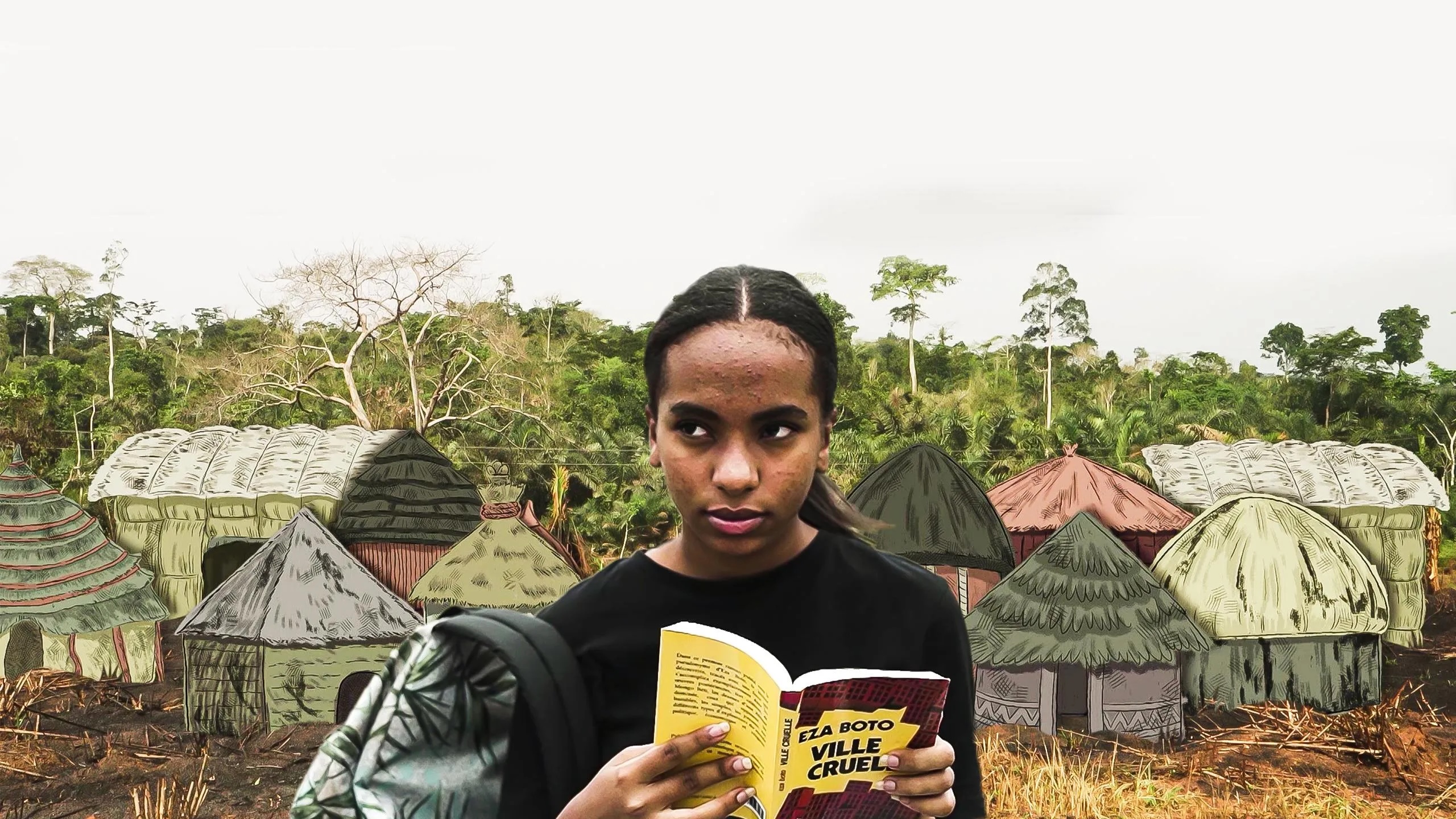
In the opening scenes of the documentary Sur les traces de ville cruelle (In the Footsteps of Cruel City), a young man walks through the misty hills on the outskirts of Yaoundé in Cameroon. In the distance, a patchwork assembly of buildings constitutes the cityscape of what is supposed to be a fictional city, Tanga. Ambroise Kom, a writer and literature professor, tells us that the forests of Cameroon provided people with everything, but they made the error of turning their backs on the forest and going to the city. As a result, they “fell into that cruelty.”
Cruel City is the title of the first novel by Cameroonian author Mongo Beti, written under the pseudonym Eza Boto. Published in 1954, it tells the story of a young man, Banda, who sets off from the village of Bamila to the city of Tanga to sell his cocoa harvest to Greek merchants and earn the bride price for the woman he has chosen to wed. In the course of this adventure, Banda loses his crop and his future bride. Sur les traces de ville cruelle, the documentary by Sarah Dauphine Tchouatcha and Tamnou Koloko, uses images of the city, animation, and interviews to retrace fragments of Banda’s journey in Cruel City while exploring the life and times of its author, Beti, a dissident who spent many years in exile in France, “fighting with his pen.”
Beti’s Tanga, a cruel city, is a creation of the colonizer, its geography a reflection of the segregated cities of pre-independence Cameroon such as Douala and Yaoundé, where urban space was structured by race. The book depicts the “truly difficult lives of the colonized people:” laborers, petty traders, cooks, kitchen hands, sex workers, civil servants, touts, hustlers, idlers, and prison laborers that swell the ranks of the city’s population. In the film, the late Cameroonian journalist Serge Pouth describes how the cities of Yaoundé and Douala are characterized by an apartheid logic that separates the white district, whose inhabitants are coded as “human” on a racialized hierarchy of value, from the native district where its black inhabitants are marked as “subhuman.” Beti’s Tanga echoes Fanon’s description of the colonized world in The Wretched of the Earth, as a world “divided in two” where the native area is a “famished sector, hungry for bread, meat, shoes, coal, and light” and the European quarter is one “where the streets are clean and smooth.”
Not only is the city a cruel place for those who move there, but it is shaped by the vicissitudes of a cash-crop-driven colonial economy, which centers the cultivation of cocoa over subsistence crops. In one scene of the film, villagers line up to have their cocoa inspected before they are authorized to sell it to the Greeks. If the cocoa is good, they buy it. If it is too dry, it is left to dry in the sun. If it is impossible to export, they set all the cocoa on fire. Banda arrives before the inspectors, carrying his 200kg of cocoa, balanced on the heads of three women who have come to the city to help him sell it. When he considers that his cocoa might be destroyed, he feels a deep pain in his heart. As he fears, the soldiers deem his cocoa to be “bad cocoa” and burn it all. When Banda protests, he is beaten up. Jean Claude Awono, an editor and professor of literature, interviewed in the film, describes how this phrase, “mauvais cacao, mettez au feu!”—“bad cocoa, set it on fire!”—derived from everyday colonial violence and became part of regular usage in Cameroon, etched in the people’s collective imagination. The material export of cocoa also carries over in the same form: cocoa, like timber, is still sold in its raw, unprocessed state, keeping Cameroon tethered to an export-oriented economy.
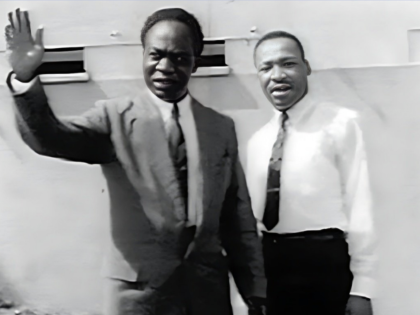
From the ugly violence of pre-independence Cameroon, the film takes us to Rouen in France, where Beti lived from 1966 with his wife Odile Tobner and taught at the Lycée Pierre Corneille. Here, he was known by his birth name, Alexandre Biyidi Awala. His colleagues were unaware that Biyidi the teacher was Mongo Beti the writer. While Cruel City was penned under the pseudonym Eza Boto, which translates as “the alienated people,” his later books were penned under Mongo Beti, translated as “the son or child of the Beti.”
In 1972, Beti published Main basse sur le Cameroun, Autopsie d’une décolonisation (Cruel Hand on Cameroon, Autopsy of a Decolonization). The book, which was banned by the French Ministry of the Interior as well as in Cameroon at the time, is an indictment of the regime of Amadou Ahidjo and of French neocolonialism. Starting in 1957, the Union des populations du Cameroun (UPC) waged a nationalist struggle for independence against the French. Unlike in Algeria, Cameroon’s struggle for decolonization did not lead to the triumph of the nationalists. Instead, as Tobner recounts, the nationalists were crushed. France waged a brutal counter-insurgency war that lasted until 1970, well beyond Cameroon’s nominal independence in 1960. As revealed in a history of France’s war in Cameroon, the French used all manner of methods, perfected first in Indochina and then in Algeria, to accomplish their pacification in Cameroon: aerial bombardments, targeted assassinations, forced disappearances, public executions, the exhibition of decapitated heads, systematic torture, and psychological manipulation. Their victory led to the installation of Ahidjo’s regime in Yaoundé, which the authors argue was a “continuation of war by other means.” The leading figures of the movement were all killed: Ruben Um Nyobé, killed by the French in 1958; Félix Moumié, assassinated by the French secret service in Geneva in 1960; Osendé Afana, taken prisoner, then killed and decapitated in 1966 under Ahidjo; and Ernest Ouandié, executed in 1971 by a firing squad in Bafoussam by Cameroonian soldiers led by a French army officer.
Not only was Beti’s book banned in France, but he was also boycotted by the French media. His detailed account of Ahidjo’s regime demonstrates the extent to which Cameroon, and other former French colonies, remained tightly controlled by France well after independence. In the preface to the 2010 edition, Tobner writes that between 1960 and 2010, the history of Cameroon did not deviate from its initial trajectory. It became a country plunged into immobility, frozen in its development, while being drained of oil, timber, and other resources. French interests in Cameroon were legion, from Total to “forestry companies, plantations—and above all, the Vincent Bolloré group, which controls virtually all of the Cameroonian state’s logistics through its operation of the port of Douala and the Camrail railway.”
In 1978, Tobner and Beti established the journal Peuples Noirs, Peuples Africains, which focused primarily on France-Africa relations, with Africans all over the continent sending in contributions during its 20-year lifespan. The journal too was suppressed, with Beti thrown out of the journal’s offices in Paris. Many of these tactics were the work of General De Gaulle’s “Mr Africa,” Jacques Foccart, who, as the film reveals, was responsible for managing de Gaulle’s “dirty tricks in Africa.” These included mounting clandestine military coups.
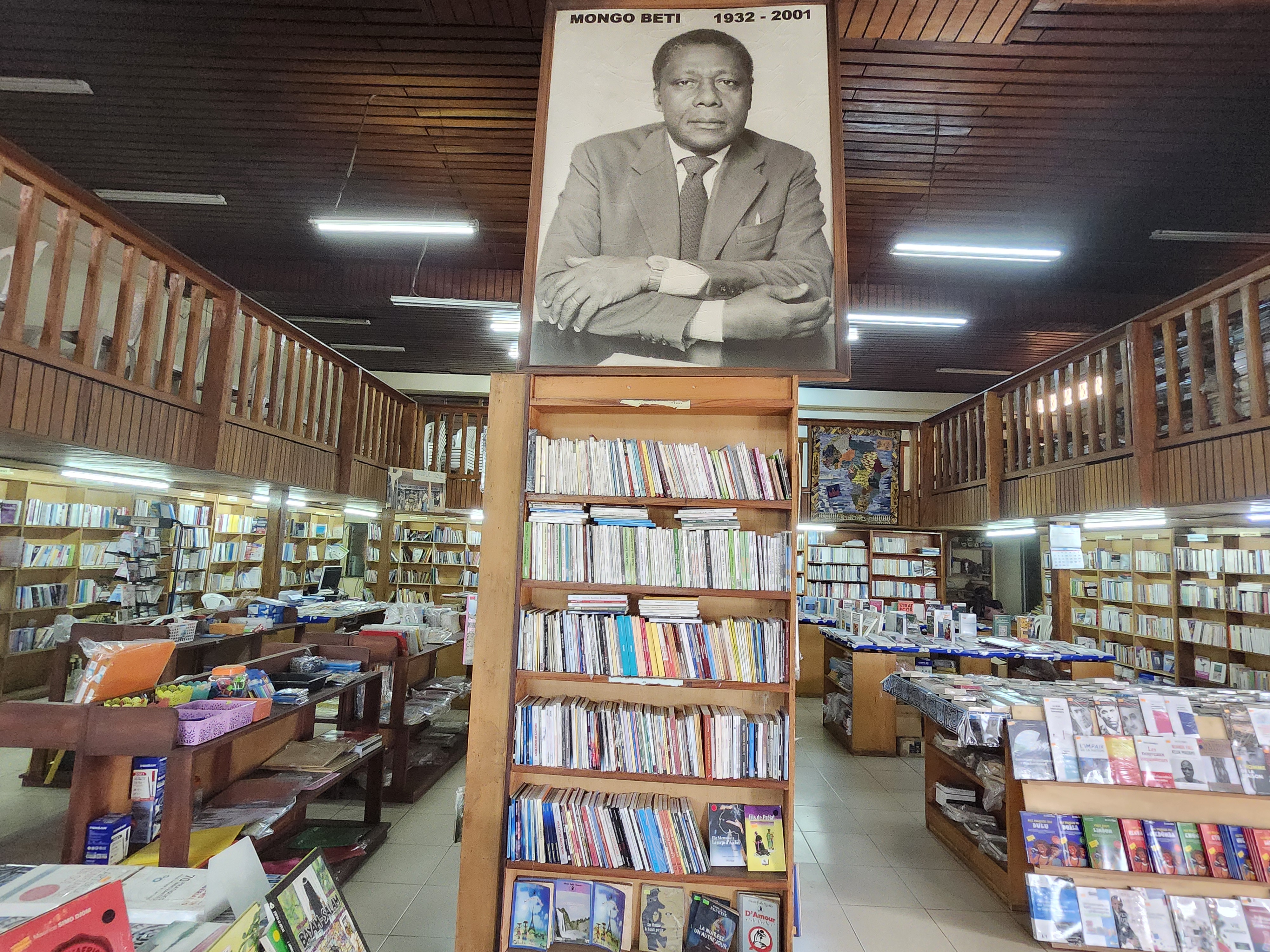
Beti finally returned home in 1994. In downtown Yaoundé, he opened a bookstore, the Librairie des Peuples Noirs, to encourage an intellectual and reading culture and to make books available to the general public, in the absence of a local publishing industry.
France’s brutal history in Cameroon was long suppressed and unacknowledged until August 2025, when President Emmanuel Macron admitted in a letter to Paul Biya, the heir to Ahidjo’s regime of terror, that a war had indeed taken place in Cameroon, during which “colonial authorities and the French army exercised repressive violence of several kinds in certain regions of the country.” As many have noted, he stopped short of offering an apology, not to mention any kind of reparations.
The journey of the making of this documentary, and in particular attempts to have it screened in Europe, suggests a reluctance to revisit the colonial past. Co-director Sarah Dauphine Tchouatcha revealed that while the film was submitted to over 40 festivals across Europe, it was selected by only two small festivals. Yet in Africa and North America, the film is regularly selected for festivals. In Cameroon, it was screened at the CAMIFF Cameroon International Film Festival, where it received the Best Documentary award, and at the Écrans Noirs Film Festival in Yaoundé, where it received the Special Jury Prize for Best Feature Documentary.
Now that France has been removed from its former colonies in West Africa and is seeking to transform and sanitize its tainted history of subjugation on the continent, it is more urgent than ever to walk in the footsteps of Mongo Beti and to resurrect the memory of France’s terror in Cameroon from the ashes of the past.