How to read postcolonial writing
The Granta controversy surrounding a Commonwealth Prize-winning story tells us less about AI than about the enduring metropolitan expectation that writing from the South should sound opaque, excessive, and primitive.
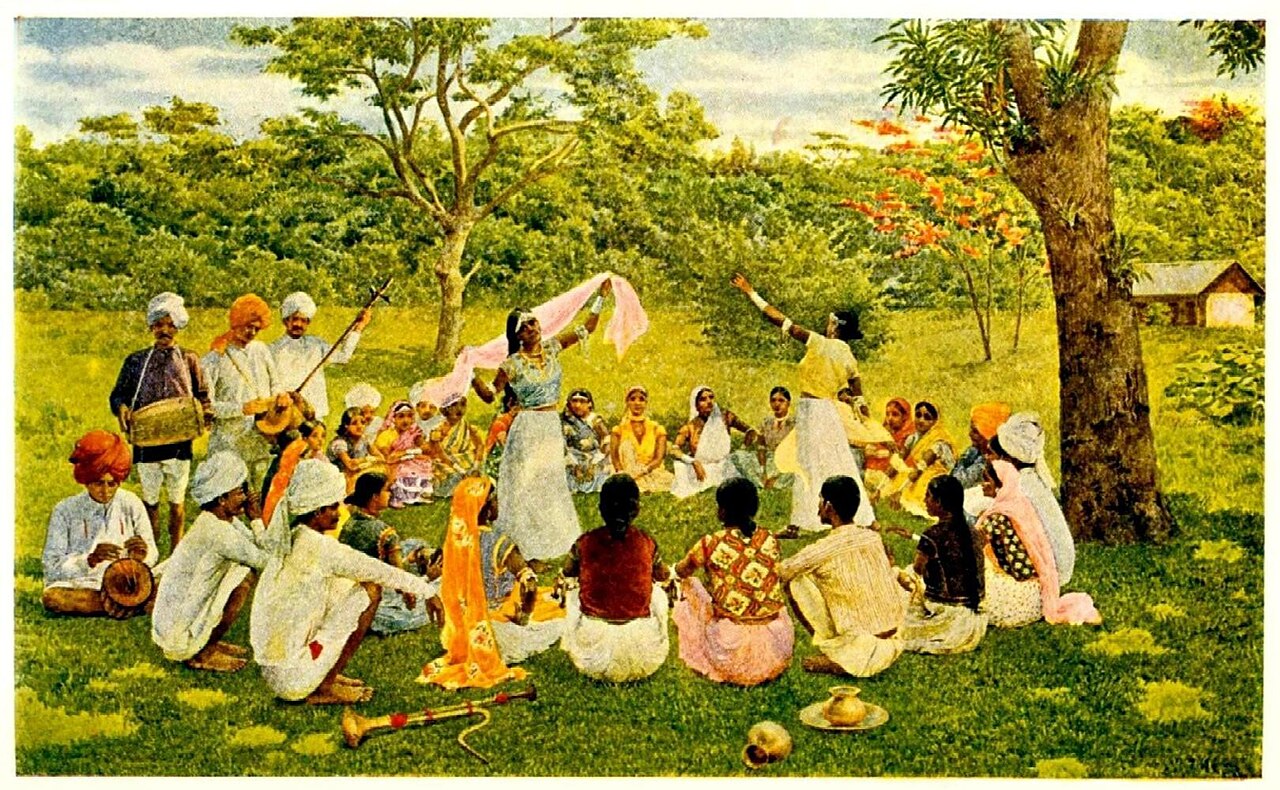
A painting by an unknown artist of East Indian workers and musicians gathered on a cacao estate in Trinidad, circa 1903. Source: Wikimedia Commons.
On May 13, the regional winners for the Commonwealth Short Story Prize for best piece of unpublished short fiction were announced. The five were Lisa-Anne Julien (South Africa, Africa region), Sharon Aruparayil (India, Asia region), John Edward DeMicoli (Malta, Canada and Europe region), Jamir Nazir (Trinidad and Tobago, Caribbean region), and Holly Ann Miller (New Zealand, Pacific region). They were selected from a pool of 7,806 entries, the second-highest number in the prize’s history. The regional winners will now progress to the final round of judging, and a winner will be announced in an online ceremony on June 30, 2026. The prize comes with a £2,500 cash award for the four regional winners and a £5,000 cash award for the overall winner. But what is perhaps more coveted than the cash prize is the winners’ publication on the Granta website. The storied London-based literary magazine has launched many African writers into the Euro-American mainstream, including Buchi Emecheta, Chimamanda Ngozi Adichie, and Binyavanga Wainaina.
To be published in Granta in many ways announces that one has arrived, at least in the metropolitan Euro-American context. What happened next with Jamir Nazir’s winning story is, therefore, not only a scandal about AI fraud, but is also a revealing episode in a much longer history of how elite, metropolitan literary institutions have read—and misread—writing from the postcolonial world. While Granta does not participate in the judging of the Commonwealth Prize, it has an agreement with the foundation to publish the writings of all the regional winners on its website. This is how readers happened on “The Serpent in the Grove,” the winning entry from the Trinidadian writer Jamir Nazir, which was published on May 12, 2026. The first few days after its publication, things were relatively quiet, but as more and more people read the piece, a maelstrom began to brew on the internet, with many accusing Nazir of having used AI to write the piece.
The saga would come to a crescendo on May 18, with posts on X (formerly Twitter) calling out the magazine and the Commonwealth Foundation. It was not just a matter of em dashes and grouping things in threes, a stylistic preference of AI and many writers alike. No, the tells were far less ambiguous—incomprehensible metaphors, parallelism, and stilted writing. The metaphors not only disoriented but also got in the way of the plot. By the end of reading the piece, one was left wondering what it was even about. Choice lines include: “Wilfred’s rum-shop leaned into the road like a rotten tooth”; “Her hair is midnight rain; her laugh is bright as zinc”; and “The girl smiled like sunrise over a sink.”
What exactly were the judges thinking when they selected this story? Surely, there were other, more worthy winners. According to Sharma Taylor, the judge for the Caribbean region, the story was selected for the following reasons:
Jamir Nazir’s language is sublime—precise yet richly evocative—conjuring vivid, lush imagery with remarkable economy. Through sharp sensory detail, he renders the Grove as a living presence, where labour, landscape, and memory are intimately entwined. Polished and confident, this is a story with a melodic voice that lingers long after the final line. Jamir Nazir’s prose pulses with a voice of restraint and quiet authority—a beautifully told and assured piece of storytelling.
If these feel like vague and uninspiring platitudes, that’s because they are. It is almost as if someone put postcolonial keywords in a blender and served up the slop. What they reveal is a critical vocabulary that has become entirely decorative—terms like “richly evocative,” “sensory detail,” and “melodic voice” floating free of any engagement with the actual sentences on the page. Nazir’s selection, therefore, is less about him using AI and more about the irony of Euro-American conceptions about the unintelligibility of postcolonial writing. Despite years of literary criticism seeking to undo the idea of the inscrutable Other, here we were. . . .
Granta, understandably, went into a frenzy. Initially, it took down the piece from its website. Then, it put it back up. Amidst these vacillations, publisher Sigrid Rausing had somehow also decided to upload the piece onto Claude AI to assess whether AI had been used—an astonishing decision to participate in the use of AI themselves. Claude came back with a lengthy explanation—outlined in the letter authored by Granta’s publisher, Sigrid Rausing—that the piece was “almost certainly not produced unaided by a human.” But it cautioned that there were passages in the short story that “don’t fit the pattern” of AI. Passages such as: “Zoongie evaporating like sweat, rum courage scuttling, a policeman’s hand on his shoulder, a magistrate’s eyes not meeting his, a boy grown without a mother narrowing his eyes at the world.” As May 18 rolled into May 19, the tide had once again changed. Now, Granta and the Commonwealth Foundation were doubling down their respective positions: Granta on its decision to publish, and the Commonwealth Foundation on its decision to award the prize to Nazir. The Commonwealth Foundation explained that the writers who had submitted pieces to the competition had all committed to abiding by their entry rules and guidelines. In other words, it is up to writers to self-report their use of AI in the authorship of their pieces, an unlikely occurrence. They also emphasized that the piece had undergone a “rigorous” judging process.
The fact is that nobody but the writer can say with total certainty whether or not the piece was generated using AI. There are those who have done the stealth work of searching his social media profiles, particularly Facebook, where he appears to be an AI enthusiast and the author of what some deem bad poetry. Whatever the case may be, it is bad writing. Its elevation to a platform like Granta suggests that when it comes to postcolonial writing, the expectation is unintelligibility. Granta has attempted to distance itself from the fiasco by emphasizing in a new header accompanying the piece on its website that the magazine is not part of the selection process. That doesn’t minimize the damage.
There is something worth pausing over here about what AI actually does when it generates prose. Large language models do not invent anything. Trained on vast corpora of existing text, they learn to predict what kinds of sentences tend to follow other kinds of sentences. This means that when an LLM generates “literary” fiction set in the postcolonial Caribbean, it does not reach for originality—it reaches for the most probable version of what such fiction has looked like in the texts it has been trained on. It reproduces the expected atmospheric density, the expected weight of landscape and labor, and the expected imagery of poverty and endurance. The scandal is that the existing formulae for “authentic” postcolonial prose are already so codified that a language model can reproduce them convincingly. In this way, AI does not disrupt literary taste so much as expose its furniture.
Euro-American publishers have a history of misrepresenting colonial and postcolonial writing from the Global South. It is ironic, too, that Granta is the platform that launched Binyavanga Wainaina’s now-famed satirical essay “How to Write About Africa.” The Commonwealth Foundation jury, through their selection, has fallen into the trap of perpetuating tropes of poverty, silenced women, and stubborn survival. Others have pointed out that some of the judges themselves are from the Global South, which would mean it is not a simple story of metropolitan outsiders imposing their expectations. But actually, this would make it something more insidious: a set of aesthetic assumptions so thoroughly institutionalized that they can be reproduced from within. The whole affair reminds me of Amos Tutuola’s dealings with the British publishing house Faber and Faber, then under the helm of T. S. Eliot, in the 1950s. An untutored writer, he asked the editors to correct what he called his “WRONG English.” The editors did not, because Faber and Faber thought his writing depicted the unmediated utterance of the primitive Other, rather than the writings of someone who didn’t have mastery of the language. Tutuola, to his credit, had impressively discovered the novel form and applied himself diligently, through the use of a dictionary, to adapt and transform Yoruba folktales into novelistic stories.
Faber and Faber published what would eventually become known as The Palm-Wine Drinkard in 1952. Unfortunately for Tutuola, his desired edits were directly at odds with the aesthetic sensibilities and ideologies that Faber and Faber brought to bear on the novel. Within a Euro-American aesthetic chronology, his work was seen as a cultural artifact that discursively affirmed modernism’s necessary “primitive” Other. For metropolitan writers and editors, Tutuola could only be located within modernism, a partially formed subject with an “unsophisticated” West African mind, but could never be recognized as one of its authors, no matter how experimental and iconoclastic his writing. If we look at the paratextual material that surrounds My Life in the Bush of Ghosts, most notably the preface (written by a professor of comparative religion), it suggests that there is something exceptional about the novel that requires a non-literary, academic framing in order for readers to feel like they can navigate the narrative. This immediately places the text outside the realm of the purely literary.
No doubt Tutuola was gifted, but editorial irresponsibility meant that his writings were mismanaged. It is worth being precise about this: what was mismanaged was not Tutuola’s talent, which was considerable and which generated some of the most inventive English-language prose of the twentieth century, but rather the institutional frame placed around it. Faber did not celebrate him despite his linguistic unevenness; in an important sense, they celebrated him because of it. The “wrongness” of the English was the point—it authenticated the primitive. Here, the irresponsibility of the judges meant that, rather than seeing the AI for what it was, the nonsense writing was seen as ingenuity. The structure of the error is identical across seven decades: Incoherence that would disqualify a European writer is reframed as authenticity when it is attached to the right cultural geography. This is what the AI controversy ultimately reveals—not a new problem introduced by technology, but an old one made newly legible. The real question this affair leaves us with is why a particular form of trained, statistical incoherence was so readily legible to its judges as postcolonial seriousness. The answer to that question should unsettle us more than any language model.