Nothing left
A much-anticipated “Conference of the Left” was supposed to unite South Africa’s progressive forces. Instead, it confirmed the harder truth: the left doesn’t need unity, it needs rebuilding.
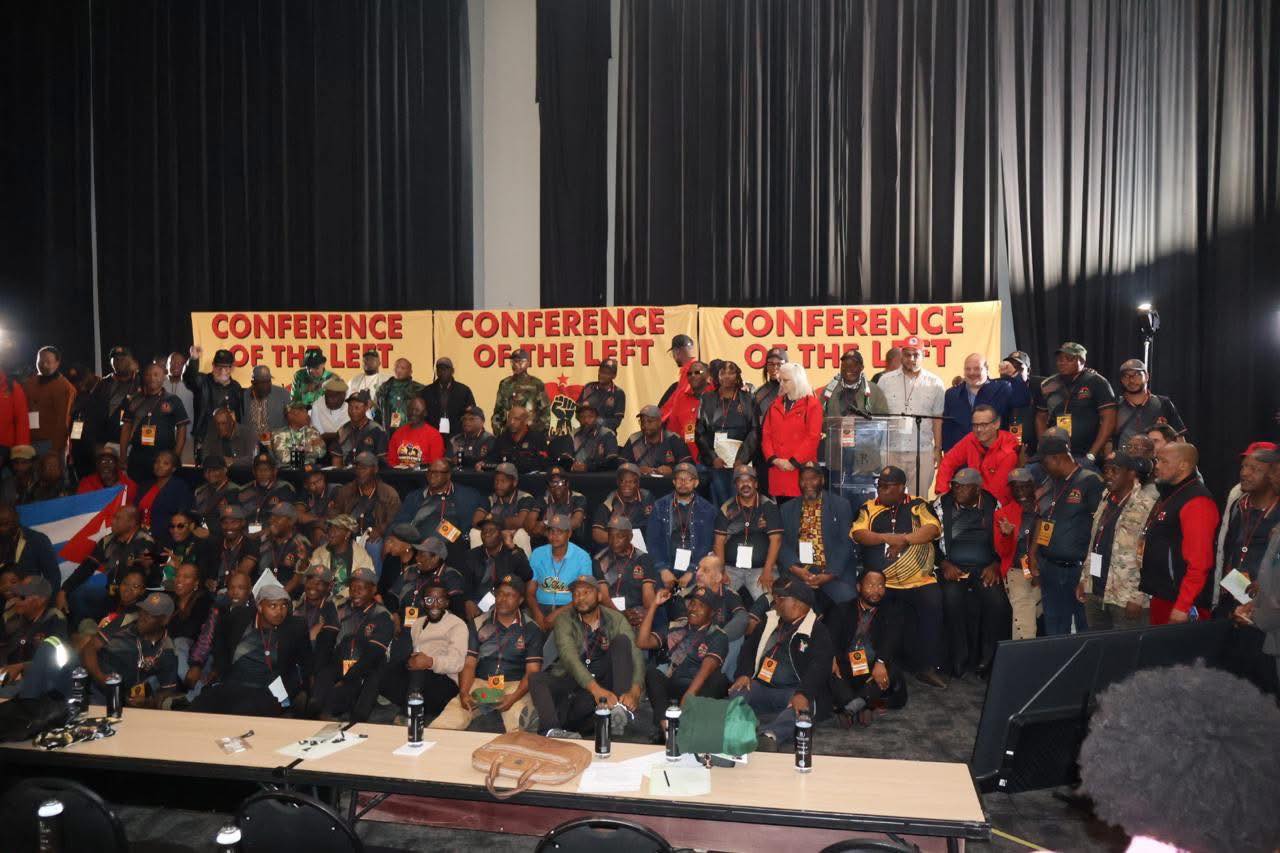
Group photo of the delegates at the Conference of the Left. Source: Fred M’bembe on Facebook.
If last weekend’s Conference of the “Left” was any indication of what progressive forces have to offer, the Democratic Alliance (DA, South Africa’s main center-right opposition party) should rest easy. The scare quotes are needed because the biggest parties to the gathering cannot in any sensible way be defined as left. Theirs were the loudest voices in the hall, and it gave a ringing hollowness to the entire proceeding.
For a party that can’t seem to retain any senior leader for longer than two months, the uMkhonto weSizwe (MK) delegation appeared surprisingly well organized. MK was the ANC’s armed wing during apartheid; the name was revived by former president Jacob Zuma in 2023 to launch his own breakaway party after the ANC moved to prosecute him for corruption. Tony “Mercedes” Yengeni—a former ANC chief whip jailed for fraud after accepting a discounted Mercedes-Benz from an arms company during a government procurement deal—addressed the gathering on their behalf on the first day. On the second, they tried to maneuver Jacob Zuma onto the podium, thankfully without success.
Zuma has probably done more than any single individual in the last 30 years to damage the welfare and political prospects of working-class South Africans. Acting always out of the narrowest and most venal of motives, he used his presidential power to hand over executive functions of government to a crime family and green-lighted a state-wide looting spree which gutted institutions across the board, collapsed service provision and wiped out a decade’s worth of growth and jobs. Deposed by his own party and facing his comeuppance, he tried, with little success, to instigate a coup and then, with somewhat more success, a popular insurrection which left hundreds dead and wiped out several billion rands more from the economy.
MK is his extended entourage, a “party” erected entirely in his own image and molded to his every impulse. It’s a clown car of gangsters and grifters who betray, cheat and steal from each other with such rapaciousness it would be comic if it weren’t so tragic. Not even family members are safe from this—the most lurid of its unending scandals has involved Zuma’s daughter trafficking her own cousins to Russian mercenary groups.
MK represents the deepest moral degeneracy of the political class in South Africa. Nelson Mandela, Joe Slovo and Walter Sisulu—the liberation movement figures who founded the original uMkhonto weSizwe in 1961—would be doing tailspins in their graves if they knew even half of what was being carried out in the name of the organization they founded.
Several other caudillos of corruption were prominent on the first day. State capture luminary and former Zuma lieutenant Ace Magashule—who ran the Free State provincial government as a personal patronage fiefdom for a decade before being suspended from the ANC—spoke for his African Congress for Transformation party, essentially the Free State chapter of MK.
Particularly ominous was Irwin Jim’s presence on the podium. Jim is the longtime general secretary of the National Union of Metalworkers of South Africa (NUMSA), once the country’s largest and most militant union. Just over a decade ago, NUMSA spearheaded an earlier ill-fated attempt to unite the left outside the ANC.
The early days of this initiative looked promising—a United Front brought together unions, community movements, and socialist parties long stranded in separate corners of the political landscape. But the sprouting of democratic self-activity which followed proved too much for the union leader. Funded by the American tech billionaire Roy Singham, Jim stifled the United Front and replaced it with the Socialist Revolutionary Workers Party, a toy vanguard built around his own authority, which duly collapsed in a few years. The voice of the international “Left” was represented last weekend by his staunch ally in these endeavors—Singham agent Vijay Prashad.
We should be somewhat less strident in making the case against the Economic Freedom Fighters (EFF), South Africa’s third-largest party, but only somewhat. Unlike MK, the EFF’s official ideology colors more consistently within the lines of left-wing politics, albeit a version of it that belongs mostly to the early 20th century. The rot starts from the head in the EFF but hasn’t reached all the way down. There is a not insignificant layer of grassroots activists in the organization whose commitments are more honest than anything its leadership is capable of representing.
But democracy is the weapon of the weak against the strong, and these comrades have none of its benefits. The EFF is, like all the others on this roster, a one-man party. And that man (Julius Malema, its founder and commander-in-chief), like all the others, is one who puts business before politics. He’s a captain of industry in the vast “informal economies” of patronage and rent-seeking that have been corroding South Africa’s political space for the last three decades.
To have included these groupings in the event was a grave insult to every well-meaning delegate that attended the conference and to the proud traditions of emancipatory politics in South Africa on which they sought to build.
I have no good insights into what prompted the South African Communist Party (SACP) organizers to make that decision. The most generous reading would put it down to a naive desire to be ecumenical and not restrict the boundaries of the coalition before the fact of democratic input. The less generous interpretation is that the space between the SACP—itself not entirely unscented by corruption—and the patronage “Left” has narrowed so much that the decision seemed natural.
I hope it was the former. And I suspect that, in making this call, SACP leaders might have been willing to shelve their reservations out of deference to the apparent strength of the patronage parties.
What we’ve lost
But MK and the EFF are weak in all the things the left needs and strong in all the ways it should fear. Their presence dragged down the level of discussion and drowned out the voices of the grassroots activists who were desperately trying to salvage something useful from the gathering.
I was asked to present framing remarks in one of those discussions—on economic strategy. I happened to have spent much of the previous week reading through old issues of the Shopsteward (the journal of the Congress of South African Trade Unions) and the South African Labour Bulletin for a research project. The period I was focused on—the late 1980s and early 1990s—was the apogee of the South African left.
The Congress of South African Trade Unions (COSATU) at the time was the organizational backbone of one of the most mobilized populations in the world—a millions-strong labor movement with robust shopfloor structures, deep ties to social and civic movements, and the confidence of a class that had vanquished a 300-year-old system of oppression. These strengths are reflected fully in its intellectual life—the deep sophistication of the debate in those years emerged from a living confrontation with power, carried by organizations that had to think seriously because they were significant enough for their ideas to matter.
I used my remarks to urge comrades to revisit this moment in our history and to try to emulate its strategic seriousness. They were not well received. First to respond was a senior figure from the EFF. Why, he probed, had COSATU failed if it had been so strategically sophisticated? His answer was numbingly simple: labor strategists had forgotten the fundamentals, the need to seize land and means of production. That should be our economic strategy.
That set the tone for the subsequent debate. Numerous speakers questioned why, in the words of one, we weren’t “obsessed enough” with taking back the land. Riffing off this, another boldly ventured that the “main problem” facing black people in the country is the constitution (because land, presumably).
A few voices tried to guide the discussion back to reality—asking what sorts of concrete demands might actually improve lives and build support on the ground. But they were outnumbered—not just by members of the patronage groups but by representatives from the numerous Mickey Mouse parties that accounted for a substantial portion of the rest of the conference delegation.
These aren’t corrupt in the ways MK are. But they are similarly deracinated and deluded—filtering reality exclusively through Bolshevik texts written in a period before most workers had seen an assembly line.
The crudeness of this conversation, juxtaposed to the quality of the engagements I had read in the journals of the early 1990s, gave me one of the most sobering moments I’ve had in the almost two decades I’ve been involved with the South African left.
The whole impetus for the conference suddenly seemed misguided to me. Our actual task, it was made clear, is not to unite the left but to rebuild it.
The challenges we face in this regard go far beyond the influence of patronage. Thirty-odd years ago the South African left was bifurcated. One half of it was absorbed into the vast party-state apparatus being erected around the Alliance—the formal tripartite alliance between the ANC, SACP, and COSATU that governed the country after 1994. The other was shunted to the furthest margins of the political landscape by that growing juggernaut. Too close to power on the one side and too far from it on the other, each degenerated in its own way.
As just one marker of this, scarcely a single significant left-wing journal remains in print in 2026.
Every apparent opening seems to take us two steps back. The so-called NUMSA moments swallowed up the few coordinating structures the “independent left” possessed. Its only legacies were deeper divisions and a degraded union. Rhodes Must Fall injected US-style campus radicalism into South Africa’s political culture, leaving nothing but bad blood and bad poetry in its wake.
The pseudo-radical sloganeering that the EFF and MK have perfected is now the common grammar of a much wider layer of self-proclaimed activists. Common is the student leader who has never tilled more than a pot plant in their life but will confidently proclaim that all problems of program and tactics can be reduced to reclaiming the land. Below, incidentally, is what the data say about that proposal. Big majorities still support land redistribution but virtually no one—outside of a few rural communities—thinks it’s a major priority.
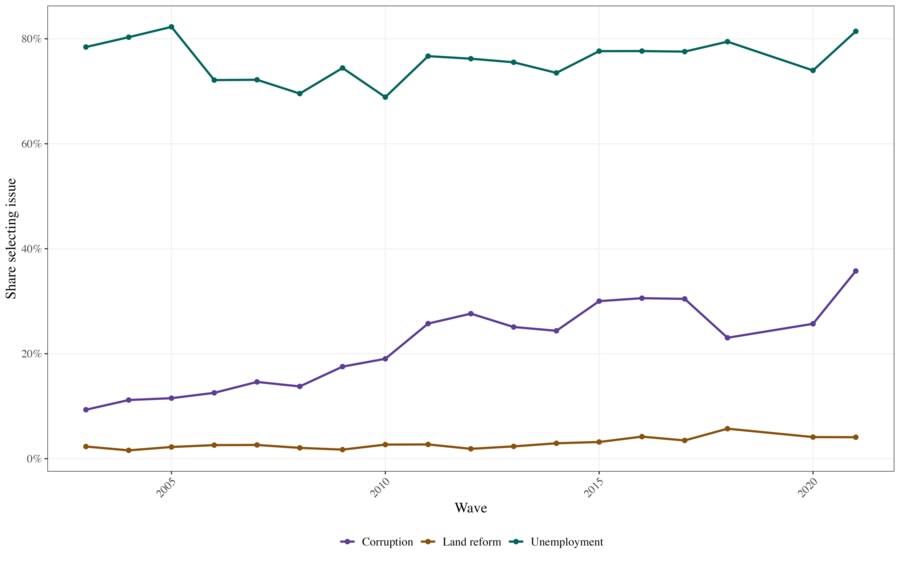
By and large, working-class South Africans want the benefits of a modern industrial economy—jobs and secure incomes. They don’t want to go back to being peasants. That should be as obvious as day. But try saying it to a room full of lefties, and you won’t be allowed to finish the sentence. This singular obsession with the land question is the cleanest indicator of the left’s detachment from mass politics and its drift into a stratosphere of symbolism and slogans.
What we’ll lose
The tragedy of all of this is that the moves the SACP is making are well timed, and if better executed, could have had an entirely different outcome. As I’ve argued at length elsewhere, the ANC’s decline is leaving open a giant space in the political map, one that should look very inviting to an aspirant left.
The reasons we are seeing this are obvious. Millions of voters are deserting the ANC because of a flaccid economy, collapsing service delivery, and corruption. The EFF and MK—offshoots of the ruling party that embody the worst of its corrupt tendencies—are hardly likely to become the new political home for most of these.
But neither are they likely to gravitate towards a party of white privilege, which pig-headedly denies the political realities most obvious to ordinary South Africans: that the legacies of the past still confine our present. Here’s a bit more data to back this up—overwhelming numbers of black South Africans support the state intervening to reduce inequality and overcome historic disadvantages, policies the DA has consistently opposed.
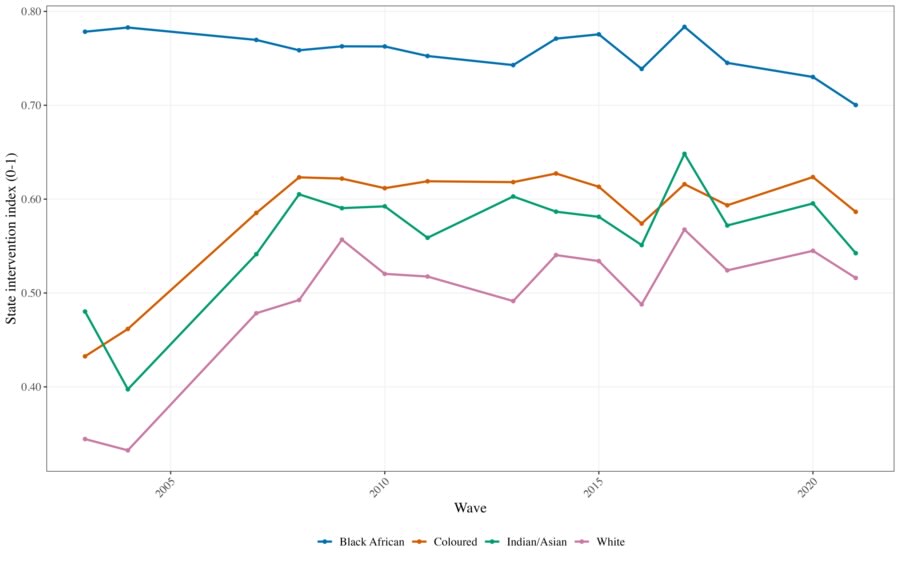
This all might be changing. The latest figures here are several years old and are trending downwards, perhaps reflecting the popular disaffection with state provision. There are early signs that the DA, for the first time, is breaking into majority black voting districts in a substantial way, and softening its liberal fundamentalism as it grows. But deep loyalties will take time to forge.
For now, the political field remains wide open. For the left, the basic formula that will have to be followed to enter that field in a convincing way seems clear: we need a party that triangulates between the two currently dominant camps—matching the DA in its anti-corruption credentials but remaining committed to economic transformation and to a viable plan for jobs. The two sides of this platform are mutually conditional: only a party that can restore some credibility to the public sector can win with an economic agenda predicated on public power.
Formulas are easy to derive of course; fulfilling them is much harder. I honestly have no idea whether the SACP is fit to play a meaningful role here. Its recent history has not exactly been inspiring. But with something of an organizational machinery still intact and some limited experience with elections and governance, it’s arguably better placed than any other going concern on the left.
Not, however, if it continues to choose the pseudo-left over the working class. This is what I meant earlier when I said that patronage parties are weak in the things we need. Radical blather combined with flagrant corruption is not a recipe that will win the Council of the Left—the coordinating body formalized by the recent conference—mass support (see a decade of flatlining EFF electoral results for the evidence).
Yet they are strong in ways that we should fear. They have the organizational and financial muscle to dominate the new “Left” front, as we saw last weekend.
That muscle does not derive from the places the left has traditionally drawn strength. It’s not rooted in a highly activated and educated membership. It doesn’t come from powerful shopfloor or street-level structures. It’s not girded by ideological clarity or strategic sensibility. It derives, instead, from patronage and populism. It comes from the personal magnetism of strongmen and the machineries of distribution that gather around them.
That is the engine of MK, and to a lesser extent, the EFF. Whatever vestigial commitments these parties have to the principles of the left are a hindrance rather than a help—witness the EFF’s anti-xenophobic stance, its one outstanding act of principle, but which has cost it dearly.
Sooner or later, this will be recognized. Patronage groupings will start to appreciate that the traditional wellsprings of the right—God, Family, and Fatherland—marry better with systems of patronage than the emancipatory vocabulary of the left ever could. Deference to authority, patriarchal order, and nationalist belonging—elements already well blended into MK’s ideological armature—are much more natural idioms for a politics built on personalist loyalty and favors from above.
The existing patronage leaders will either evolve naturally in their direction, or be overtaken by others less encumbered by the pretenses of popular power.
Jumping into bed with them is not, therefore, a short-cut means of reviving the left. It’s a surefire way to doom it. It will only prove the DA leader’s point: that left-right distinctions will quickly cease to have any real meaning in South African politics. The only relevant cleavage will be between a bloc that wants to govern in favor of the existing elite and a bloc that doesn’t want to govern at all—whose only ambition is to finish picking over the carcass of the South African state.
If the latter is what the public comes to associate with the left, it will be catastrophic for our long-term project. Last weekend’s images of Yengeni, Magashule, Malema and co. pontificating in front of a big “Conference of the Left” banner, flanked by SACP leaders, took us one step closer to that outcome. It was a sad sight. If the left is to be rebuilt, it will not be through the people who helped destroy the conditions for working-class politics in the first place.