South Africa in history’s struggle
Kevin Cox’s NLR essay on South Africa claims to correct liberal and culturalist accounts through historical materialism. But it reproduces the very epistemic and analytical failures it sets out to overcome.
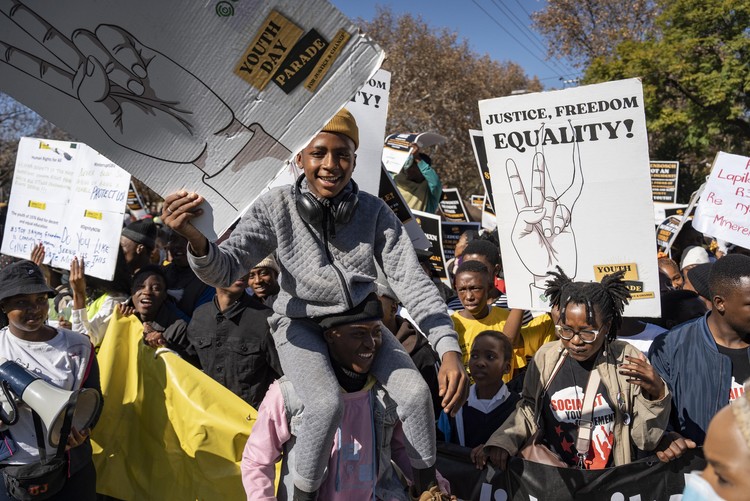
A participant is carried on another protester’s shoulders during the National Youth Coalition’s Youth Day march to the Union Buildings in Pretoria on 16 June 2023. Source: Ihsaan Haffejee/GroundUp.
Kevin Cox’s late-2025 New Left Review essay, “South Africa in History’s Shadow,” presents itself as a corrective to what he regards as insufficiently structural explanations of post-apartheid South Africa. Rejecting liberal moralism, culturalist essentialism, and what he characterises as the naïveté of the post-apartheid left, Cox aims to situate South Africa’s crisis in long-term historical legacies: the deindustrialization of sections of the Global South, the late proletarianization of the working class in parts of Africa, the racial composition of class formation, and the intensity of mining-led accumulation (led by Anglo American, whose largest overseas stockholder is BlackRock). On the surface, Cox’s account appears consonant with the traditions of historical materialism and dependency theory—including important recent contributions such as Seeraj Mohamed’s work on the financialization of the South African economy. Yet the essay ultimately reproduces many of the conceptual failures it claims to overcome. Cox’s analysis remains trapped within a liberal structuralism that evacuates politics, flattens African social history, and, most seriously, fails to situate South Africa within the contemporary architecture of imperialism—a dimension explored in depth in Residual Governance by Gabrielle Hecht.
More fundamentally, Cox fails to engage with racial capitalism as theorised by prominent South African social scientists such as Bernard Magubane and Harold Wolpe, for whom race is not a secondary or residual category but constitutive of capitalist accumulation itself. South Africa’s mineral economy, labour migrancy system, and post-apartheid class formation cannot be understood outside this framework, which links capitalist development directly to racial domination and imperial extraction rather than treating them as unfortunate historical overlays.
Africa and the people without history
One of the most troubling features of Cox’s essay is its habitual treatment of “Africans” as a homogeneous historical subject. Despite extended historical discussion, Africans repeatedly appear as an undifferentiated “majority”, acted upon rather than acting, structured by forces but rarely structuring them. This is not a minor semantic problem. It is the reproduction of a form of epistemic imperialism: the reduction of complex social formations in the Global South to inert populations rather than historically constituted classes, communities, and political agents.
Cox’s references to “Xhosa” and “Zulu” peoples are particularly revealing. These categories are deployed as if they were primordial, stable entities, rather than products of layered historical processes: precolonial state formation, colonial ethnography, missionary linguistics, apartheid-era Bantustan engineering, and post-apartheid political contestation. A cursory reading of South African history would have revealed that Xhosa and Zulu are not “mere tribes”, but historically constituted nations with complex state traditions, class formations, and political economies that long predate colonial conquest. To reproduce the language of tribe, even implicitly, is to reinscribe colonial epistemology into contemporary analysis. As scholars from Archie Mafeje to Mahmood Mamdani have shown, “tribe” is not an anthropological residue but a colonial technology of rule. To reproduce it uncritically, even while acknowledging apartheid’s “tribalisation”, is to concede conceptual ground to racial liberalism.
The flattening of African history mirrors the very logic that enabled apartheid: Africans as labour units, as demographic aggregates, as problems to be managed. By contrast, our view is to see African history as concrete social formations—amaThembu, amaMpondo, amaTembe, Barolong, migrant mineworkers, township youth, rural women, informal traders—each embedded in specific relations of production and struggle. To collapse these histories into racialized shorthand is not structural analysis; it is abstraction emptied of material specificity.
This epistemic erasure is compounded by Cox’s sources. A cursory glance at his references confirms that Black intellectuals (African, Indian and Coloured), political leaders, and working-class voices scarcely appear as sources or footnotes. This is reminiscent of the vast literature on Jan Smuts whose biographies routinely excluded Black voices until recently, when Bongani Ngqulunga’s work began to redress this silencing. Cox reproduces this archive of absence.
Ideological slippages
Cox’s invocation of Frans Cronjé (former head of the Institute of Race Relations) is not incidental. It signals an ideological slippage that runs throughout the essay. While Cox formally distances himself from liberal and culturalist accounts, he repeatedly borrows their analytic frames: corruption as pathology, ethnic politics as regression, the state as a neutral apparatus gone wrong. This reliance is deeply problematic. The Institute of Race Relations has long functioned as a key ideological node of white liberal capital in South Africa—opposing land expropriation, defending property rights, and framing redistribution as civilisational decline. As Phila Msimang has shown, IRR research is systematically misleading and riddled with methodological errors designed to produce results favourable to its lobbying endeavours. Elon Musk has used IRR data in the specious claims that underpinned the Musk-Trump theory of “white genocide.” To cite Cronjé as a serious interlocutor without a sustained ideological critique is to launder liberal racism through the language of structural concern.
Alongside Cronjé, Cox also relies on R. W. Johnson, another deeply problematic liberal commentator. Mzala Nxumalo long ago exposed Johnson’s ideological limitations. Reviewing Johnson’s book How Long Will South Africa Survive? in Dawn (August 1979), Mzala wrote: “This book has a very attractive title, particularly for us South Africans actively involved in a protracted struggle to overthrow the Pretoria regime. More than that, this title gives one an impression that the author is either a prophet or a profound political analyst”. He continued: “We are dealing here with a confused and above all a highly contemptuous bourgeois economist.” Cox’s uncritical use of Johnson thus situates his analysis within a lineage of liberal pessimism that has historically underestimated liberation movements and misread African agency.
This analytic frame matters because it shapes Cox’s understanding of crisis. Corruption becomes a moral failure of cadres rather than a predictable outcome of post-colonial state mediation within racial capitalism. Ethnicization appears as an atavistic return rather than a strategic deployment within neoliberal scarcity. Liberalism’s categories are retained even as its conclusions are disavowed.
The missing Global North
Perhaps the most significant absence in Cox’s essay is the Global North within the Global South. South Africa is not merely a post-apartheid society struggling with legacies; it is a nodal point of global racial capitalism. Here Cox misses an opportunity to engage with the wider body of literature on anti-colonialism and on the South African Communist Party’s colonialism of a special type (CST) thesis. South Africa contains a “Global North within the Global South”: a white settler bourgeoisie structurally integrated into imperial circuits of finance, trade, and ideology, coexisting with a racially oppressed majority subjected to underdevelopment. This internal colonial structure explains both the persistence of inequality and the intensity of Western pressure on South Africa.
White monopoly capital, financialized conglomerates, mining houses, and agribusinesses remain deeply entangled with imperial circuits of accumulation. These are not residues of the past but active forces shaping the present. Cox acknowledges continuity in property relations, yet he stops short of naming imperialism as an active structure. There is no sustained analysis of how South African capital is integrated into Western financial systems, how rating agencies discipline fiscal policy, or how multinational corporations extract value with impunity—dynamics traced in detail in Ben Fine and Zavareh Rustomjee’s foundational work on the Minerals-Energy Complex. Nor does Cox engage with the ways in which South Africa is targeted ideologically by the Global North precisely because it has begun to challenge imperial consensus. Organisations such as AfriForum and, in key respects, the Democratic Alliance routinely appeal to Washington and allied Western centres to lobby for punitive measures against South Africa whenever transformative policies that diverge from imperial preferences are proposed or implemented.
Cox’s structuralism remains curiously inward-looking, because imperialism appears as historical backdrop rather than as an active material force shaping South Africa’s present. Yet South Africa’s political economy is tightly disciplined by its integration into imperial circuits of finance, trade, and valuation. Mining and financial conglomerates remain deeply enmeshed in London- and New York–centred capital markets through dual listings, profit repatriation, and shareholder pressure, while credit-rating agencies function as quasi-sovereign actors, constraining fiscal policy and disciplining redistributive ambition through the threat of downgrades and capital flight. The consequences are measurable: chronic underinvestment in productive capacity, a persistent reliance on volatile mineral exports, and a narrowing of policy space under conditions of external surveillance. These pressures are not abstract. They form the material backdrop to South Africa’s cautious macroeconomic stance and help explain why moments of geopolitical deviation—whether through BRICS+ alignment, non-alignment in inter-imperial conflicts, or the case brought against Israel at the International Court of Justice—are met with intensified narratives of “state failure”, corruption, and civilisational decline. Without situating South Africa within this contemporary architecture of imperial power, structural explanation collapses into description.
When South Africa’s government departs from Washington orthodoxy, it is punished. US-based billionaires Elon Musk, David Sacks, and Peter Thiel bring their childhood experiences of apartheid South Africa to structure the hallucinations of a “white genocide” with “Afrikaner refugees” fleeing the country; the US government then punishes South Africa with punitive tariffs and sharp cuts to AIDS funding (slashing PEPFAR funding by over 80 percent and freezing $440 million, or 17–22 percent, of South Africa’s HIV budget). It is a counter-offensive of imperial ideology, aimed at delegitimizing South Africa’s land debate, its International Criminal Court case against Israel, and its participation in the BRICS+ formation. Cox’s failure to address this dimension leaves his analysis politically inert.
One of the most glaring silences in “South Africa in History’s Shadow” is its near-total neglect of South Africa’s international positioning. South Africa’s role in BRICS+, its leadership in bringing Israel before the International Court of Justice, and its cautious but non-aligned stance on Ukraine and Iran are not peripheral issues. They are central to understanding contemporary South African politics. These positions reflect the contradictions of a national bourgeois project under imperial pressure. South Africa’s foreign policy is progressive not because its ruling class is virtuous, but because its historical legitimacy, regional role, and internal class compromise compel it to act in certain ways. Cox’s inward-looking structuralism cannot account for this dynamic.
South Africa’s economy remains structurally extractive, rooted in colonial legacies of mineral exports (gold, platinum, diamonds) and cheap Black migrant labour funnelled through reserves and hostels to sustain Western commodity chains. Linkages to the West—via London and Johannesburg stock listings (Anglo American), IMF and World Bank conditionalities, and G7 capital flows—perpetuate racialized dependency, with multinationals repatriating profits while a narrow Black Economic Empowerment (BEE) elite manages the façade of transformation.
This structural configuration has locked South Africa into a middle-income trap. Antonio Andreoni and Fiona Tregenna’s comparative work on industrial policies in China, Brazil and South Africa shows how premature deindustrialization, weak innovation, and overreliance on volatile commodity exports have blocked the transition to high-income status. Colonial extractive institutions prioritise elite capture and Western capital repatriation, producing extreme inequality, low investment, and technological dependency on Global North value chains.
Erasure of class struggle
Despite its length, Cox’s essay contains remarkably little politics. The ANC appears as a monolith in decline, the masses as disillusioned voters or lumpen rioters. The living history of class struggle—often contradictory, often fragmented—is reduced to episodic references. The 2012 Marikana massacre, the 2014 break between NUMSA and COSATU, the tensions within the Tripartite Alliance (of the ANC, SACP, and COSATU), the emergence of independent unions, the SACP’s renewed assertion of autonomy, and an endless stream of political and industrial actions in townships and in factories are not footnotes. They are expressions of unresolved contradictions within South Africa’s national liberation settlement. Cox’s treatment of these dynamics is cursory.
The history of the Alliance, which emerged from the 1928 Comintern intervention and the Native Republic Thesis, is profound in shaping what is now known as the Tripartite Alliance. NUMSA appears as a symptom, not a project. The SACP is referenced without engagement with its debates on socialism, state power, and imperialism. In reducing politics to electoral outcomes and factionalism, Cox reproduces a liberal conception of political exhaustion rather than analysing contested hegemony.
In discussing Marikana, Cox compounds this erasure. It is more accurate to speak of the Lonmin massacre—a company named after the London and Rhodesian Mining and Land Company Limited, incorporated in the UK in 1909 as a colonial venture exploiting Rhodesian (Zimbabwean) platinum. Cox also commits a factual error by describing Cyril Ramaphosa as a former General Secretary of COSATU. Ramaphosa was the founding General Secretary of the National Union of Mineworkers (NUM) and later Secretary General of the ANC after its unbanning. White capital is effectively absolved, while blame is displaced onto Ramaphosa (a non-executive director) and the ANC.
Cox’s account of South Africa’s vast reserve army of labour is marked by a conspicuous gendered silence. Unemployment and social crisis appear largely through masculinised figures—young men, township unrest, violence—while the labour that sustains social reproduction disappears from view. Yet South African capitalism has depended not only on the super-exploitation of African men but on the unpaid and underpaid reproductive labour of African women, who sustained households, raised children, and reproduced labour power across generations. This reflects a crisis of social reproduction in which capitalist accumulation increasingly relies on racialized and gendered unpaid labour—a dynamic analysed by Nancy Fraser and, with respect to reproductive labour specifically, by Silvia Federici. In post-apartheid South Africa, working-class households bear intensified pressures rooted in migrant labour legacies and outsourcing practices, as illustrated by struggles such as those of Wits University cleaners, studied by Khayaat Fakier and Jacklyn Cock. As a result, women in townships and rural areas increasingly rely on kinship networks to subsidise everyday survival, compensating for the insufficiency of social grants, as Sarah Mosoetsa has documented.
Post-apartheid deindustrialization has intensified this burden: women disproportionately absorb unemployment through informal work, care labour, and survivalist economies, while social grants operate as fragile mechanisms of partial decommodification rather than simple welfare. By abstracting reproduction from political economy, Cox renders crisis as disorder rather than as a systemic crisis of reproduction managed through gendered exploitation.
Reductions
Cox’s assertion that whites, Indians, and Coloureds “vote DA” is not merely empirically dubious; it is analytically lazy. It erases the long histories of radicalism, labour militancy, and anti-apartheid struggle within these communities. Race cannot substitute for class analysis. Electoral behaviour reflects material conditions, ideological struggle, organizational presence, and historical memory. To reduce it to racial blocs is to abandon Marxist analysis in favour of demographic determinism.
The treatment of Black Economic Empowerment (BEE) is similarly reductionist. BEE did not originate as an ANC solution to “Anglo-Afrikaner control” but can be traced to apartheid-era Black Advancement programmes following the 1976 student uprising and the murder of Steve Biko in 1977. These initiatives sought to cultivate a Black bourgeois buffer under sanctions pressure. Thus, B-BBEE (Broad-Based Black Economic Empowerment) continues a transformation trajectory initiated under apartheid, aimed at stabilizing capitalism rather than dismantling it.
Moreover, contemporary debates around renaming streets, towns, and airports are wrongly framed as racial “tit-for-tat”. This erases the central role of Indian and Coloured South Africans in the liberation struggle through organizations such as the Natal and Transvaal Indian Congresses and the Coloured People’s Congress. Leaders such as JB Marks, Ahmed Kathrada, Mac Maharaj, Yusuf Dadoo, Billy Nair, Dulce September, Phyllis Naidoo, and others were imprisoned on Robben Island or forced into exile. Reducing these histories to resentment over BEE reproduces Verwoerdian racial logic rather than non-racial liberation politics.
National liberation, not failed transition
At its core, Cox’s essay remains trapped in the discourse of failed transition. Apartheid’s legacies are heavy; the ANC made compromises; global capitalism foreclosed options. All true. Yet this narrative risks naturalising defeat. National liberation is not a moment but a long process, marked by advances, setbacks, and renewed struggle. South Africa did not “fail” to complete a transition; it entered a new phase of struggle under altered conditions of imperial power. The task is not to mourn what might have been, but to analyse what is and what can be built.
Certainly, the persistence of ethnonationalism represents one of the contradictions of the post-1994 settlement. The democratic state has paradoxically perpetuated bantustan logic through the current nine-province configuration, largely aligned with apartheid ethnic homelands. This has undermined integration and consolidated ethnonational identities, as Radebe argues in Apartheid Did Not Die. The older four provinces (Cape, Natal, Transvaal, and Orange Free State) would arguably have been more effective in forging national unity. These continuities of ethnonationalism must be understood not as cultural pathologies, but as expressions of unresolved national questions under conditions of capitalist crisis, explored in depth in the edited volume on the unresolved national question in South Africa.
Kevin Cox offers a detailed, often informative account of South Africa’s historical burdens. But burden is not destiny. By stripping African history of agency, borrowing liberal frameworks, ignoring imperialism, and evacuating class politics, the essay ultimately reproduces the pessimism it seeks to explain. South Africa is not merely trapped by its past; it is contested terrain within global capitalism.
The question is not why South Africa has failed to escape its past, but how its people continue to struggle within—and against—the structures of racial capitalism and imperialism. To answer that question requires abandoning liberal structuralism and returning to internationalism, class struggle, and historical agency. South Africa is not merely in history’s shadow. It is in history’s struggle.