How Morocco’s diaspora is remaking the nation
When Ayyoub Bouaddi chose Morocco over France, he wasn’t just making a football decision, he was enacting a theory of citizenship that has been in the making since 1880.
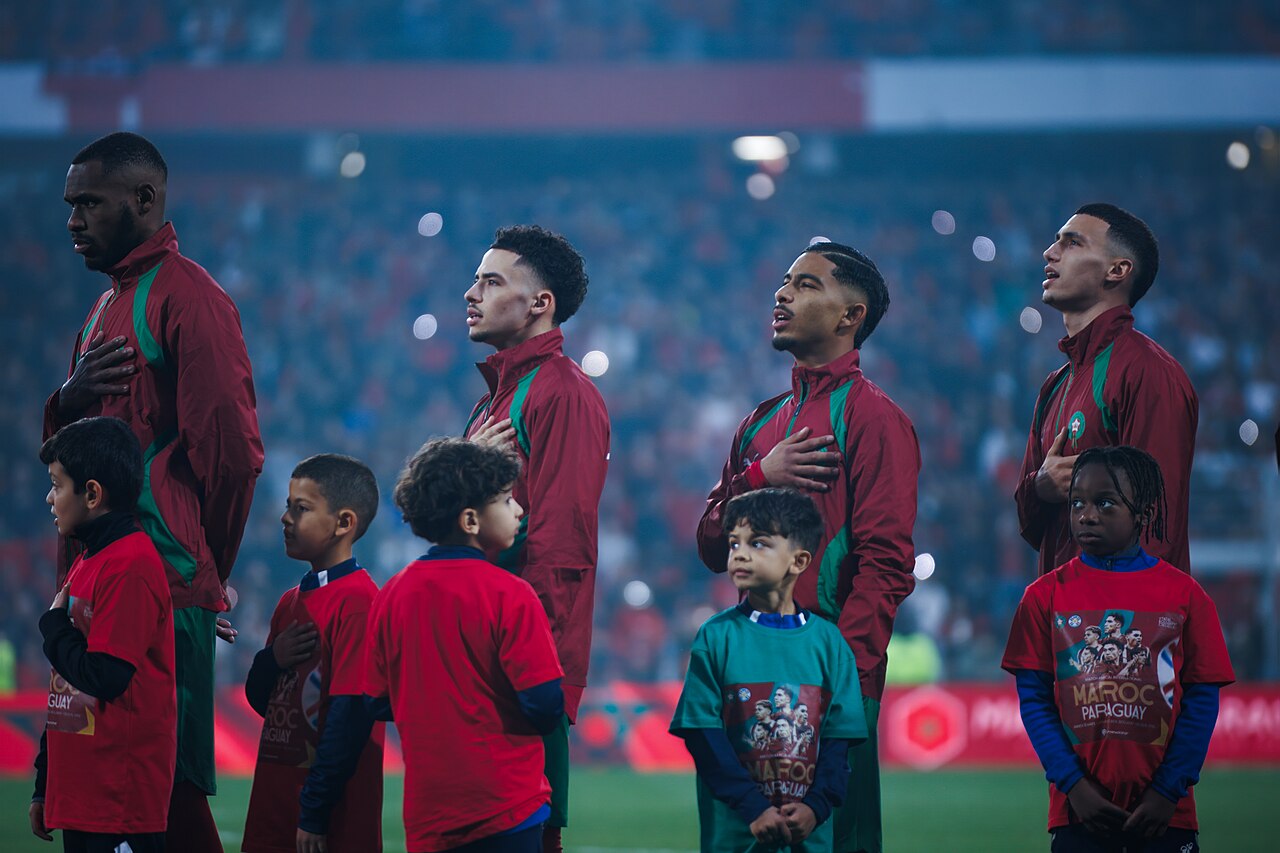
Members of the Moroccan national team line up for the national anthem ahead of a friendly match against Paraguay in Lens, France, on 31 March 2026. Photo: Abdelali Bentarki/Wikimedia Commons.
The North American countries of Canada, Mexico, and the United States are currently hosting the 23rd edition of the FIFA World Cup. Probably reflecting the expansiveness of the territory in which it is organized, this tournament includes 48 teams. The first round of the knockout stage has not even ended yet, but the usual public polemics regarding ticket prices, affordability, game scheduling, visas, and the uneven conditions under which supporters and teams are required to navigate this global event are vividly underway. However, the performance of Ayyoub Bouaddi, the previously unknown 18-year-old Franco-Moroccan midfielder, in his team’s game against Brazil diverted attention from these issues to fascinating questions about postcolonialism, citizenship, and belonging.
Dazzled by the Moroccan national team’s historic match with Brazil, commentators from both the Global North and the Global South started wondering what made this miracle possible. Some praise the Moroccan Federation’s methodical work since 2010 to revolutionize the country’s sports through the Mohammed VI Football Academy, while others highlight the overrepresentation of players with dual citizenship. Some even wondered if a national team whose players were born, raised, and trained in countries beyond Morocco’s territorial borders is truly Moroccan, and whether its successes would be possible without its transnational makeup.
These questions are not new. They were raised during the 2022 Qatar World Cup, and they will continue to be asked in the future because they are, in their essence, about an open-ended postcoloniality and its ramifications for belonging to a nation. It’s almost normal to praise European national teams when they incorporate descendants of their former colonies, but audiences seem to question this same principle when a formerly colonized postcolonial state from Tamazgha (North Africa), Morocco in this case, benefits from the services of its diaspora. These questions acquire an even bigger political significance when right-wing politicians instrumentalize them to demonize immigrants and question their allegiance to their European nations. Lamine Yamal sparked a controversy by wearing custom-made boots with Moroccan and Equatorial Guinean flags to honor his origins while playing for the Spanish national team against Cape Verde.
Colonization was instrumental in the very invention of Moroccan citizenship, which was born in response to European states’ scramble to colonize the country in the 19th century. In their attempt to dominate Morocco, European powers sought to extirpate a class of wealthy Moroccan protégés from the purview of the country’s tax laws. However, the sultan was able to impose the condition that any Moroccan who returned to the country, even if he was naturalized somewhere else, would be subjected to Moroccan law. The agreement of 1880, signed by France, Belgium, Spain, Denmark, Britain, Portugal, and the US, among others, made Moroccanness an eternal bond. Thus, a defensive mechanism devised to stave off the impact of extended protections of Moroccan citizens on the treasury paved the way for descendants of Moroccans to claim their right to an unbroken filiation with the land of their ancestors. Colonialism can be clearly credited for this eternal Moroccanness, which has become both transnational and indissoluble over time.
It is within this framework that Morocco’s use of dual-national players can be understood. It is true that FIFA’s eligibility framework allows players to represent a country through nationality, birth, descent, residence, and, under defined conditions, a change of sporting association. European, African, Asian, and American teams all operate within this system because modern football reflects migration, mixed families, colonial histories, labor mobility, and multiple citizenships. As a FIFA member state, Morocco reaps the benefits of this framework to both ensure footballing prestige and perpetuate Moroccanness beyond its borders. However, what makes Morocco a unique case is the extension of the politics of citizenship beyond FIFA to represent cyclical moments of renewal of the connection between Morocco and its transnational citizens. Every global sporting event offers the state a powerful platform to attract and co-opt new candidates in different fields.
The postcolonial nature of the questions raised about players who were born and raised in Europe is particularly fraught. Ousmane Sonko, the president of Senegal’s parliament, quipped during an interview with France 24 and RFI before Senegal’s 2026 World Cup opening match against France that whatever the result, “Africa will have beaten Africa.” Sonko’s remark named a familiar postcolonial irony: European national teams often draw strength from players who originate from former colonies, further complicating simplistic ideas about belonging and national grandeur.
The children of colonies played for their colonizers for decades. Similar to the African tirailleurs—colonial soldiers recruited from French West Africa—Afro-European footballers have been called into service to defend the colors of their colonial national teams. Larbi Ben Mbark, known as the “Black Pearl,” and whom Pelé named “Football God,” was born in Casablanca, joined Olympique de Marseille in 1938, and represented France 17 times. Other Moroccan players—Abderrahmane Mahjoub, Mustapha Ben M’Barek, and Abdesselem Ben Mohammed—also represented France before Moroccan independence. In the last three decades, Zinedine Zidane, a phenomenal player of Algerian origins, played for France. Kylian Mbappé, Franco-Ivorian, chose France. As already mentioned, Lamine Yamal, the Spain-born player of Moroccan and Equatorial Guinean origins, chose Spain over his father’s country. The imbrication of histories of colonialism and sports could not be any clearer.
Like in other fields, extraction has been fundamental to the growth of European football. France, Spain, Belgium, and the Netherlands drew strength from demographics that followed from colonial empires, labor migration, family reunification, and postcolonial settlement. Because of conquest and demands for cheap labor for post-WWII reconstruction, Europe has attracted hundreds of thousands of migrants from all over the world to exploit their energy. Unlike what right-wing politicians assert, the rise in the number of immigrants is the natural result of extractive colonial practices that dislocated able-bodied people from their homelands or created conditions, through economic impoverishment, that pushed them to leave. The children of these migrants entered football and other sports through schools, neighborhoods, urban communities, clubs, and academies shaped by colonial histories. European teams and clubs extracted their talent and exploited their legitimate ambitions. In the meantime, their feats on the pitch perform resilience against—and survival of—unequal citizenship, racialization, and xenophobia.
Extraction was unidirectional. Both labor and brain drain followed the same pattern. Doctors, soldiers, players, and workers moved from former colonies to the Global North; from the periphery to the metropole. The unspoken truth has nonetheless been that the children of formerly colonized nations should feel blessed for being included in the benefits of European modernity. Powerful media routinized the image of minorities playing for predominantly white teams, normalizing and entrenching unidirectionality. However, Morocco’s mobilization of its notion of eternal citizenship to attract an entire team of talents born and trained abroad changes the optics of this unidirectionality.
In fact, Morocco’s recruitment of diaspora footballers redirects the economy of extractive practices in football. Before anything, Morocco is demonstrating how football can acquire a decolonial force with many social, cultural, and political ramifications. A player trained in Madrid, Paris, Brussels, Amsterdam, Lille, Rotterdam, or Barcelona may acquire technical capital in Europe, but decides to reverse the direction of benefits. Unlike the usual course that allows Europe to always benefit from the talents of the Global South, Morocco’s practice is almost reparative of colonial history: It allows us to see players who benefited from the privileges of these systems redirect those benefits toward their formerly colonized country in their turn. When a Europe-born player chooses to play for Morocco, he reroutes the flow of value to his ancestral homeland. Consequently, Morocco’s national team unsettles some observers because it claims value that European systems invested in creating, but instead of benefiting Europe, Morocco reaps the yield of decades-long training.
Ayyoub Bouaddi, the 18-year-old phenomenon, made global news after his performance against Brazil. Having evolved within the French football system, he chose to represent Morocco instead of waiting for a chance to play for France. Although France looked better for him on paper, Bouaddi committed to play for Morocco one month before the start of the World Cup, defying the logic of fame and financial success. Bouaddi illustrates how foreign-born Moroccan players are leveraging a football world in which birthplace, training, ancestry, memory, opportunity, and family obligation come together to sway players’ decisions about who to play for. His choice was decolonial in many ways, primarily because it embodies the eternal Moroccan citizenship that has broader professional, political, and sentimental dimensions.
Bouaddi is a symbol of a generational shift in which playing for national teams in Europe is no longer treated as the highest form of recognition. Immigrant families and young players still dream of wearing the jerseys of Spanish, French, British, and other European clubs. European club football remains the center of money, visibility, training infrastructure, and global prestige, but club aspirations and national identification are separate. To put it differently: Europe remains the dominant professional football marketplace, where players can make phenomenal amounts of money, while national teams of origin, like Morocco, Nigeria, Ivory Coast, and Algeria, provide sites for the performance of identity, pride, Islam, and decoloniality. North African footballers can pursue careers in European clubs while choosing to represent African nations internationally. This new pattern demonstrates that European clubs are workplaces while national teams are where one manifests belonging.
Morocco’s unique place in this architecture is the result of systematic investment in maintaining the relationship between the country and its diaspora. Treated initially as a source of hard currency for a country with no oil reserves, official discourse and annual celebration of the return of migrants placed the diaspora at the heart of national life. This extraordinary care to strengthen ties with the country of origin has meant that millions of Moroccan-descended families strive to keep ties through language, religion, food, summer travel, remittances, family linkages, and cultural memory. For many players, Morocco functions as a living presence sustained by parents, grandparents, personal names, food, and annual visits to the country. For at least three generations, Morocco has continuously strived to strengthen the filiation and show its immigrant children their significance.
Not only do these elements form the personality of young diasporic Moroccans, they also continue to inform the relationship with the country of descent even for those born and raised in the diaspora. One’s birthplace matters, but the power of memory and spending formative summers in the bled cement belonging. A player born in Spain or France may spend the entire year learning football in European institutions and sports academies, but their target remains spending the summer in Morocco, swimming in rivers, listening to grandparents, and reconnecting with cousins in the village. Summers in Morocco become heavenly moments of escape in which the elevated status the migrant family enjoys in its homeland helps rehabilitate the damage exclusion and xenophobia instill in some of these children. The annual pilgrimage to Morocco is not just a time for vacation. It is a healing period from the ails of European racism and its coloniality.
Magharibat al-alam, which literally means “Moroccans of the world,” has become a powerful concept that holds more than a descriptive label for the diaspora. It is a strategic category in which emigration serves nation-building and its prestige. While it is mainly visible in football, it operates across various facets of Moroccan life, including investment, diplomacy, innovation, and culture. Although they still have no right to vote, Moroccans of the world are as essential for the legitimacy of the state as their co-citizens within the country. As members of the national body, Moroccan citizens abroad across generations participate in reactualizing the eternal Moroccanness established in the 19th century. This participation is sustained through a robust institutional infrastructure, which includes the Hassan II Foundation for Moroccans Residing Abroad, the Council of the Moroccan Community Abroad, and administrations working directly to deal with the specific issues of this category of Moroccans.
This investment in the diaspora is not fortuitous. It is a macroeconomic asset. The World Bank put personal remittances to Morocco at roughly 7.8 percent of GDP in 2024. The International Fund for Agricultural Development (IFAD) reported Moroccan remittances rising from more than US$11.5 billion in 2023 to about US$12.9 billion in 2024, around 8 percent of GDP. These transfers stabilize foreign exchange, support consumption, finance housing, and cushion families against financial shocks and seasonal struggles. Morocco also seeks to turn diaspora capital into productive investment in real estate, tourism, small and medium-sized enterprises, regional development, technology, and innovation. Recent policy language stresses administrative simplification, investment facilitation, and a more unified interface for Moroccans residing abroad. The state seeks to convert affective attachment—the summer return, the grandmother’s affection, the annual transfer—into longer-term economic participation.
Magharibat al-alam therefore names a dispersed human-capital network that Morocco has harnessed and continues to mobilize without requiring full migration back. Culturally, the category helps Morocco confront an intergenerational challenge: how to maintain second- and third-generation attachment to Morocco when daily life, schooling, citizenship practice, and professional futures lie elsewhere. The state answers through monarchy, Islam, Arabic, Amazigh identity, family return, summer programs, and national ceremonies. The diaspora helps narrate Morocco as a country whose national community exceeds its territory and whose influence travels through people as much as through embassies, firms, ports, or football academies.
Morocco is the first country in the history of the World Cup to have played with a team of entirely foreign-born players. Morocco has thus decolonized the game by reversing the traditional course of choice in which young talents from migrant parents experience the pressure of playing for countries that historically dominated the game. Almost everyone knows an African or Latin American player who plays for a European national team. However, Morocco is now creating a unique category in which players who would usually be able to play for European teams choose to play for their parents’ country of origin. Again, this is not a happenstance. It is the result of a national strategy to keep the eternality of the ties between Morocco and its diaspora.
In a recent interview that aired on Al Jazeera a few days before the current World Cup, Fouzi Lekjaa, president of the Royal Moroccan Football Federation, framed Morocco’s football project in explicitly national terms. Since 2010, he noted, Morocco has treated football as part of a broader state project linking elite competition to youth formation, civic discipline, national visibility, and soft power. In this account, the national team operates as a transnational institution at the service of Moroccanization. The national team acts as a crucible that brings together players formed in Morocco and their counterparts trained abroad to channel their descent, memory, discipline, and ambition in order to serve a project that is cast as modern, strategic, and sovereign. It serves both state and society by portraying an ecumenical and all-inclusive vision of Morocco. The origins of this ecumenical project date back to the 1970s, which witnessed the first attempts to maintain a relationship with Moroccan Jewish diasporas.
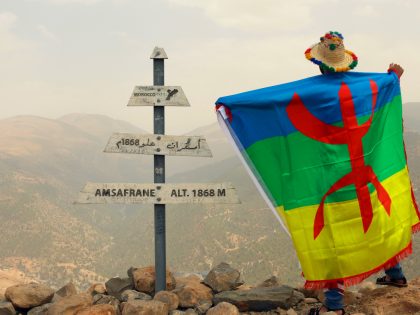
Beyond the pitch, diasporization has been good for critical reflection on the country’s identity. For historical reasons related to the migration patterns after colonization, most of the foreign-born players, including Bouaddi, are Amazigh. Their parents and grandparents left the Souss and the Ouarzazate regions as well as the Rif to work in underground mining in post-WWII Europe. While some of these migrant workers returned after their temporary contracts expired, others stayed and brought their families with them, creating their own enclaves where they sustained their Amazigh traditions and passed them down to their descendants. These youth are at ease with identity questions, and they are proud of their plural Amazigh-Arab heritage. They made history in Qatar in 2022 by carrying the Amazigh flag. Their European education allows them to challenge erasure because they understand the importance of freedom. With these players, Amazigh identity has never had such a global platform for its projection.
Despite its obvious benefits, this diasporization strategy must also confront a genuine risk. If European-trained recruitment replaces investment in Moroccan academies, the domestic league, and opportunities for children inside Morocco, the project would deepen dependence on European systems. A serious national football strategy must connect diaspora recruitment to domestic development, as Lekjaa himself noted. The player formed in Europe and the player formed in Morocco should belong to the same national football ecosystem, one that treats Moroccan talent as both territorial and diasporic. Morocco must define its dependence on the ready-made player and its relationship with one in the making locally in order for the cross-fertilization to yield sustainable results.
Morocco’s 2022 World Cup semifinal run, its current participation in the 2026 edition, and its role as a co-organizer of the 2030 World Cup have demonstrated the country’s commitment to football as a state project. However, success at the top must widen opportunity below—in regional academies, local clubs, youth programs, and the national football competition, known as Botola. Critics of this model of investment in sports also raise questions about the equivalent for education, hospitals, and human rights. When Hakim Ziyech, the Dutch Moroccan right-winger, did not return to the national team roster, after an unexplained absence, social media commentators linked his removal from the team to his pro-Palestinian statements during Israel’s war on Gaza and the ensuing acrimonious debate that he had with Itamar Ben-Gvir, Israel’s minister of national security. The Moroccan Federation has not provided any explanation for Ziyech’s absence, which poses significant questions about the ability of Morocco to accommodate the critical consciousness of foreign-born players for whom free engagement with political questions is sacrosanct. However, global prestige is a package, and a country with great ambitions like Morocco cannot pick and choose. Bouaddi models the example of the player-student, and his trajectory can serve as an example that footballing cannot come at the expense of studies and strong educational institutions that will form and sustain the Morocco of the future.
Morocco’s national team offers much fodder for reflection on nationality after empire, migration, and global sport. Europe long benefited from African and Tamazghan players while presenting their excellence as European achievements. Mobilizing eternal citizenship, Morocco now upends this trend by placing the parents’ homeland at the core of European football decisions.