What Mbappé, Olise and Yamal can’t fix
Football’s three mixed Maghrebi and Black African stars are not emissaries of a new pan-Africanism. And the continent doesn’t need them to be.
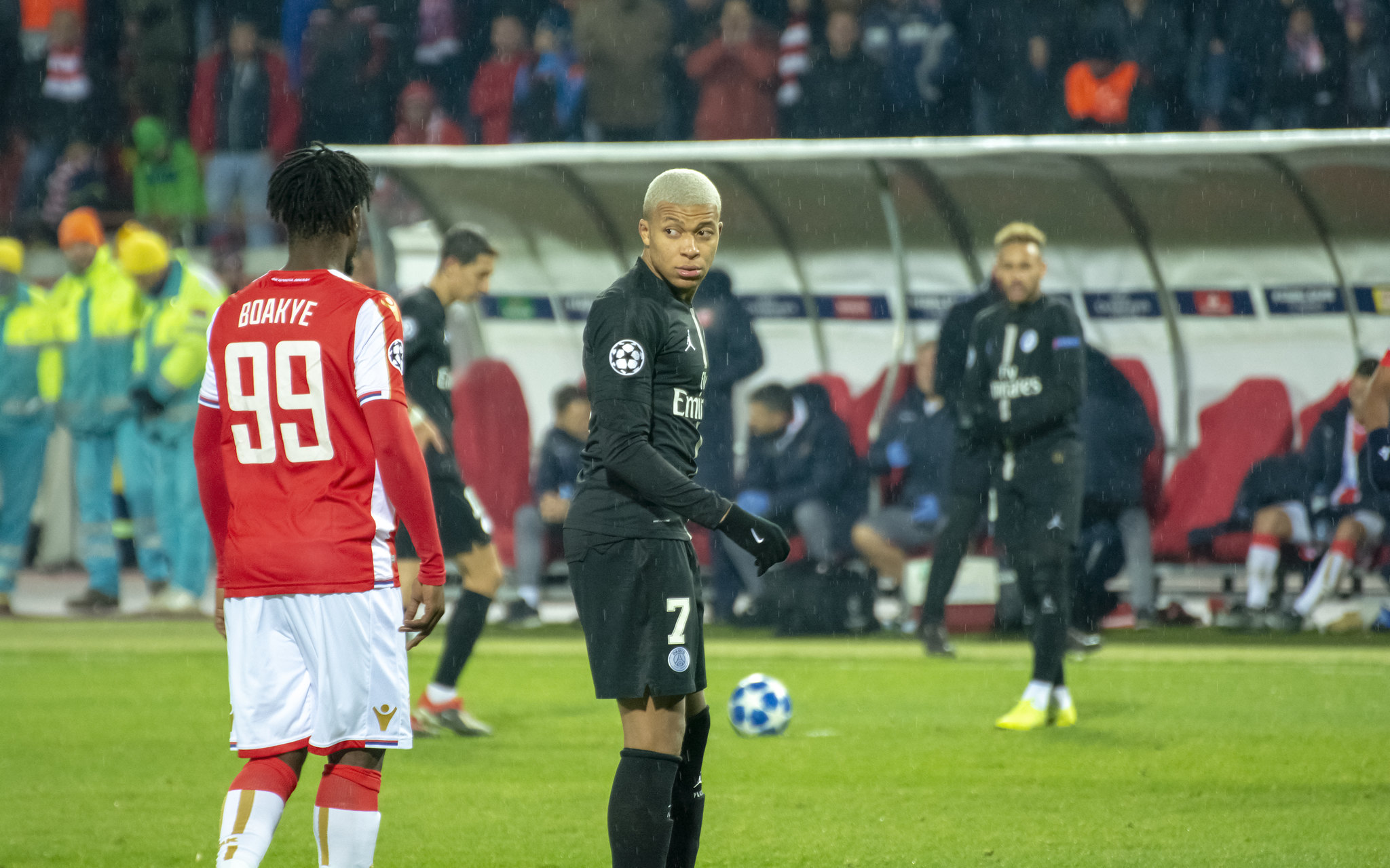
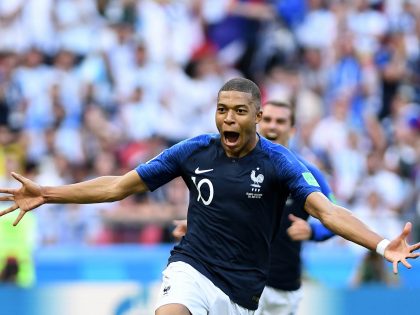
Kylian Mbappe in 2018. Source: Balkan Photos via Flickr CC BY 2.0.
If Spain and France meet in the semifinals of the 2026 World Cup, as the bookies predict, three of the brightest talents currently playing the game will take the field, all sharing a quality entirely unrelated to footballing skills. Kylian Mbappé, Michael Olise, and Lamine Yamal are all of mixed Maghrebi and Black African descent. France legend Thierry Henry has described Mbappé and Olise as France’s Most Valuable Player and Most Important Player, respectively, for the way the two combined to deadly effect against Senegal. The teenage Yamal scored for Spain against Saudi Arabia and showed flashes of the brilliance that has drawn comparisons to Messi despite not being 100 percent fit.
Three of the brightest stars, all with the same improbable trans-Saharan ancestry. But if anyone expects these three to be emissaries of some all-encompassing pan-Africanism, disappointment lies ahead. While there are signs that the gap between the Maghreb and Black Africa has narrowed, closer integration is being fueled not by iconic Afropeans playing the beautiful game but by trade, travel, and mutual economic interest.
None of this is to dismiss the globalized immigrant youth culture of Bondy, Marseille, and Brussels as influential in European sport and the creative industries, and increasingly in West and Central Africa too. This culture is also subtly reshaping who and what codes as African.
Take Kylian Mbappé and his younger brother Ethan. A few years ago, in Abidjan, where I live, I asked an Algerian journalist whether there was any appetite back home to claim Kylian—not for the Fennecs, it was too late for that, but as an icon, a son of the soil, the way Kenya claimed Obama. He scoffed; Algerians did not think of Kylian as one of theirs.
Yet there are news reports that the Algerian federation is now pursuing Ethan, who, because less gifted, is unlikely to get a look in with the French team. Ethan is gettable, football is soft power, and the practice of mining the diaspora for talent is only gathering pace. Now, Senegal and Morocco are not only competing with France for talent, they also battle each other to win commitments from eligible diaspora players.
How, whether—and how quickly—perceptions about where the line is drawn between Maghrebi and Black African will shift owing to players like Ethan Mbappé, who has yet to commit to any team, and even more so to the less well-known Issa Diop, who plays for Fulham in the English Premier League. Of mixed Senegalese-Moroccan heritage, Diop chose to play for Morocco and repaid the choice by heading home a stoppage-time equalizer against the Netherlands on June 30. After that goal forced extra time, Morocco went through on penalties to the round of 16.
On an instinctive level, it makes sense that it should be Morocco at the forefront from the North African side, which “feels” closer culturally and economically to countries like Senegal and Côte d’Ivoire than, say, Tunisia or Algeria. Like Brazil, perhaps, the country has emerged as a sort of leader within the Global South because it scans as multiracial and progressive. In a recent New Yorker essay, Dan Greene accurately notes that the Global South embraced Morocco’s 2022 World Cup team, which reached the tournament’s semifinals. Morocco and its national football team position themselves as representing all of Africa and the Arab world.
And yet it’s proved easier to win over the Global South than the African continent, which polices the boundaries of Pan-Africanism stringently (as an aside: South Africa has learned during this World Cup that not only North African countries risk being ostracized by the African community of nations). It’s a safe bet that most Africans would root for Morocco in a tournament only in the absence of a Black African team, and irritation with the country surged during the 2025 AFCON as a result of Towelgate and the charged tournament final between Senegal and Morocco.
African and diaspora news and social media channels are filled with accusations of perfidy, racism, and foul play by the two sides. As the fallout dragged on, the whole debacle began to seem like the resumption of a long-running family quarrel.
A post by the Instagram influencer, the Merc, caught my eye. Black Africans had never thrown North Africa out of the continent, he said in a video screed; North Africa had walked out on its own. Among his other charges: America had put a man of Black African descent in its highest office before a single North African country had trusted a Black face with real power. How many North African families would be proud enough to celebrate seeing a daughter marry a dark-skinned man from Khartoum or Accra? If the honest answer was no, how African were they, really?
Hyperbolic accusations of this sort are mostly about clicks and engagement, of course, but the Merc’s reading of the tension is ahistorical (perhaps he has never heard of Anwar Sadat?) and shallow. Algiers was a capital of African and even Black liberation as much as Accra or Kinshasa, playing host to the Black Panthers and Frantz Fanon. Its national stadium today is named for Mandela, who once trained with its guerrillas. And if we are implicating Africans in advancing colonialism, then the thousands of West and Central African tirailleurs who deployed first to Indochina and then to Algeria must be added to the ledger.
I don’t want to take the Merc as more than a single—if heavily amplified—voice. There were many other voices in the social media sphere that took a light-hearted teasing tone in commenting about Towelgate, and many of the memes were pointed but not racist.
And the sentiments expressed on Moroccan social media? Some voices were defensive and dismissive of the charges that Morocco was not playing fair, but there was also plenty of contrition. Reddit’s main Morocco thread was thick with self-reproach rather than excuse. National team captain Jihan Hakimi conceded he was not proud of the image his team had given; another player, Ismael Saibari, sought out Senegal goalkeeper Édouard Mendy at the airport to apologize.
It is messy, as these things are. The 2026 World Cup will settle one question at least: if Morocco go deep, will the rest of Africa come with them, or sit on its hands? As for Mbappé, Olise, and Yamal, if all three play in the semifinal, the world will watch three brown men with funny names playing for Europe’s two best teams.